


Increased levels of interleukin 31 (IL-31) in osteoporosis
- PMID: 26449657
- PMCID: PMC4599585
- DOI: 10.1186/s12865-015-0125-9
Increased levels of interleukin 31 (IL-31) in osteoporosis
Abstract
Background: Several inflammatory cytokines play a key part in the induction of osteoporosis. Until now, involvement of the Th2 cytokine interleukin-31 (IL-31) in osteoporosis hadn't yet been studied. IL-31 is a proinflammatory cytokine mediating multiple immune functions, whose involvement in a wide range of diseases, such as atopic dermatitis, inflammatory bowel diseases and cutaneous lymphomas, is now emerging. Given the important role of IL-31 in inflammation, we measured its serum levels in postmenopausal osteoporotic patients.
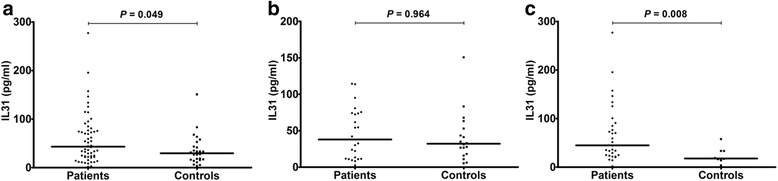
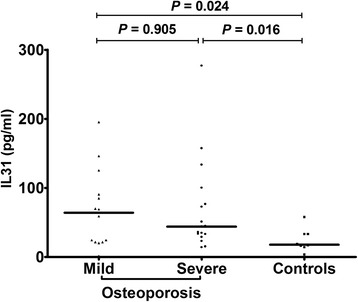
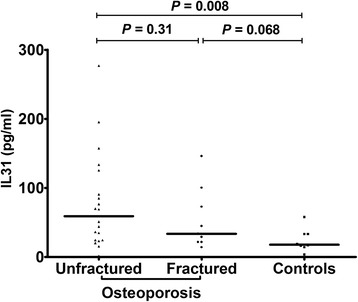
Methods and results: In fifty-six postmenopausal females with osteoporosis and 26 healthy controls, bone mineral density (BMD) measurements were performed by using calcaneal quantitative ultrasound (QUS) technique, confirmed at the lumbar spine and hip by dual energy X-ray absorptiometry (DXA). Both patients and controls were divided according to age (less or more than 65 years) and disease severity (T-score levels and presence of fractures). Serum IL-31 levels were measured by ELISA technique. Osteoporotic patients exhibited elevated levels of serum IL-31 compared with healthy controls (43.12 ± 6.97 vs 29.58 ± 6.09 pg/ml; p < 0.049). IL-31 expression was higher in over 65 years old patients compared to age-matched controls (45 ± 11.05 vs. 17.92 ± 5.92; p < 0.01), whereas in younger subjects no statistically significant differences were detected between patients and controls (37.91 ± 6.9 vs 32.08 ± 8.2). No statistically significant differences were found between IL-31 levels in patients affected by mild (T-score > -3) compared to severe (T-score < -3) osteoporosis (59.17 ± 9.22 vs 37.91 ± 10.52), neither between fractured and unfractured osteoporotic women (33.75 ± 9.16 vs 51.25 ± 8.9).
Conclusions: We showed for the first time an increase of IL-31 serum levels in postmenopausal women with decreased BMD. Although they did not reflect the severity of osteoporosis and/or the presence of fractures, they clearly correlated with age, as reflected by the higher levels of this cytokine in aged patients.
Figures
References
-
- Sigl V, Penninger JM: RANKL/RANK-From bone physiology to breast cancer. Cytokine Growth Factor Rev 2014. doi: 10.1016/j.cytogfr.2014.01.002 - PubMed
MeSH terms
Substances
LinkOut - more resources
Full Text Sources
Other Literature Sources
Medical
