


Assessing the knowledge, attitude and practice of family planning among women living in the Mbouda health district, Cameroon
- PMID: 26452643
- PMCID: PMC4598975
- DOI: 10.1186/s12978-015-0085-9
Assessing the knowledge, attitude and practice of family planning among women living in the Mbouda health district, Cameroon
Abstract
Background and objective: Promotion of family planning has been shown to reduce poverty, hunger, maternal and infant mortality, and contribute to women's empowerment. But many resource-limited countries still have very low rates of contraceptive use. The present study aimed to assess the knowledge, attitude and practice of family planning among women living in a resource-poor rural setting.
Methods: We conducted a cross-sectional study in January 2010 in the Mbouda Health District, Cameroon. After a multistage random selection, 120 households were selected. Participants were women aged at least 15 years old, sexually active, and who volunteered to participate in the study. Data were collected during an anonymous interview using a structured pre-tested questionnaire.
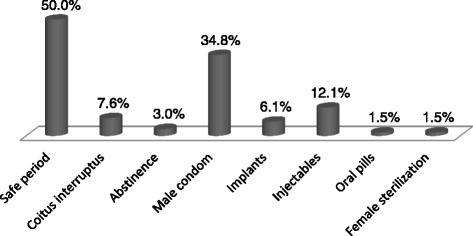
Results: A total of 101 women were enrolled, their ages ranging from 18-58 years with a mean of 31.7 ± 8.8 years. Ninety-six percent of these women had already heard about family planning. Almost all respondents (98 %) were aware of at least one contraceptive method, the most cited being the male condom (96 %), the safe period (86.1 %), injectables (76.2 %) and oral pills (75.2 %), Sixty-six women (65.3 %) were currently practicing at least one contraceptive method, and the three prevailing methods used were: the safe period (50 %), the male condom (34.8 %), and injectables (12.1 %). The main reasons precluding women from practicing contraception were lack of knowledge (31.4 %), uselessness (31.4 %) and unbearable side effects (8.6 %). Fourteen of these women (42.4 %) expressed the willingness to start practicing contraception if they received more information about the subject. Decision on the number of children to have was made by both the man and the woman in 59.5 % of cases. The practice of contraception had been decided by the couple in 39.6 % of cases, and 9.4 % of men were not aware that their wives were currently practicing contraception.
Conclusion: Although the level of awareness about family planning and contraceptive methods is quite satisfactory, the level of contraceptive use is not optimal in our setting. Consequently, more adapted educational and counseling interventions should be undertaken among women, and family planning messages directed to men need to be included too.
Figures
References
-
- Orbeta A. Poverty, vulnerability and family size: evidence from the Philippines. ADBI Discussion Paper No. 29. Tokyo: Asian Development Bank Institute; 2005.
-
- UN Department of Social Affairs Population Division: World population policies 2003. In. New York: United Nations; 2004
-
- UN Department of Social & Economic Affairs Population Division: Levels and trends in contraceptive use: 2003 Revision. In. New York: United Nations; 2004
MeSH terms
LinkOut - more resources
Full Text Sources
Other Literature Sources
