


Signal transduction in mammalian oocytes during fertilization
- PMID: 26453398
- PMCID: PMC4700098
- DOI: 10.1007/s00441-015-2291-8
Signal transduction in mammalian oocytes during fertilization
Abstract
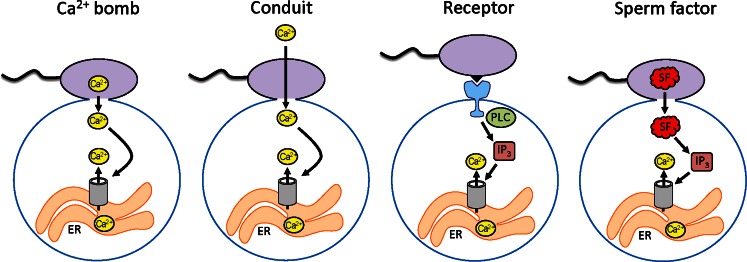
Mammalian embryo development begins when the fertilizing sperm triggers a series of elevations in the oocyte's intracellular free Ca(2+) concentration. The elevations are the result of repeated release and re-uptake of Ca(2+) stored in the smooth endoplasmic reticulum. Ca(2+) release is primarily mediated by the phosphoinositide signaling system of the oocyte. The system is stimulated when the sperm causes the hydrolysis of phosphatidylinositol 4,5-bisphosphate (PIP2) into inositol 1,4,5-trisphosphate (IP3) and diacylglycerol (DAG); IP3 then binds its receptor on the surface of the endoplasmic reticulum that induces Ca(2+) release. The manner in which the sperm generates IP3, the Ca(2+) mobilizing second messenger, has been the subject of extensive research for a long time. The sperm factor hypothesis has eventually gained general acceptance, according to which it is a molecule from the sperm that diffuses into the ooplasm and stimulates the phosphoinositide cascade. Much evidence now indicates that the sperm-derived factor is phospholipase C-zeta (PLCζ) that cleaves PIP2 and generates IP3, eventually leading to oocyte activation. A recent addition to the candidate sperm factor list is the post-acrosomal sheath WW domain-binding protein (PAWP), whose role at fertilization is currently under debate. Ca(2+) influx across the plasma membrane is also important as, in the absence of extracellular Ca(2+), the oscillations run down prematurely. In pig oocytes, the influx that sustains the oscillations seems to be regulated by the filling status of the stores, whereas in the mouse other mechanisms might be involved. This work summarizes the current understanding of Ca(2+) signaling in mammalian oocytes.
Keywords: Embryo; Fertilization; Oocyte; Signal transduction; Sperm.
Figures

References
-
- Aarabi M, Balakier H, Bashar S, Moskovtsev SI, Sutovsky P, Librach CL, Oko R. Sperm content of postacrosomal WW binding protein is related to fertilization outcomes in patients undergoing assisted reproductive technology. Fertil Steril. 2014;102:440–447. doi: 10.1016/j.fertnstert.2014.05.003. - DOI - PubMed
-
- Aarabi M, Qin Z, Xu W, Mewburn J, Oko R. Sperm-borne protein, PAWP, initiates zygotic development in Xenopus laevis by eliciting intracellular calcium release. Mol Reprod Dev. 2010;77:249–256. - PubMed
-
- Bedford-Guaus SJ, McPartlin LA, Xie J, Westmiller SL, Buffone MG, Roberson MS. Molecular cloning and characterization of phospholipase C zeta in equine sperm and testis reveals species-specific differences in expression of catalytically active protein. Biol Reprod. 2011;85:78–88. doi: 10.1095/biolreprod.110.089466. - DOI - PubMed
Publication types
MeSH terms
Substances
LinkOut - more resources
Full Text Sources
Other Literature Sources
Miscellaneous
