. 2015 Dec 15;309(12):L1467-77.
doi: 10.1152/ajplung.00275.2015. Epub 2015 Oct 9.

Hydrogen peroxide-induced calcium influx in lung microvascular endothelial cells involves TRPV4

Affiliations

Hydrogen peroxide-induced calcium influx in lung microvascular endothelial cells involves TRPV4

Karthik Suresh et al. Am J Physiol Lung Cell Mol Physiol. .

Abstract

In acute respiratory distress syndrome, both reactive oxygen species (ROS) and increased intracellular calcium ([Ca(2+)]i) are thought to play important roles in promoting endothelial paracellular permeability, but the mechanisms linking ROS and [Ca(2+)]i in microvascular endothelial cells are not known. In this study, we assessed the effect of hydrogen peroxide (H2O2) on [Ca(2+)]i in mouse and human lung microvascular endothelial cells (MLMVEC and HLMVEC, respectively). We found that in both MLMVECs and HLMVECs, exogenously applied H2O2 increased [Ca(2+)]i through Ca(2+) influx and that pharmacologic inhibition of the calcium channel transient receptor potential vanilloid 4 (TRPV4) attenuated the H2O2-induced Ca(2+) influx. Additionally, knockdown of TRPV4 in HLMVEC also attenuated calcium influx following H2O2 challenge. Administration of H2O2 or TRPV4 agonists decreased transmembrane electrical resistance (TER), suggesting increased barrier permeability. To explore the regulatory mechanisms underlying TRPV4 activation by ROS, we examined H2O2-induced Ca(2+) influx in MLMVECs and HLMVECs with either genetic deletion, silencing, or pharmacologic inhibition of Fyn, a Src family kinase. In both MLMVECs derived from mice deficient for Fyn and HLMVECs treated with either siRNA targeted to Fyn or the Src family kinase inhibitor SU-6656 for 24 or 48 h, the H2O2-induced Ca(2+) influx was attenuated. Treatment with SU-6656 decreased the levels of phosphorylated, but not total, TRPV4 protein and had no effect on TRPV4 response to the external agonist, GSK1016790A. In conclusion, our data suggest that application of exogenous H2O2 increases [Ca(2+)]i and decreases TER in microvascular endothelial cells via activation of TRPV4 through a mechanism that requires the Src kinase Fyn.

Keywords: ARDS; ROS; TRPV4; calcium; lung injury.


Figures

Fig. 1.
Fig. 1.
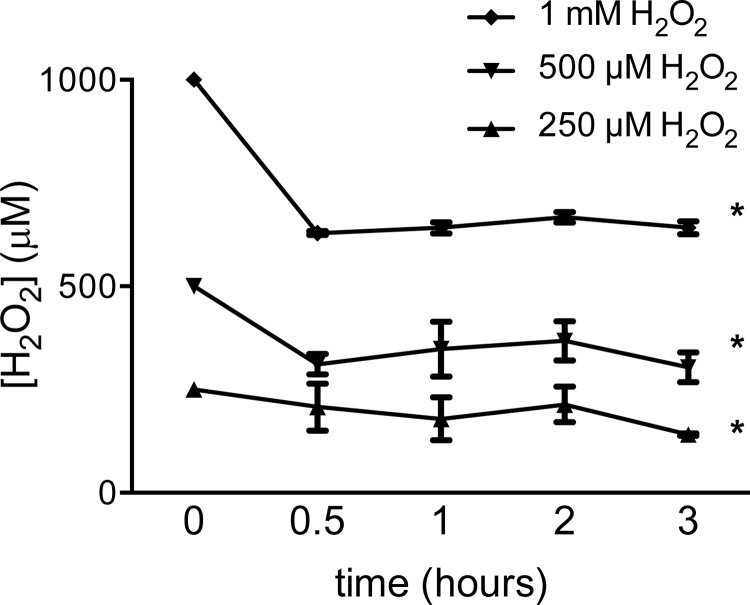
Traces of HPO electrode current at 450 mV poise voltage when placed in warmed Krebs solution containing 250 μM, 500 μM, and 1 mM H2O2 (n = 4–5 experiments/group). *Significant difference from control.
Fig. 2.
Fig. 2.
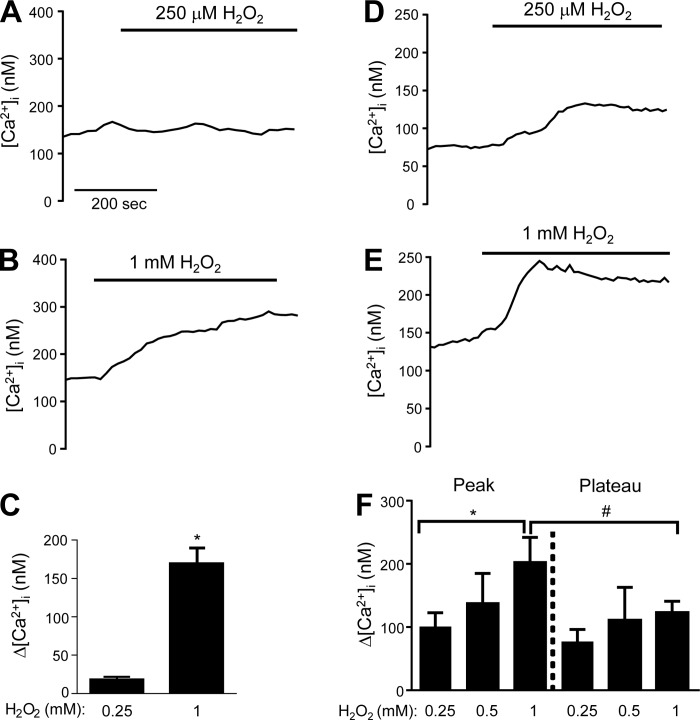
Representative traces (A and B) and bar graph (C) showing mean ± SE change in intracellular Ca2+ ([Ca2+]i) from baseline in mouse lung microvascular endothelial cells (MLMVEC) exposed to 250 μM and 1 mM H2O2 in Krebs buffer (n = 4–6 experiments, 25–30 cells/experiment). Representative traces (D and E) and bar graph (F) showing means ± SE in human lung microvascular endothelial cells (HLMVEC) exposed to increasing doses of H2O2 (n = 6–12 experiments, 20–40 cells/experiment for all groups). *Significant difference from 250 μM; #significant difference between peak and plateau Δ[Ca2+]i.
Fig. 3.
Fig. 3.
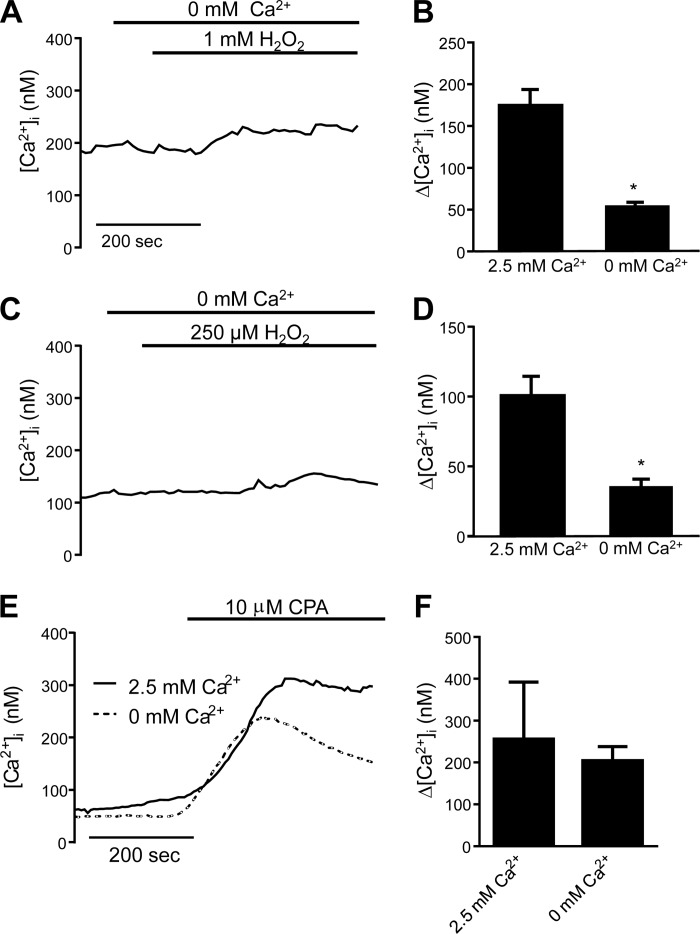
Representative trace and bar graph showing mean ± SE change in [Ca2+]i in MLMVEC (A and B) and HLMVEC (C and D) exposed to H2O2 while perfused with Krebs buffer containing 0 mM Ca2+ (n = 5–9 experiments, 20–40 cells/experiment for all groups). Mean traces (E) and bar graph (F) showing mean ± SE change in [Ca2+]i in HLMVEC exposed to cyclopiazonic acid (10 μM) in regular and Ca2+-free Krebs solutions (n = 3 experiments, 20–40 cells/experiment for all groups). *Significant difference from 2.5 mM Ca2+ group.
Fig. 4.
Fig. 4.
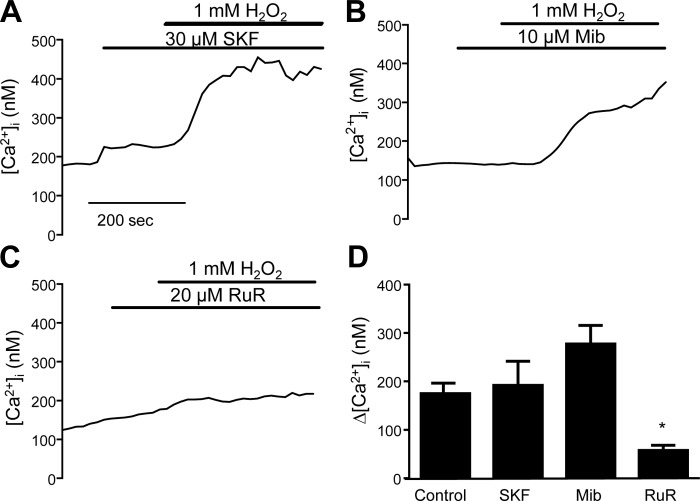
Representative tracings showing change in [Ca2+]i following pretreatment with SKF96365 (SKF; 30 μM) (A), mibefradil (Mib; 10 μM) (B), and ruthenium red (RuR; 20 μM) (C). D: bar graph showing mean change ± SE in [Ca2+]i following H2O2 in cells pretreated with SKF, Mib, or RuR. *Significant difference from control; n = 6 experiments each, 25–30 cells/experiment.
Fig. 5.
Fig. 5.
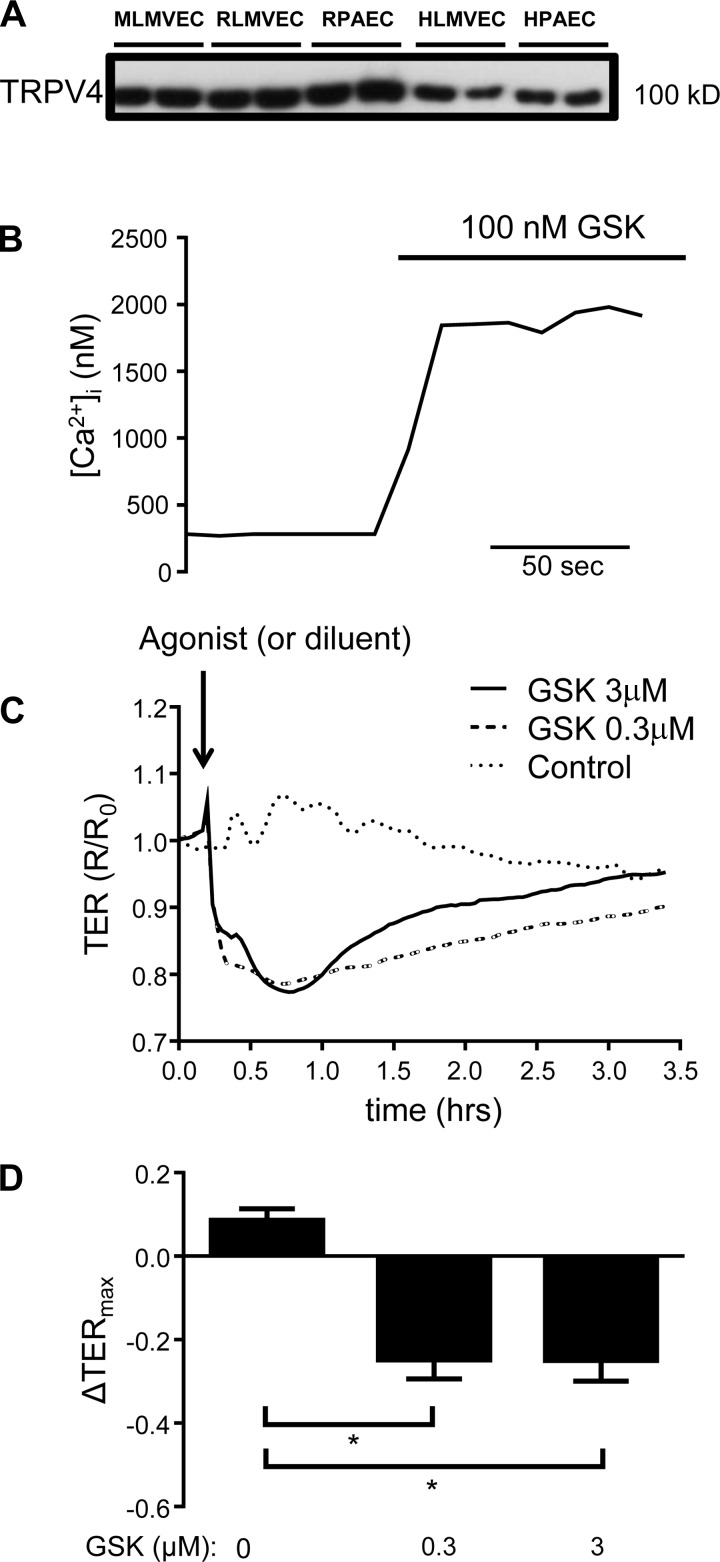
A: expression of TRPV4 in human and rodent lung endothelial cells, including mouse and rat microvascular endothelial cells (MLMVEC, RLMVEC), rat pulmonary artery endothelial cells (RPAEC), human lung microvascular endothelial cells (HLMVEC), and human lung pulmonary artery endothelial cells (HPAEC). B: increase in [Ca2+]i in HLMVEC following exposure to GSK1016790 (GSK; 100 nM). C and D: electrical cell impedance sensing (ECIS) traces and bar graph showing mean ± SE decrease in transmembrane electrical resistance (TER) in HLMVEC following exposure to GSK. *Significant difference from control; n = 8 experiments each.
Fig. 6.
Fig. 6.
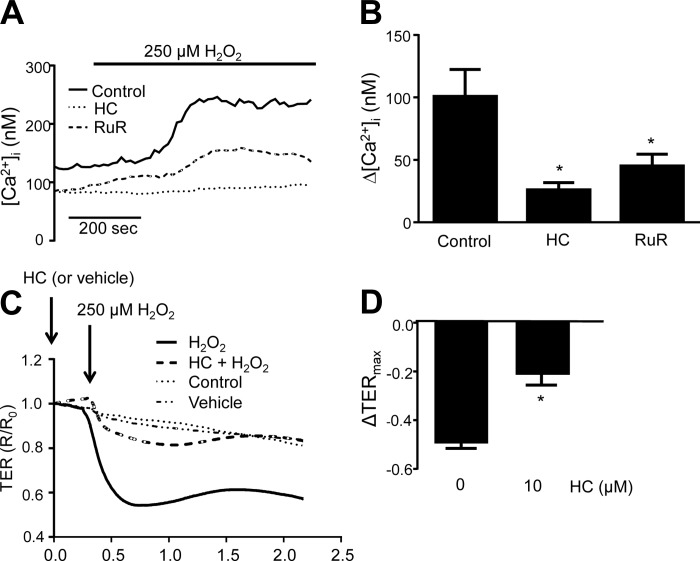
Representative traces (A) and bar graph (B) showing mean ± SE change in [Ca2+]i in HLMVEC treated with the TRPV4 inhibitors RuR (20 μM) and HC-067047 (1 μM). ECIS traces (C) and bar graph (D) showing mean ± SE decrease in TER in HLMVEC following exposure to 250 μM H2O2 with and without HC pretreatment. For comparison purposes, the untreated H2O2 response shown in B is reproduced from Fig. 2. *Significant difference from control; n = 6–8 experiments/group, 20–40 cells/experiment.
Fig. 7.
Fig. 7.
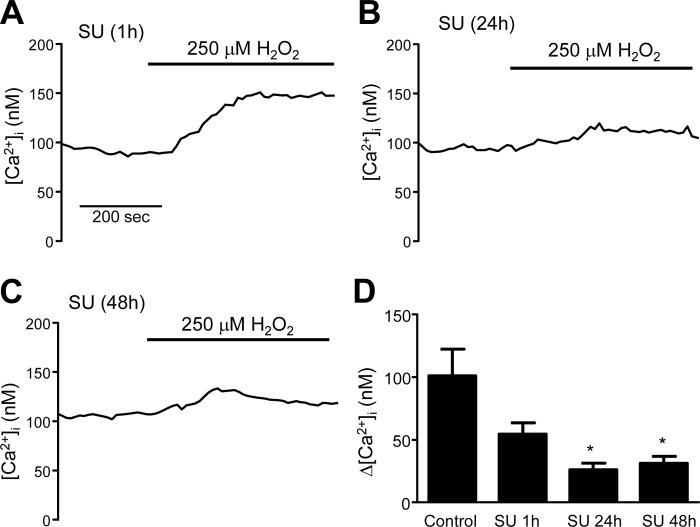
Representative traces of [Ca2+]i in HLMVEC following pretreatment with the Fyn inhibitor, SU (5 μM), for 1 (A), 24 (B), and 48 h (C). D: bar graph showing mean ± SE change in [Ca2+]i in control and SU-treated HLMVEC following exposure to 250 μM of H2O2. For comparison purposes, the 250 μM H2O2 response shown in Fig. D is reproduced from Fig. 2. *Significant difference from control; n = 6 experiments/group, 20–40 cells/experiment.
Fig. 8.
Fig. 8.
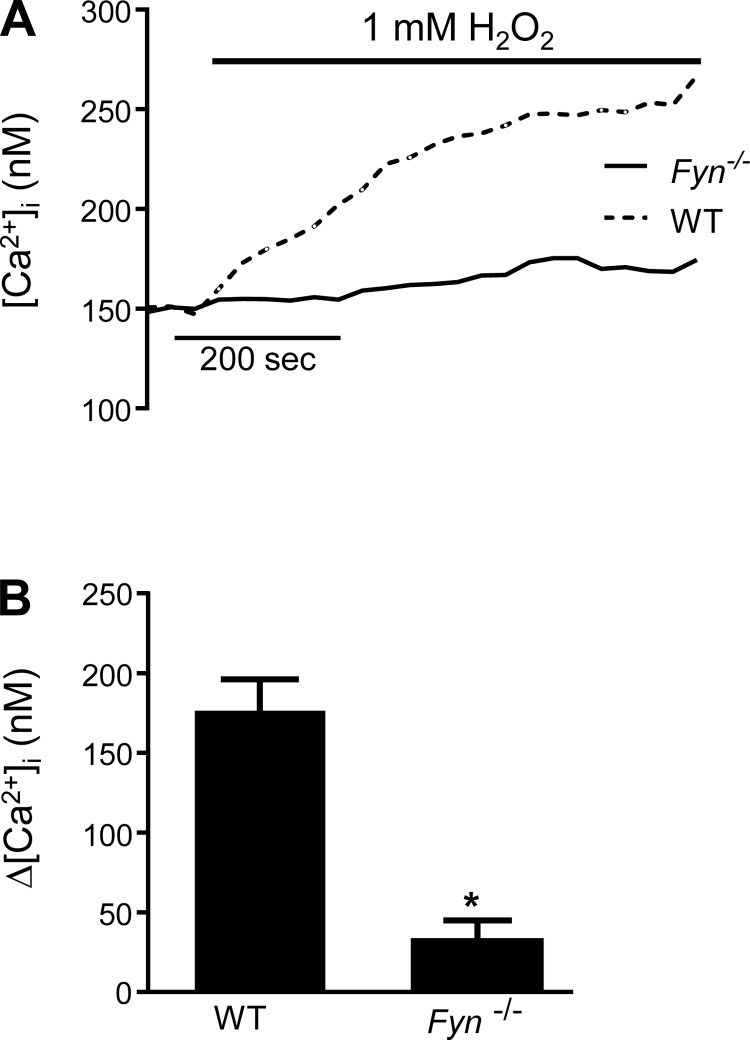
Representative traces (A) and bar graph (B) showing mean ± SE change in [Ca2+]i in MLMVEC isolated from Fyn−/− mice and exposed to 1 mM H2O2. *Significant difference from wild-type (WT); n = 3–6 experiments/group, 20–40 cells/experiment.
Fig. 9.
Fig. 9.
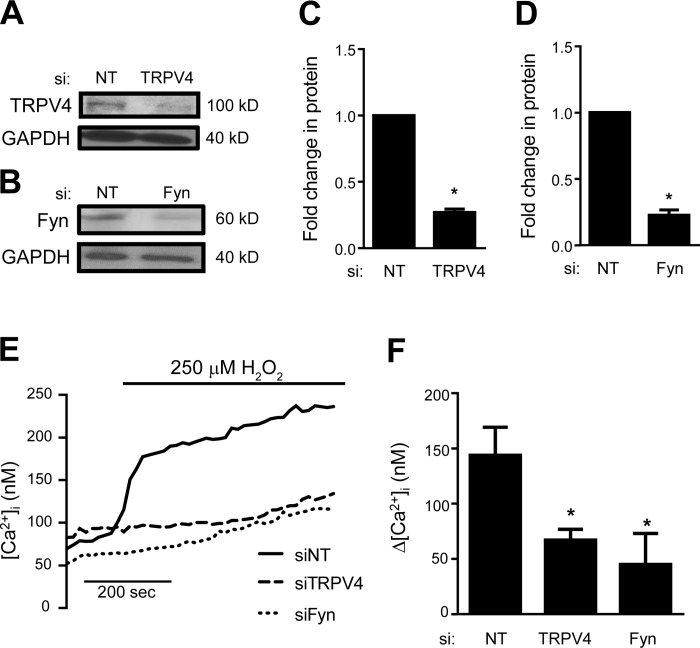
Representative immunoblot images (A and B) and densitometry (C and D) showing TRPV4 and Fyn protein levels for HLMVEC transfected with nontargeting (siNT) and TRPV4 (siTRPV4) or Fyn (siFyn) siRNA (n = 3 independent experiments). Representative traces (E) and bar graph (F) showing mean ± SE change in [Ca2+]i in HLMVEC transfected with siNT, siTRPV4, or siFyn and exposed to 250 μM H2O2 (n = 4–7 experiments/group, 20–40 cells/experiment). *Significant difference from siNT.
Fig. 10.
Fig. 10.
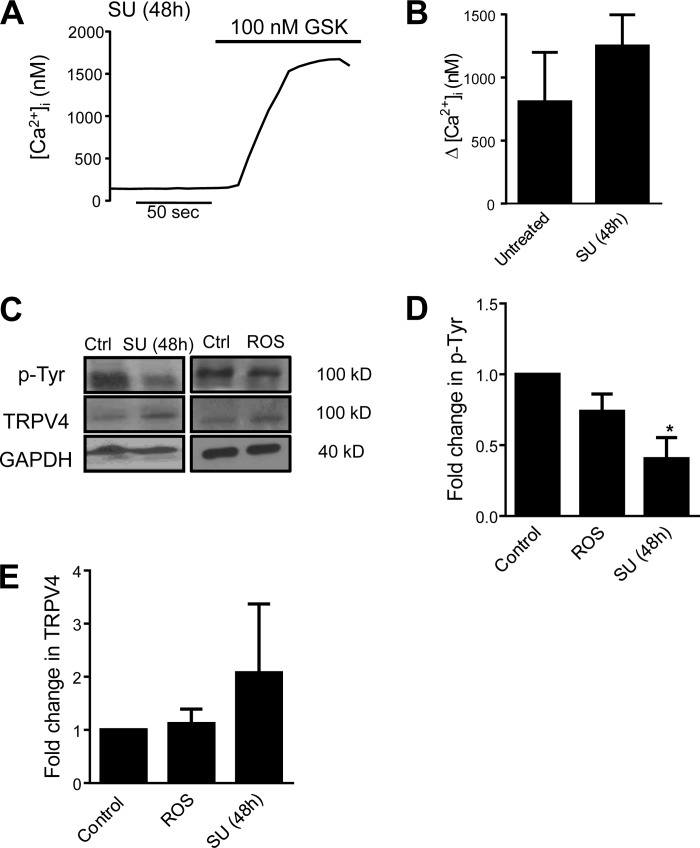
A: representative trace of [Ca2+]i in HLMVEC exposed to GSK (100 nM) after treatment with SU (5 μM) for 48 h. B: bar graph showing mean ± SE change in [Ca2+]i in control and SU-treated HLMVEC following exposure to GSK (n = 5 experiments/group). C–E: representative immunoblot images and densitometry showing protein levels of phosphotyrosine and TRPV4 protein in HLMVEC under control conditions, or treated with either 250 μM H2O2 or SU (5 μM). *Significant difference from control; n = 3 independent experiments.

References

    1. Abid MR, Kachra Z, Spokes KC, Aird WC. NADPH oxidase activity is required for endothelial cell proliferation and migration. FEBS Lett 486: 252–256, 2000. - PubMed
    1. Ahmmed GU, Mehta D, Vogel S, Holinstat M, Paria BC, Tiruppathi C, Malik AB. Protein kinase Calpha phosphorylates the TRPC1 channel and regulates store-operated Ca2+ entry in endothelial cells. J Biol Chem 279: 20941–20949, 2004. - PubMed
    1. Alessandri-Haber N, Dina OA, Joseph EK, Reichling DB, Levine JD. Interaction of transient receptor potential vanilloid 4, integrin, and SRC tyrosine kinase in mechanical hyperalgesia. J Neurosci 28: 1046–1057, 2008. - PMC - PubMed
    1. Alvarez DF, King JA, Weber D, Addison E, Liedtke W, Townsley MI. Transient receptor potential vanilloid 4-mediated disruption of the alveolar septal barrier: a novel mechanism of acute lung injury. Circ Res 99: 988–995, 2006. - PMC - PubMed
    1. Anidi IU, Servinsky LE, Rentsendorj O, Stephens RS, Scott AL, Pearse DB. CD36 and Fyn kinase mediate malaria-induced lung endothelial barrier dysfunction in mice infected with Plasmodium berghei. PloS One 8: e71010, 2013. - PMC - PubMed

Publication types

MeSH terms

Substances

LinkOut - more resources