. 2015 Oct 9:15:243.
doi: 10.1186/s12870-015-0635-x.

A transposable element insertion in the susceptibility gene CsaMLO8 results in hypocotyl resistance to powdery mildew in cucumber

Affiliations

A transposable element insertion in the susceptibility gene CsaMLO8 results in hypocotyl resistance to powdery mildew in cucumber

Jeroen A Berg et al. BMC Plant Biol. .

Abstract

Background: Powdery mildew (PM) is an important disease of cucumber (Cucumis sativus L.). CsaMLO8 was previously identified as a candidate susceptibility gene for PM in cucumber, for two reasons: 1) This gene clusters phylogenetically in clade V, which has previously been shown to harbour all known MLO-like susceptibility genes for PM identified in dicot species; 2) This gene co-localizes with a QTL on chromosome 5 for hypocotyl-specific resistance to PM.

Methods: CsaMLO8 alleles from susceptible and resistant cucumber were cloned and transformed to mlo-mutant tomato. Cucumber seedlings were inoculated with Podosphaera xanthii, tissues were studied for CsaMLO8 expression at several timepoints post inoculation using qRT-PCR. The occurrence of the observed loss-of-function allele of CsaMLO8 in resequenced cucumber accessions was studied in silico.

Results: We cloned CsaMLO8 alleles from susceptible and resistant cucumber genotypes, the latter carrying the QTL for hypocotyl resistance. We found that insertion of a non-autonomous Class LTR retrotransposable element in the resistant genotype leads to aberrant splicing of CsaMLO8 mRNA. Heterologous expression of the wild-type allele of CsaMLO8 in a tomato mlo-mutant restored PM susceptibility. However, heterologous expression of the CsaMLO8 allele cloned from the resistant cucumber genotype failed to restore PM susceptibility. Furthermore we showed that inoculation of susceptible cucumber with the PM pathogen Podosphaera xanthii induced transcriptional upregulation of CsaMLO8 in hypocotyl tissue, but not in cotyledon or leaf tissue. This coincides with the observation that the QTL at the CsaMLO8-locus causes full resistance in hypocotyl tissue, but only partial resistance in cotyledons and true leafs. We studied the occurrence of the loss-of-function allele of CsaMLO8 in cucumber germplasm by an in silico approach using resequencing data of a collection of 115 cucumber accessions, and found that this allele was present in 31 out of 115 accessions.

Conclusions: CsaMLO8 was characterised as a functional susceptibility gene to PM, particularly in the hypocotyl where it was transcriptionally upregulated upon inoculation with the PM pathogen P. xanthii. A loss-of-function mutation in CsaMLO8 due to the insertion of a transposable element was found to be the cause of hypocotyl resistance to PM. This particular allele of CsaMLO8 was found to occur in 27 % of the resequenced cucumber accessions.


Figures
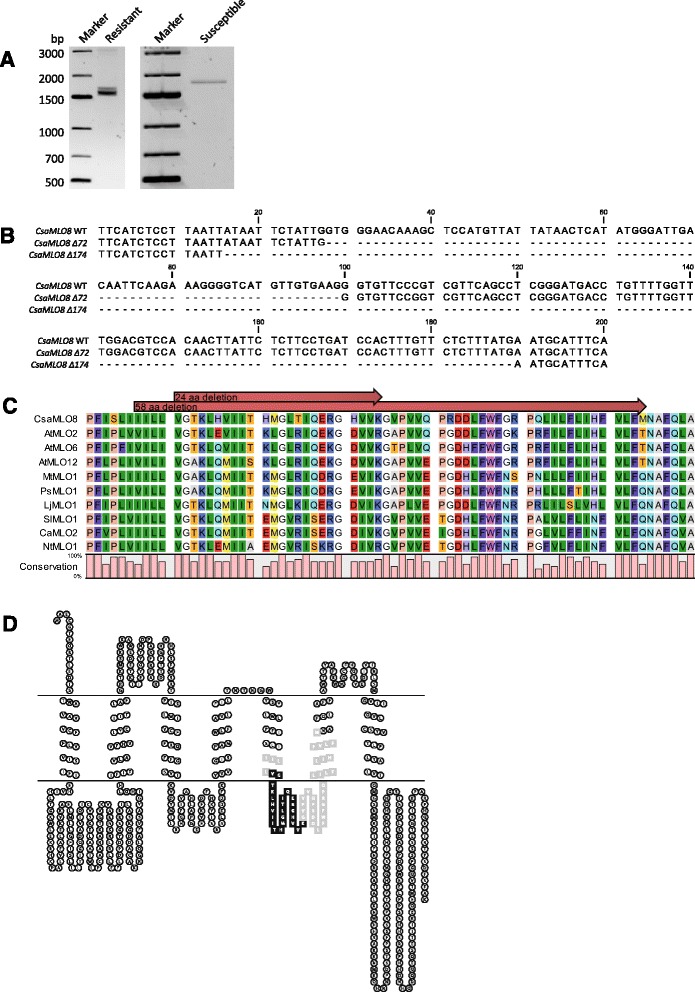
Fig. 1
Fig. 1
Characterization of CsaMLO8 alleles from resistant and susceptible cucumber genotypes. a cDNA of resistant (left panel) and susceptible (right panel) cucumber genotypes was used as template for PCR with CsaMLO8 specific primers. Amplified products were analysed on 1.25 % agarose gels. Whereas the product amplified from cDNA of the susceptible genotype gives a single band of the expected size, cDNA of the resistant genotype results in two separate bands, both of a smaller size than expected. b Full length CsaMLO8 amplified from cDNA from susceptible and resistant cucumber genotypes was sequenced. A partial alignment is shown between the (wild-type) sequence as obtained from the susceptible genotype and the sequences from two deletion variants (∆72 and ∆174) obtained from the resistant genotype. Numbers are relative to the start of the alignment. c Partial alignment of the CsaMLO8 protein and other proteins encoded by clade V MLO S-genes of several species. Amino acid residues are coloured according to the RasMol colour scheme. The 24 and 58 amino acid residues deleted in the proteins encoded by the ∆72 and the ∆174 variants of CsaMLO8 are indicated by red arrows. A bar graph underneath the alignment indicates the conservedness of each amino acid position. d Graphic representation of the transmembrane structure of the predicted CsaMLO8 protein, determined using HMMTOP 2.1 [30]. The plasma membrane is indicated by two horizontal lines. Amino acid residues highlighted in black are predicted to be deleted in the protein encoded by the ∆72 variant of the CsaMLO8 gene, residues highlighted in black and grey are predicted to be deleted in the protein encoded by the ∆174 variant of the CsaMLO8 gene
Fig. 2
Fig. 2
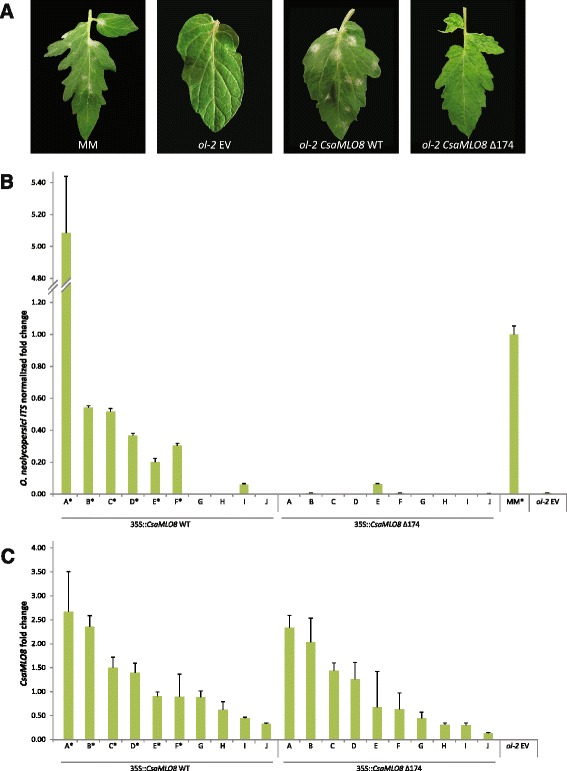
Complementation of ol-2 tomato with CsaMLO8 WT restores PM susceptibility, whereas complementation with CsaMLO8∆174 does not. The PM resistant ol-2 tomato mutant with a deletion in SlMLO1 [21] was transformed with either a 35S::CsaMLO8 WT construct, a 35S::CsaMLO8∆174 construct, or an empty vector (EV) control. Cuttings from these transformants were inoculated with a Oidium neolycopersici spore suspension. As additional control we used the wild-type, susceptible cv. Moneymaker (MM). a The phenotype of susceptible control MM, resistant EV transformed ol-2, and transgenic individuals overexpressing either CsaMLO8 WT or CsaMLO8∆174 in ol-2 background. Photographs were taken 16 days post inoculation. b Relative quantification by qPCR of the ratio between Oidium neolycopersici and plant gDNA in susceptible MM, resistant EV transformed ol-2, and transgenic individuals overexpressing either CsaMLO8 WT or CsaMLO8∆174 in ol-2 background. Fold changes were normalised relative to the susceptible control MM. Bars represent the average fold change over 3 technical replicates. Error bars indicate standard deviation. Asterisks indicate plants scored as susceptible to powdery mildew based on macroscopic evaluation. c Relative quantification by qRT-PCR of the ratio between CsaMLO8 expression and expression of tomato housekeeping gene SlEF-α in EV transformed ol-2 and transgenic individuals overexpressing either CsaMLO8 WT or CsaMLO8∆174 in ol-2 background. Bars represent the average fold change over 3 technical replicates. Error bars indicate standard deviation. Asterisks indicate plants scored as susceptible to powdery mildew based on macroscopic evaluation
Fig. 3
Fig. 3
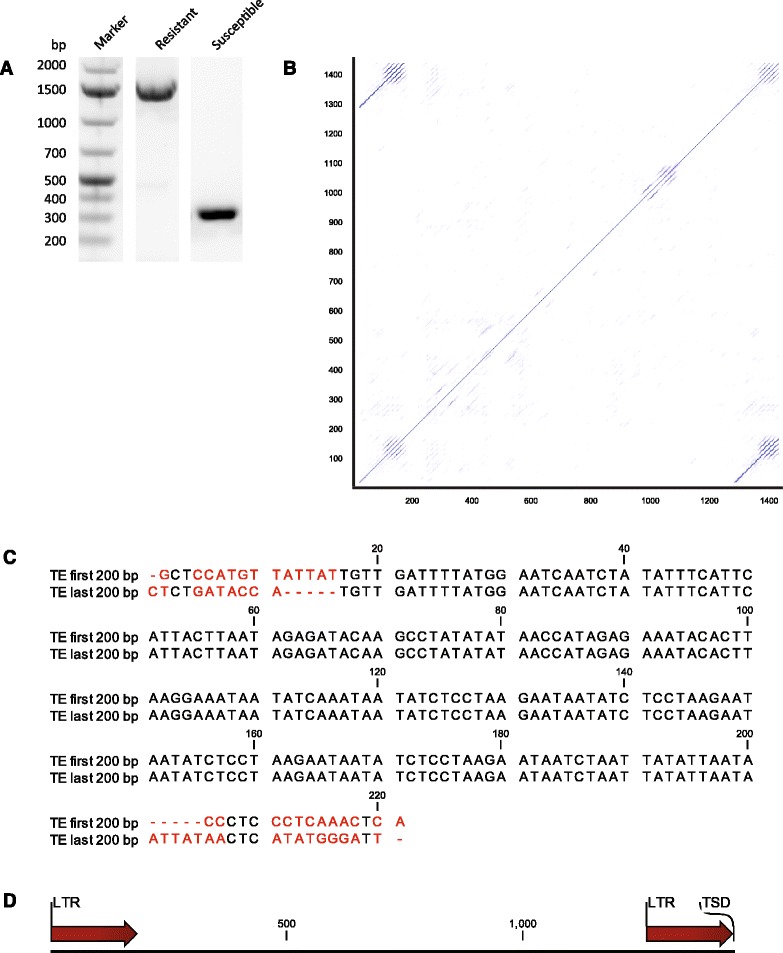
Amplification and sequencing of CsaMLO8 from genomic DNA isolated from the resistant genotype reveals the insertion of an 1449 bp long Transposable Element (TE). a The genomic region of CsaMLO8 in which deletions in the coding sequence were observed in the resistant genotype was amplified from DNA isolated from both the susceptible and resistant genotypes. Amplified products were analysed on 1.25 % agarose gel. Whereas the product amplified from the susceptible genotype was of the expected size, the product amplified from the resistant genotype was larger than expected. b The product amplified from the resistant genotype as described in (A) was sequenced, which revealed an insertion with a length of 1449 bp. A dot-plot was made of the insertion to see whether the sequence contains repetitive elements. c The first and last 200 bp of the insertion, plus 15 bp of CsaMLO8 before and after the insertion were aligned to one another, to verify the presence of long terminal repeats (LTRs). Non-aligned parts of the sequence are highlighted in red. It can be seen that the first 184 bp of the insertion are completely identical to the last 184 bp of the insertion. There is a duplication of 5 bp from CsaMLO8 before and after the insertion (Target site duplication, 5′-ATTAT-3′). d Schematic representation of the insertion. The locations of LTRs and the 3′ TSD are indicated
Fig. 4
Fig. 4
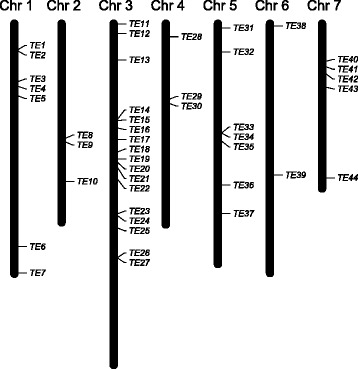
There are 44 putative homologous TEs in the cucumber reference genome. A BLASTn search was performed on the cucumber reference genomes with the LTR sequence of the TE found to be inserted in CsaMLO8. Pairs of putative LTRs within 20 kb of one another were considered borders of putative TEs. 44 putative TEs were identified, chromosomal locations of which are indicated
Fig. 5
Fig. 5
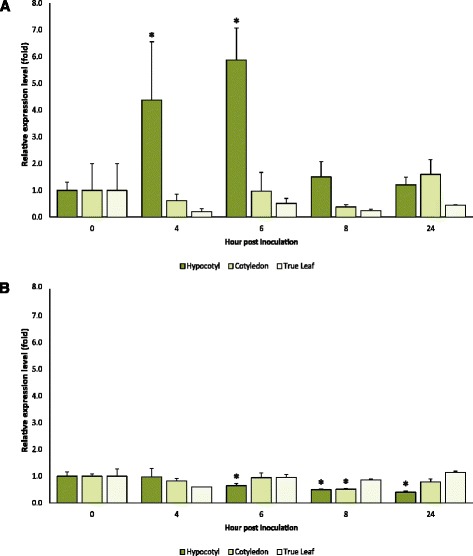
CsaMLO8 transcription is induced after inoculation with Podosphaera xanthii in hypocotyl tissue, but not in cotyledon or true leaf tissue. Susceptible (a) and resistant (b) cucumber seedlings were inoculated with a P. xanthii spore suspension. Prior to and 4, 6, 8 and 24 h post inoculation, hypocotyl, cotyledon and true leaf tissue were harvested and immediately frozen in liquid nitrogen. Relative quantification of CsaMLO8 expression was performed by qRT-PCR. Fold changes were normalised relative to CsaMLO8 expression prior to inoculation. Bars represent the average fold change over three independent biological replicates. Error bars indicate standard errors of the mean. Asterisks indicate significant differences to the expression prior to inoculation (Student’s T test, P < 0.05)

References

    1. Food and Agriculture Organization of the United Nations, Statistics Division. [http://faostat3.fao.org/] Accessed May 2015.
    1. Pérez-García A, Romero D, Fernández-Ortuño D, López-Ruiz F, De Vicente A, Torés JA. The powdery mildew fungus Podosphaera fusca (synonym Podosphaera xanthii), a constant threat to cucurbits. Mol Plant Pathol. 2009;10:153–60. doi: 10.1111/j.1364-3703.2008.00527.x. - DOI - PMC - PubMed
    1. Block CC, Reitsma KR. Powdery Mildew Resistance in the U. S. National Plant Germplasm System Cucumber Collection. Hortic Sci. 2005;40:416–20.
    1. Jahn M, Munger HM, McCreight JD. The powdery mildews: a comprehensive treatise. 2002. Breeding cucurbit crops for powdery mildew resistance; pp. 239–48.
    1. Shanmugasundaram S, Williams PH, Peterson CE. Inheritance of resistance to powdery mildew in cucumber. Phytopathology. 1971;61:1218–21. doi: 10.1094/Phyto-61-1218. - DOI

Publication types

MeSH terms