. 2015 Oct 27;112(43):13190-4.
doi: 10.1073/pnas.1516704112. Epub 2015 Oct 9.

Lateral chirality-sorting optical forces

Affiliations

Lateral chirality-sorting optical forces

Amaury Hayat et al. Proc Natl Acad Sci U S A. .

Abstract

The transverse component of the spin angular momentum of evanescent waves gives rise to lateral optical forces on chiral particles, which have the unusual property of acting in a direction in which there is neither a field gradient nor wave propagation. Because their direction and strength depends on the chiral polarizability of the particle, they act as chirality-sorting and may offer a mechanism for passive chirality spectroscopy. The absolute strength of the forces also substantially exceeds that of other recently predicted sideways optical forces.

Keywords: chirality; optical forces; optical spin; optical spin-momentum locking; optical spin–orbit interaction.


Conflict of interest statement

The authors declare no conflict of interest.

Figures
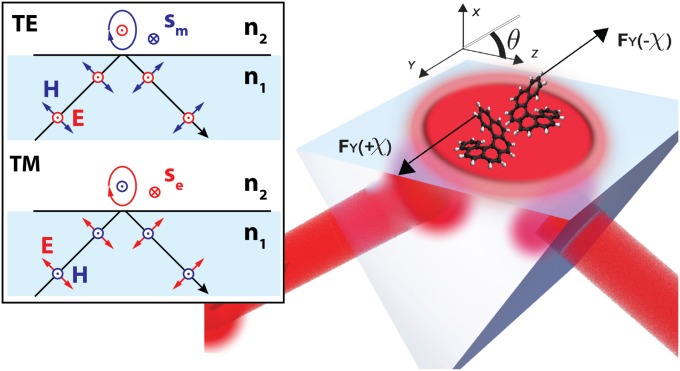
Fig. 1.
Fig. 1.
Chirality-dependent lateral forces in an evanescent field. An evanescent field arises as light in a high index medium (n1) is totally internally reflected at the interface with a low index medium (n2) at an angle θ beyond the critical angle. Particles in an evanescent field with transverse spin angular momentum experience lateral forces depending on their chiral polarizability χ, with particles with opposite helicities experiencing lateral forces in oppose directions. (Inset) Totally internally reflected TE and TM waves give rise to evanescent waves that have transverse spin due to their elliptically polarized magnetic (TE) and electric (TM) fields.
Fig. 2.
Fig. 2.
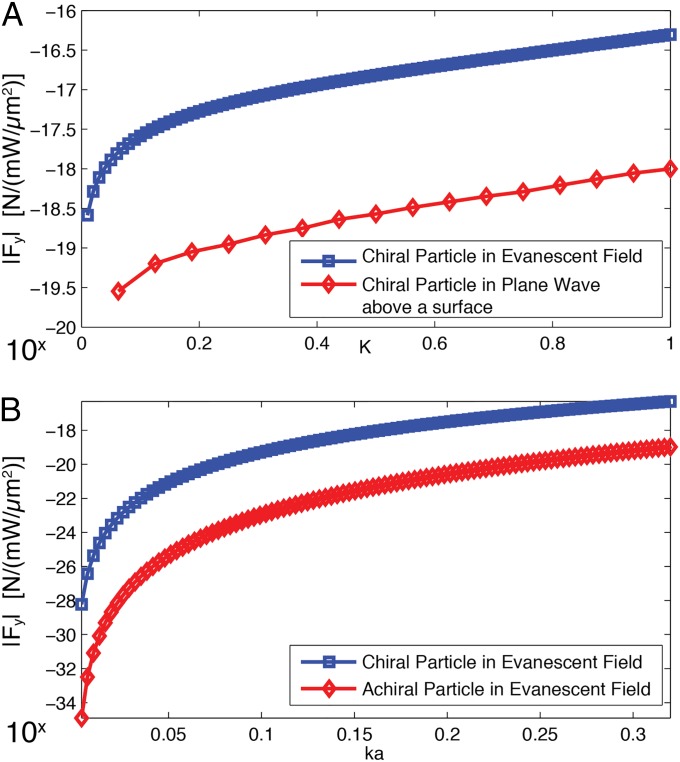
Lateral optical forces. The previously predicted lateral optical forces in comparison with the lateral force on a chiral particle in an evanescent field. The absolute value of the lateral force Fy is shown on a logarithmic scale in base 10. (A) The lateral optical force on a chiral nanosphere in a plane wave above a reflective surface according to Wang and Chan (16) and due to an evanescent field with τ=1 as a function of the chirality parameter K for positive helicity (20, 33) (Supporting Information). The sphere is nonmagnetic, situated 60 nm above the surface, and has a dielectric constant of ϵs=2 and a radius of 30 nm. In case of the force in the evanescent field, the intensity refers to the intensity of a beam that is totally internally reflected at a flint glass/air interface at an angle of θ=36.4°. (B) The lateral force on an achiral sphere (K=0) due to the Belifante spin momentum density according to Bliokh et al. (17) and on an equivalent chiral sphere (K=1) as a function of ka, where a is the radius of the sphere and k=n2ω/c is the wavenumber of the evanescent field. In both cases the sphere is nonmagnetic and situated at a height of 30 nm, has dielectric constant ϵs=2, and experiences the evanescent field generated at a flint glass/air interface at an incident angle of θ=36.4°. In the former case the polarization of the evanescent field has σ=1 and in the latter τ=1.
Fig. S1.
Fig. S1.
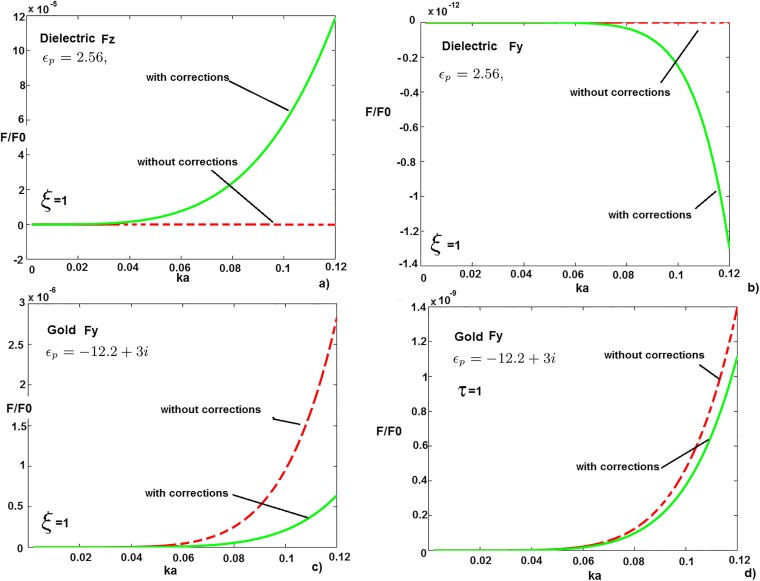
Impact of Draine’s correction on the optical force. The optical force on an achiral sphere with radius a and dielectric constant ϵp in an evanescent field with wavenumber k=n2ωc as a function of ka using the static polarizability (red, dashed line) and the dynamic polarizability after Draine’s correction (green, continuous line). A and B correspond to the force on a dielectric sphere with ϵp=2.56 and an incident polarization corresponding to ξ=1 (linear diagonal polarization), respectively, along the z direction (parallel to po, A) and the y direction (lateral optical force, B). C and D correspond to the lateral optical force using a gold sphere with ϵp=12.2+3i with an incident polarization of the beam corresponding, respectively, to ξ=1 (linear diagonal polarization, C) and τ=1 (linear horizontal polarization, D). The force is normalized by F0=(a2/4π)Iinc, where Iinc=|Einc|2 is the square modulus of the incident electric field. The sphere is suspended in water (index n2=1.33) and the evanescent field is generated by total internal reflection in a prism of index n1=1.74.Taking an incident intensity of 1.0mW/μm2 we have F0/a2=Iinc/4π3.3104Ncm2. Here the incident angle of total internal reflection is θ51 ° (so, above the critical angle, which is around θ=49.5 °). Note that in B the force without correction is zero.

References

    1. Kelvin Lord. 1904. Baltimore Lectures (C. J. Clay and Sons, London), pp 436, 619.
    1. Smith SW. Chiral toxicology: It’s the same thing...only different. Toxicol Sci. 2009;110(1):4–30. - PubMed
    1. Sekhon BS. Chiral pesticides. J Pest Sci. 2009;34(1):1–12.
    1. US Food and Drug Administration FDA’s policy statement for the development of new stereoisomeric drugs. Chirality. 1992;4(5):338–340. - PubMed
    1. Caner H, Groner E, Levy L, Agranat I. Trends in the development of chiral drugs. Drug Discov Today. 2004;9(3):105–110. - PubMed

Publication types