


Incidence of Hypertension-Related Emergency Department Visits in the United States, 2006 to 2012
- PMID: 26454813
- PMCID: PMC4648677
- DOI: 10.1016/j.amjcard.2015.09.007
Incidence of Hypertension-Related Emergency Department Visits in the United States, 2006 to 2012
Abstract
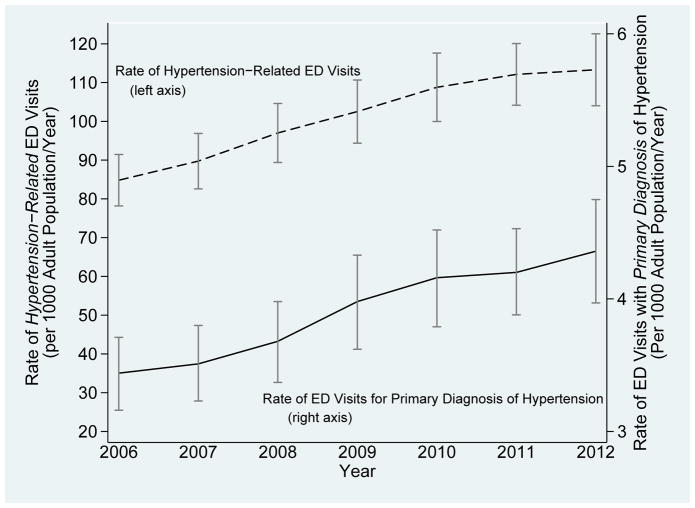
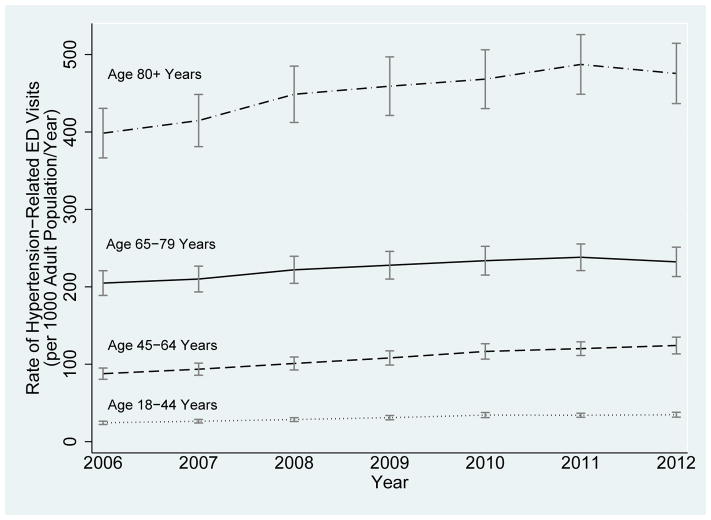
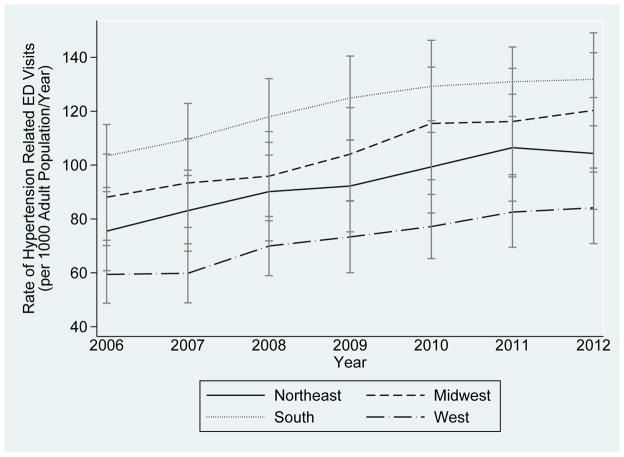
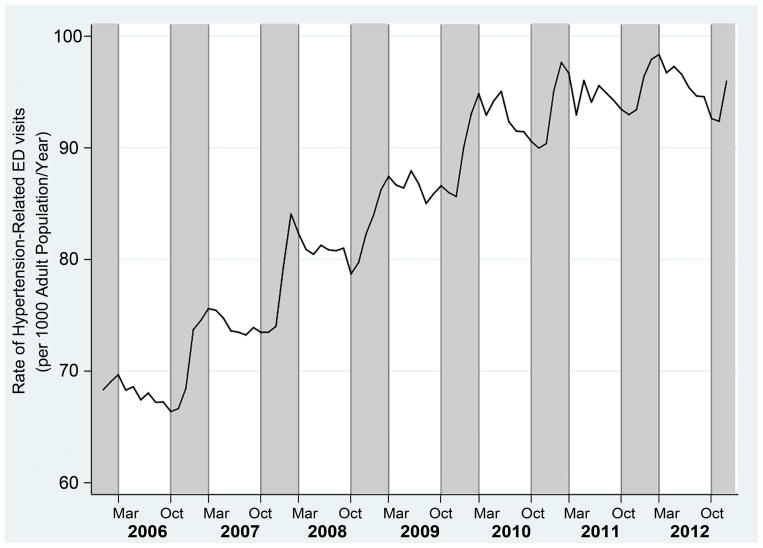
Hypertension is a common chronic condition, but the burden of emergency department (ED) visits due to hypertension and associated patient and hospital characteristics are not well described. The goals of this study were to (1) establish the burden of hypertension-related ED visits, estimated by the total number, proportion of adult visits, and population-based rate, (2) evaluate for change over time, and (3) identify associated patient and hospital characteristics. The Nationwide Emergency Department Sample from 2006 to 2012 was used to identify hypertension-related ED visits (International Classification of Diseases, Ninth Revision, Clinical Modification codes 401 to 405, inclusive, and 437.2), and this was linked to US Census Bureau July population estimates to determine population-based rates for each study year. Negative binomial regression was performed to determine whether rates of hypertension-related ED visits changed over time. A total of 165,946,807 hypertension-related ED visits occurred during the 7-year study period (23.6% of all adult ED visits), and hypertension was the primary diagnosis for 6,399,088 (0.9% of all adult ED visits). The estimated yearly incidence rate increased 5.2% per year (incident rate ratio, 1.052; 95% confidence interval, 1.044 to 1.061; p <0.001) for hypertension-related visits and 4.4% per year (incidence rate ratio, 1.044; 95% confidence interval, 1.038 to 1.051; p <0.001) for ED visits with a primary diagnosis of hypertension. Over the same time, the proportion hospitalized decreased and the proportion of visits increased at safety net hospitals and among uninsured patients. In conclusion, these data indicate that hypertension-related ED visits are common and increasing.
Published by Elsevier Inc.
Conflict of interest statement
Figures
References
-
- Go AS, Mozaffarian D, Roger VL, Benjamin EJ, Berry JD, Blaha MJ, Dai S, Ford ES, Fox CS, Franco S, Fullerton HJ, Gillespie C, Hailpern SM, Heit JA, Howard VJ, Huffman MD, Judd SE, Kissela BM, Kittner SJ, Lackland DT, Lichtman JH, Lisabeth LD, Mackey RH, Magid DJ, Marcus GM, Marelli A, Matchar DB, McGuire DK, Mohler ER, 3rd, Moy CS, Mussolino ME, Neumar RW, Nichol G, Pandey DK, Paynter NP, Reeves MJ, Sorlie PD, Stein J, Towfighi A, Turan TN, Virani SS, Wong ND, Woo D, Turner MB American Heart Association Statistics C, Stroke Statistics S. Executive summary: heart disease and stroke statistics--2014 update: a report from the american heart association. Circulation. 2014;129:399–410. - PubMed
-
- CDC. Vital signs: prevalence, treatment, and control of hypertension--United States, 1999–2002 and 2005–2008. MMWR. 2011;60:103–108. - PubMed
-
- Polgreen LA, Suneja M, Tang F, Carter BL, Polgreen PM. Increasing trend in admissions for malignant hypertension and hypertensive encephalopathy in the United States. Hypertension. 2015;65:1002–1007. - PubMed
Publication types
MeSH terms
Grants and funding
LinkOut - more resources
Full Text Sources
Other Literature Sources
Medical
