Effect of Olea ointment and Acetate Mafenide on burn wounds - A randomized clinical trial
- PMID: 26457099
- PMCID: PMC4598908
- DOI: 10.4103/1735-9066.164507
Effect of Olea ointment and Acetate Mafenide on burn wounds - A randomized clinical trial
Abstract
Background: The main goals in treating burns are to accelerate tissue renovation and prevent infection. Topical antibiotics are used in the treatment of burns, but they can cause side effects. Recently, a traditional ointment (Olea) has been used in Iran in the treatment of burns. This study examines the effect of topical honey ointment in healing of burn patients.
Materials and methods: In this randomized controlled trial (RCT), 30 hospitalized patients selected by conventional sampling (10 in Olea group and 20 in Acetate Mafenide ointment group) were evaluated. Inclusion criteria were: having second-degree burns and body surface area equal to or < 40%. One group was treated using topical Olea ointment and the other with Acetate Mafenide ointment (8.5%). Chi-square, Fisher exact test, and Kaplan-Meier were used. Significance level was considered as P < 0.05.
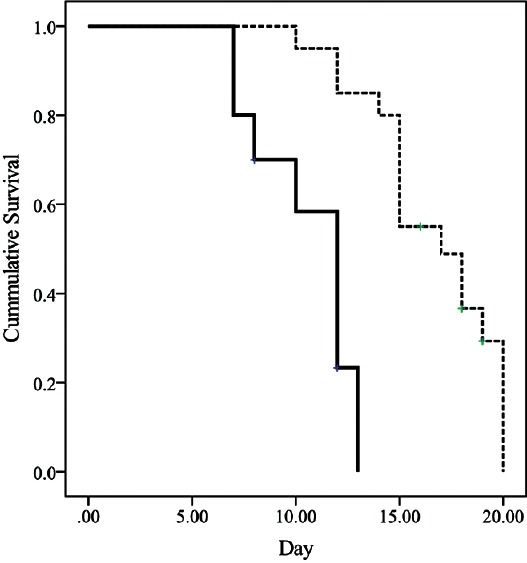
Results: None of the patients in the Olea group needed surgery for debridement, while in the second group, 13 patients (65%) needed debridement (P = 0.001). In the Olea group, 1 patient (10%) and in the second group, 19 patients (95%) had positive cultures after 7 days (P < 0.001). The mean time of granulation tissue formation in the Olea group was 12 days (10.3-13.6) and in the other group, it was 17 days (13.3-20.6) (P < 0.001).
Conclusions: Olea ointment is a useful treatment for burns, and it can prevent infections, accelerate tissue repair, and facilitate debridement. Therefore, using this ointment is recommended for the treatment of burns.
Keywords: Burns; re-epithelialization; wound healing; wounds and injuries.
Conflict of interest statement
Figures
References
-
- Salas Campos L, Fernandes Mansilla M, Martinez de la Chica AM. Topical chemotherapy for the treatment of burns. Rev Enferm. 2005;28:67–70. - PubMed
-
- Wijesinghe M, Weatherall M, Perrin K, Beasley R. Honey in the treatment of burns: A systematic review and meta-analysis of its efficacy. N Z Med J. 2009;122:47–60. - PubMed
-
- Atiyeh BS, Costagliola M, Hayek SN, Dibo SA. Effect of silver on burn wound infection control and healing: Review of the literature. Burns. 2007;33:139–48. - PubMed
-
- Poon VK, Burd A. In vitro cytotoxity of silver: Implication for clinical wound care. Burns. 2004;30:140–7. - PubMed
-
- Song JJ, Salcido R. Use of Honey in Wound Care: An Update. Advances in Skin and Wound Care. 2011;24:40–4. - PubMed
LinkOut - more resources
Full Text Sources
Other Literature Sources