Review
. 2015:2015:536962.
doi: 10.1155/2015/536962. Epub 2015 Sep 20.

NSAIDs and Cardiovascular Diseases: Role of Reactive Oxygen Species

Affiliations
Review

NSAIDs and Cardiovascular Diseases: Role of Reactive Oxygen Species

Rajeshwary Ghosh et al. Oxid Med Cell Longev. 2015.

Abstract

Nonsteroidal anti-inflammatory drugs (NSAIDs) are the most commonly used drugs worldwide. NSAIDs are used for a variety of conditions including pain, rheumatoid arthritis, and musculoskeletal disorders. The beneficial effects of NSAIDs in reducing or relieving pain are well established, and other benefits such as reducing inflammation and anticancer effects are also documented. The undesirable side effects of NSAIDs include ulcers, internal bleeding, kidney failure, and increased risk of heart attack and stroke. Some of these side effects may be due to the oxidative stress induced by NSAIDs in different tissues. NSAIDs have been shown to induce reactive oxygen species (ROS) in different cell types including cardiac and cardiovascular related cells. Increases in ROS result in increased levels of oxidized proteins which alters key intracellular signaling pathways. One of these key pathways is apoptosis which causes cell death when significantly activated. This review discusses the relationship between NSAIDs and cardiovascular diseases (CVD) and the role of NSAID-induced ROS in CVD.


Figures

Figure 1
Figure 1
Inhibition of cyclooxygenase pathway by NSAIDs. Coxibs as well as nonselective NSAIDs inhibit the formation of the metabolites of the cyclooxygenase pathway thereby disrupting the homeostasis maintained by these metabolites. Coxibs cause an imbalance between the levels of thromboxane and prostacyclin being more favorable towards thromboxane and decreasing prostacyclin levels leading to the aggregation of platelets and causing thrombosis.
Figure 2
Figure 2
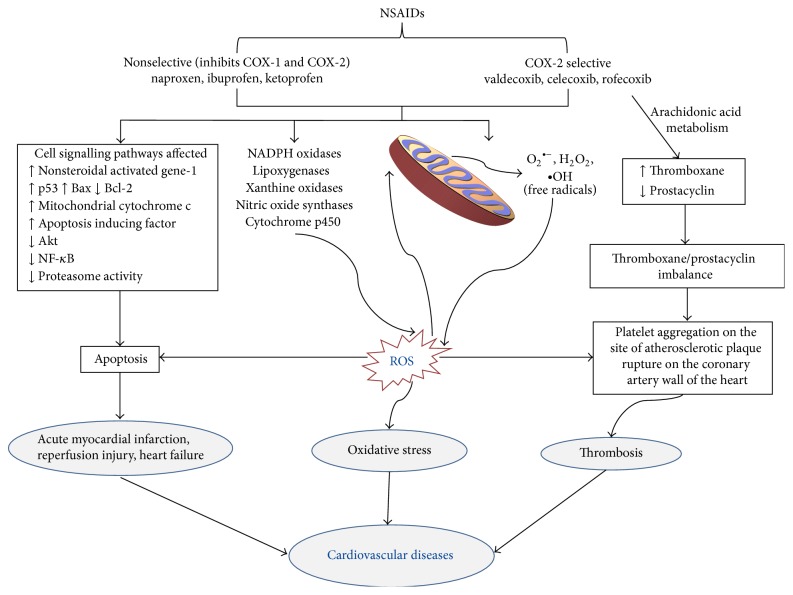
Pathways involved in the development of cardiovascular diseases by NSAIDS. The figure shows the upregulation and downregulation of various pathways by NSAIDs leading to the development of CVD. Mitochondria play a major role in the generation of ROS induced by NSAIDs followed by oxidative stress and finally CVD.

References

    1. Crofford L. J. Use of NSAIDs in treating patients with arthritis. Arthritis Research & Therapy. 2013;15(supplement 3, article S2) doi: 10.1186/ar4174. - DOI - PMC - PubMed
    1. Cha Y. I., DuBois R. N. NSAIDs and cancer prevention: targets downstream of COX-2. Annual Review of Medicine. 2007;58:239–252. doi: 10.1146/annurev.med.57.121304.131253. - DOI - PubMed
    1. Cuzick J., Otto F., Baron J. A., et al. Aspirin and non-steroidal anti-inflammatory drugs for cancer prevention: an international consensus statement. The Lancet Oncology. 2009;10(5):501–507. doi: 10.1016/S1470-2045(09)70035-X. - DOI - PubMed
    1. Liggett J. L., Zhang X., Eling T. E., Baek S. J. Anti-tumor activity of non-steroidal anti-inflammatory drugs: cyclooxygenase-independent targets. Cancer Letters. 2014;346(2):217–224. doi: 10.1016/j.canlet.2014.01.021. - DOI - PMC - PubMed
    1. Lanza F. L., Chan F. K. L., Quigley E. M. M. Guidelines for prevention of NSAID-related ulcer complications. The American Journal of Gastroenterology. 2009;104(3):728–738. doi: 10.1038/ajg.2009.115. - DOI - PubMed

Publication types

MeSH terms