


From invagination to navigation: The story of magnetosome-associated proteins in magnetotactic bacteria
- PMID: 26457474
- PMCID: PMC4815348
- DOI: 10.1002/pro.2827
From invagination to navigation: The story of magnetosome-associated proteins in magnetotactic bacteria
Abstract
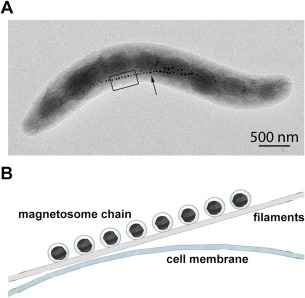
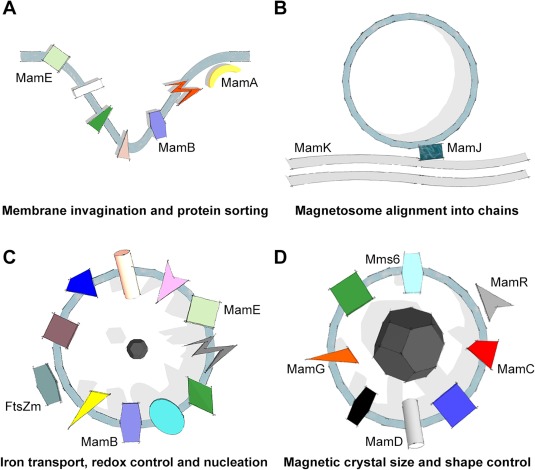
Magnetotactic bacteria (MTB) are a group of Gram-negative microorganisms that are able to sense and change their orientation in accordance with the geomagnetic field. This unique capability is due to the presence of a special suborganelle called the magnetosome, composed of either a magnetite or gregite crystal surrounded by a lipid membrane. MTB were first detected in 1975 and since then numerous efforts have been made to clarify the special mechanism of magnetosome formation at the molecular level. Magnetosome formation can be divided into several steps, beginning with vesicle invagination from the cell membrane, through protein sorting, followed by the combined steps of iron transportation, biomineralization, and the alignment of magnetosomes into a chain. The magnetosome-chain enables the sensing of the magnetic field, and thus, allows the MTB to navigate. It is known that magnetosome formation is tightly controlled by a distinctive set of magnetosome-associated proteins that are encoded mainly in a genomically conserved region within MTB called the magnetosome island (MAI). Most of these proteins were shown to have an impact on the magnetism of MTB. Here, we describe the process in which the magnetosome is formed with an emphasis on the different proteins that participate in each stage of the magnetosome formation scheme.
Keywords: biomineralization; magnetic nanoparticles; magnetosome; magnetotactic bacteria; protein function.
© 2015 The Protein Society.
Figures
References
-
- Bazylinski DA, Frankel RB (2004) Magnetosome formation in prokaryotes. Nat Rev Microbiol 2:217–230. - PubMed
-
- Bellini S (2009) On a unique behavior of freshwater bacteria. Chin J Oceanol Limnol 27:3–5.
-
- Bellini S (2009) Further studies on “magnetosensitive bacteria.” Chin J Oceanol Limnol 27:6–12.
-
- Blakemore R (1975) Magnetotactic bacteria. Science 190:377–379. - PubMed
-
- Faivre D, Schüler D (2008) Magnetotactic bacteria and magnetosomes. Chem Rev 108:4875–4898. - PubMed
Publication types
MeSH terms
Substances
LinkOut - more resources
Full Text Sources
Other Literature Sources
