. 2015 Nov;47(11):1326-1333.
doi: 10.1038/ng.3400. Epub 2015 Oct 12.

The genomic landscape of juvenile myelomonocytic leukemia

Affiliations

The genomic landscape of juvenile myelomonocytic leukemia

Elliot Stieglitz et al. Nat Genet. 2015 Nov.

Erratum in

  • Nat Genet. 2015 Nov;47(11):1333
  • Corrigendum: The genomic landscape of juvenile myelomonocytic leukemia.
    Stieglitz E, Taylor-Weiner AN, Chang TY, Gelston LC, Wang YD, Mazor T, Esquivel E, Yu A, Seepo S, Olsen SR, Rosenberg M, Archambeault SL, Abusin G, Beckman K, Brown PA, Briones M, Carcamo B, Cooper T, Dahl GV, Emanuel PD, Fluchel MN, Goyal RK, Hayashi RJ, Hitzler J, Hugge C, Liu YL, Messinger YH, Mahoney DH Jr, Monteleone P, Nemecek ER, Roehrs PA, Schore RJ, Stine KC, Takemoto CM, Toretsky JA, Costello JF, Olshen AB, Stewart C, Li Y, Ma J, Gerbing RB, Alonzo TA, Getz G, Gruber TA, Golub TR, Stegmaier K, Loh ML. Stieglitz E, et al. Nat Genet. 2016 Jan;48(1):101. doi: 10.1038/ng0116-101a. Nat Genet. 2016. PMID: 26711114 No abstract available.

Abstract

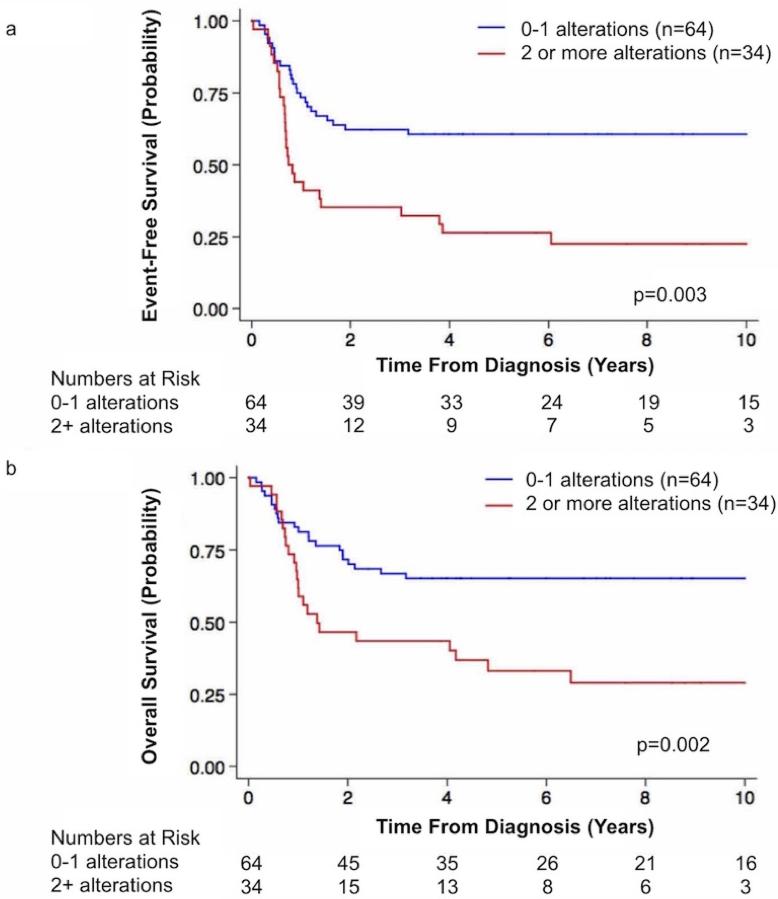
Juvenile myelomonocytic leukemia (JMML) is a myeloproliferative neoplasm (MPN) of childhood with a poor prognosis. Mutations in NF1, NRAS, KRAS, PTPN11 or CBL occur in 85% of patients, yet there are currently no risk stratification algorithms capable of predicting which patients will be refractory to conventional treatment and could therefore be candidates for experimental therapies. In addition, few molecular pathways aside from the RAS-MAPK pathway have been identified that could serve as the basis for such novel therapeutic strategies. We therefore sought to genomically characterize serial samples from patients at diagnosis through relapse and transformation to acute myeloid leukemia to expand knowledge of the mutational spectrum in JMML. We identified recurrent mutations in genes involved in signal transduction, splicing, Polycomb repressive complex 2 (PRC2) and transcription. Notably, the number of somatic alterations present at diagnosis appears to be the major determinant of outcome.


Figures
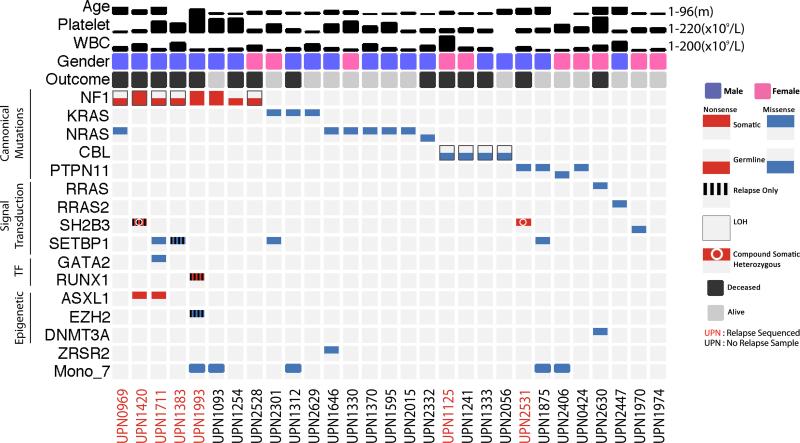
Figure 1
Figure 1
Mutations identified by exome sequencing. Twenty-nine patients who underwent whole exome sequencing are displayed. Each patient is presented in a single condensed column including mutations identified at germline, diagnostic (noted in black) and relapse (noted in red) timepoints. Germline mutations are presented in colors in the bottom half of the box of any given gene and somatic mutations in the top half. Mutations only present at relapse are denoted with vertical striped bars. Loss of heterozygosity in a single gene is annotated with a thin black rectangle surrounding the mutation. Somatic compound heterozygous mutations are noted with a white circle.
Figure 2
Figure 2
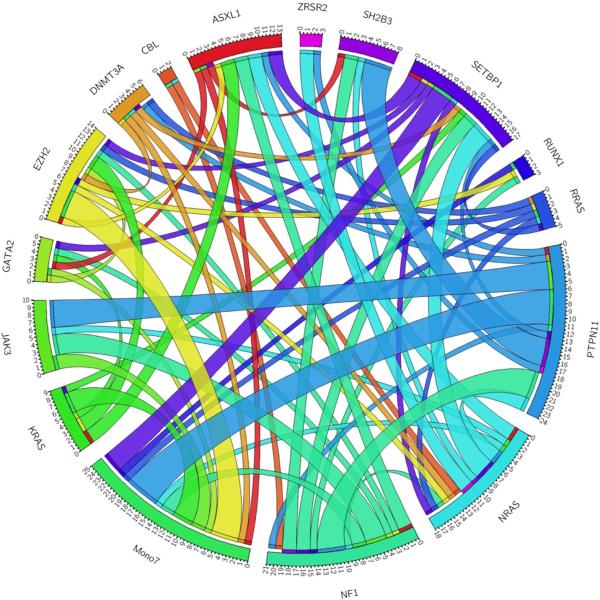
Circos plot of samples with at least two mutations. Using data from whole exome and targeted resequencing, patients with at least two mutations are depicted. Associations between genomic alterations in the same patient are marked by connecting bands, with the width of the band proportional to the frequency of the association.
Figure 3
Figure 3
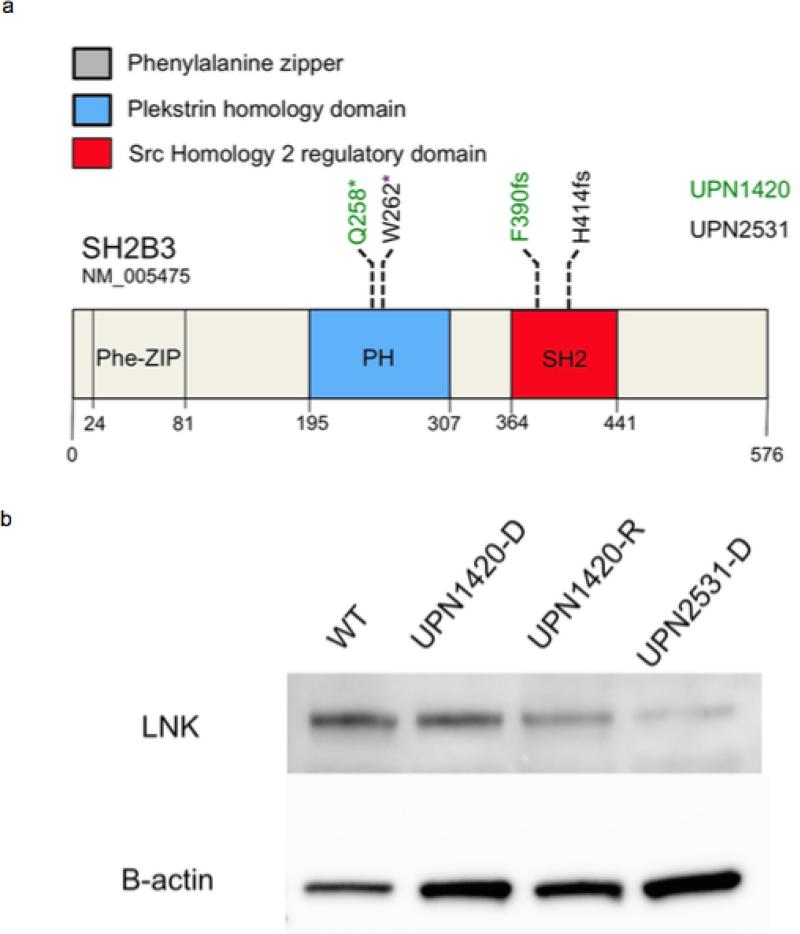
Mutations in SH2B3 decrease expression of LNK. (a) Compound mutations in the Plekstrin and Src Homology 2 domains are presented for each patient found to harbor SH2B3 lesions on whole exome sequencing. (b) Western blot analysis from whole cell lysates using anti-LNK and anti-B-actin antibodies. Commensurate with the allelic fraction of each mutation (UPN1420-Relapse, 31%, UPN2531-Diagnosis, 37%), the expression of LNK is decreased.
Figure 4
Figure 4
Event-free and overall survival of patients stratified by the number of somatic alterations. Kaplan-Meier estimated (a) event-free survival (log-rank p=0.002) and (b) overall survival (log-rank p=0.002) according to the number of somatic alterations at diagnosis.

References

    1. Chang TY, Dvorak CC, Loh ML. Bedside to bench in juvenile myelomonocytic leukemia: insights into leukemogenesis from a rare pediatric leukemia. Blood. 2014;124:2487–97. - PubMed
    1. Dvorak CC, Loh ML. Juvenile Myelomonocytic Leukemia: Molecular Pathogenesis Informs Current Approaches to Therapy and Hematopoietic Cell Transplantation. Front Pediatr. 2014;2:25. - PMC - PubMed
    1. Matsuda K, et al. Spontaneous improvement of hematologic abnormalities in patients having juvenile myelomonocytic leukemia with specific RAS mutations. Blood. 2007;109:5477–80. - PubMed
    1. Matsuda K, et al. Long-term survival after nonintensive chemotherapy in some juvenile myelomonocytic leukemia patients with CBL mutations, and the possible presence of healthy persons with the mutations. Blood. 2010;115:5429–31. - PubMed
    1. Bresolin S, et al. Gene expression-based classification as an independent predictor of clinical outcome in juvenile myelomonocytic leukemia. J Clin Oncol. 2010;28:1919–27. - PubMed

Publication types

MeSH terms