


Reading the mind of children in response to food advertising: a cross-sectional study of Malaysian schoolchildren's attitudes towards food and beverages advertising on television
- PMID: 26459341
- PMCID: PMC4603941
- DOI: 10.1186/s12889-015-2392-z
Reading the mind of children in response to food advertising: a cross-sectional study of Malaysian schoolchildren's attitudes towards food and beverages advertising on television
Abstract
Background: Television food advertising (TVFA) is the most dominant medium in the obesogenic environment promoting unhealthy food choices in children.
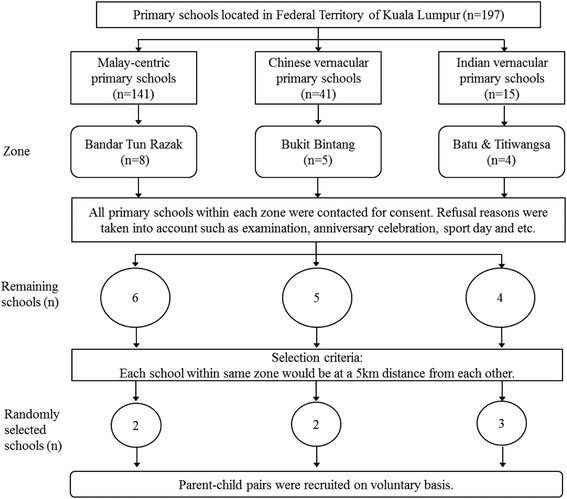
Methods: This cross-sectional study investigated children's attitudes towards TVFA by examining four well-cited induction factors namely advertisement recognition, favourite advertisement, purchase request, and product preference. Malaysian urban schoolchildren (7 to 12 years) of equal ethnic distribution were voluntarily recruited (n = 402). Questionnaire administration was facilitated using a food album of 24 advertised food products.
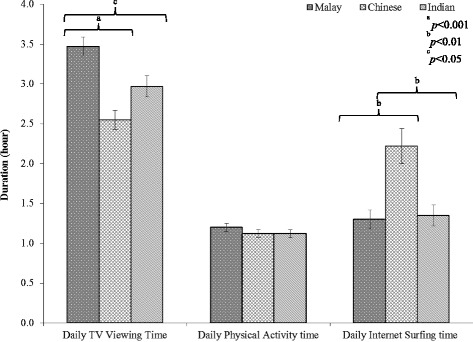
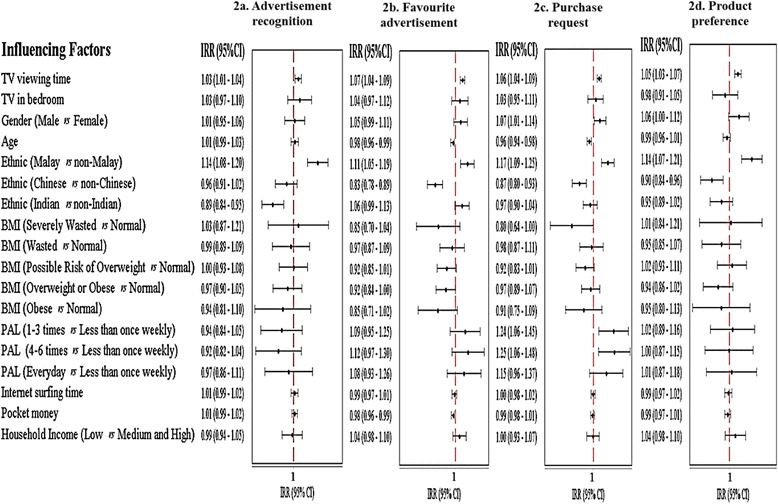
Results: Majority of children were older (66.2 %), girls (56.7 %) with one-third either overweight or obese. TV viewing time for weekend was greater than weekdays (4.77 ± 2.60 vs 2.35 ± 1.40 h/day) and Malay children spent more time watching TV compared to Chinese (p < 0.001) and Indian (p < 0.05) children. Chinese children spent significantly more time surfing the internet compared to either Malay or Indian (p < 0.01). Median score trend was advertisement recognition > favourite advertisement and product preference > purchase request, and significantly greater (p < 0.001) for non-core than core food advertisements. TV viewing time and ethnicity significantly influenced all induction factors for non-core foods. After correcting for all influencing factors, 'favourite advertisement' (IRRfinal adj: 1.06; 95 % CI: 1.04 to 1.08), 'purchase request' (IRRfinal adj: 1.06; 95 % CI: 1.04 to 1.08) and 'product preference' (IRRfinal adj: 1.04; 95 % CI: 1.02 to 1.07) still were significantly associated with TV viewing time. For every additional hour of TV viewing, the incidence rates increased significantly by 1.04 to 1.06 for 'favourite advertisement', 'purchase request' and 'product preference' related to non-core foods amongst Malay and Indian children. However, Chinese children only demonstrated a significant association between TV viewing time and 'favourite advertisement' (IRRadj: 1.06; 95 % CI: 1.01 to 1.10).
Conclusion: This study highlights TVFA as a powerful medium predisposing the mind of children to non-core foods through appealing TV commercials, promoting purchase request and generating unhealthy food preferences in early childhood.
Figures
References
-
- Ng M, Fleming T, Robinson M, Thomson B, Graetz N, Margono C, et al. Global, regional, and national prevalence of overweight and obesity in children and adults during 1980–2013: a systematic analysis for the Global Burden of Disease Study 2013. Lancet. 2014;384(9945):766–81. doi: 10.1016/S0140-6736(14)60460-8. - DOI - PMC - PubMed
-
- Foresight. Tackling obesities: Future choices – Project report. Government Office for Science. 2007. https://www.gov.uk/government/uploads/system/uploads/attachment_data/fil.... Accessed 4 Jul 2014.
Publication types
MeSH terms
LinkOut - more resources
Full Text Sources
Other Literature Sources
