. 2015 Nov 15;195(10):5045-54.
doi: 10.4049/jimmunol.1500700. Epub 2015 Oct 12.

Housing Temperature-Induced Stress Is Suppressing Murine Graft-versus-Host Disease through β2-Adrenergic Receptor Signaling

Affiliations

Housing Temperature-Induced Stress Is Suppressing Murine Graft-versus-Host Disease through β2-Adrenergic Receptor Signaling

Nicholas D Leigh et al. J Immunol. .

Abstract

Graft-versus-host disease (GVHD) is the major complication of allogeneic hematopoietic cell transplantation, a potentially curative therapy for hematologic diseases. It has long been thought that murine bone marrow-derived T cells do not mediate severe GVHD because of their quantity and/or phenotype. During the course of experiments testing the impact of housing temperatures on GVHD, we discovered that this apparent resistance is a function of the relatively cool ambient housing temperature. Murine bone marrow-derived T cells have the ability to mediate severe GVHD in mice housed at a thermoneutral temperature. Specifically, mice housed at Institutional Animal Care and Use Committee-mandated, cool standard temperatures (∼ 22°C) are more resistant to developing GVHD than are mice housed at thermoneutral temperatures (∼ 30°C). We learned that the mechanism underlying this housing-dependent immunosuppression is associated with increased norepinephrine production and excessive signaling through β-adrenergic receptor signaling, which is increased when mice are cold stressed. Treatment of mice housed at 22°C with a β2-adrenergic antagonist reverses the norepinephrine-driven suppression of GVHD and yields similar disease to mice housed at 30°C. Conversely, administering a β2-adrenergic agonist decreases GVHD in mice housed at 30°C. In further mechanistic studies using β2-adrenergic receptor-deficient (β2-AR(-/-)) mice, we found that it is host cell β2-AR signaling that is essential for decreasing GVHD. These data reveal how baseline levels of β-adrenergic receptor signaling can influence murine GVHD and point to the feasibility of manipulation of β2-AR signaling to ameliorate GVHD in the clinical setting.


Figures

Figure 1
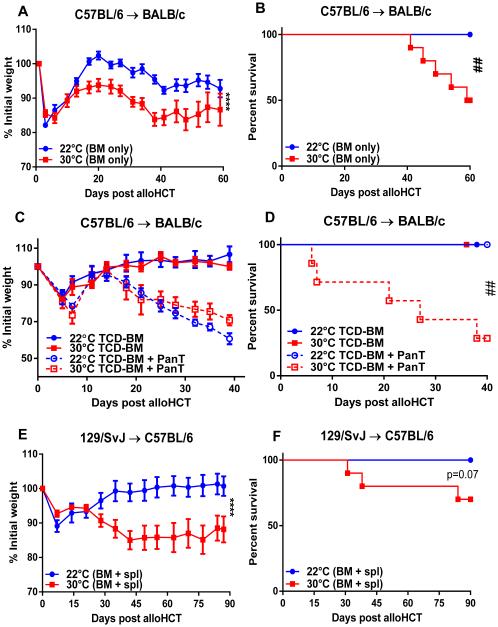
Figure 1. GVHD is exacerbated following alloHCT in mice maintained at 30°C
(A-D) BALB/c mice were transplanted as described in Materials and Methods. Following transplant of total BM alone (A-B) or TCD-BM + PanT (C-D), weight loss and survival of BALB/c hosts was monitored. (E, F) C57BL/6 mice were lethally irradiated (965 cGy) and transplanted on day -1 with 2×10⁶ 129/SvJ BM + 7.5×10⁶ splenocytes on day 0. Weight loss (C) and survival (D) were subsequently monitored. (A, C, E) Data presented as mean ± SEM (n = 3-10; **** p < 0.0001; Two-way ANOVA). (B, D, F) Data presented percent survival (n = 10; ## p < 0.01; Mantel-Cox test).
Figure 2
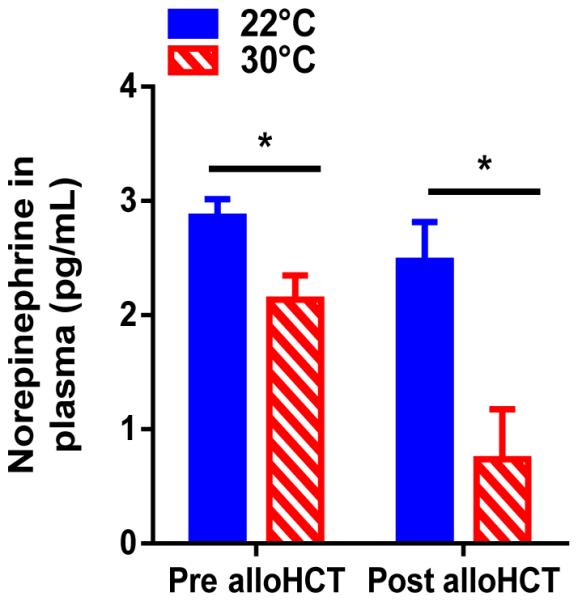
Figure 2. Mild cold stress increases circulating norepinephrine pre- and post-alloHCT
BALB/c mice were housed at 22°C or 30°C and transplanted as described in Materials and Methods. (A) Norepinephrine levels were measured in BALB/c mice prior to transplant and on day 13 following alloHCT. (A) Data presented as mean ± SEM (n = 5-8; *p < 0.05; Student’s t test).
Figure 3
Figure 3. The adrenergic stress response reduces allogeneic T cell mediated GVHD
(A-B) BALB/c mice were transplanted and treated as described in Materials and Methods. Mice were treated daily with propranolol or PBS while weight (A) and survival (B) were monitored. (C-D) C57BL/6 mice were transplanted with syngeneic BM as described in Materials and Methods. Host mice were treated daily with propranolol or PBS and weight loss (C) and survival (D) were monitored. (A, C, E) Data presented as mean ± SEM (n = 5-10; **** p < 0.0001; Two-way ANOVA). (B, D, F) Data presented as percent survival (n = 5-10; # p < 0.05, ## p < 0.01; Mantel-Cox test).
Figure 4
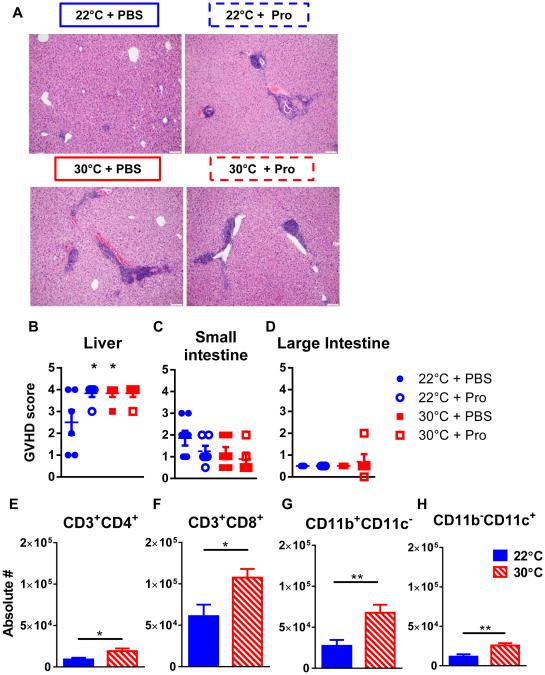
Figure 4. Alleviating adrenergic stress increases liver GVHD
BALB/c mice were transplanted as described in Materials and Methods. 54 days following alloHCT livers (A, B) and small (C) and large (D) intestines were excised and fixed in formalin. GVHD was scored using a previously described semi-quantitative scoring system. (E-H) Livers were harvested day 5 post-alloHCT as described in Materials and Methods. Cells were counted by trypan blue exclusion using a hemocytometer and then analyzed by flow cytometry for the presence of CD3+CD4+ T cells (E), CD3+CD8+ T cells, CD11b+CD11c (G), and CD11bCD11c+ cell (H). Data are pooled from two individual experiments. (B-H) Data presented as mean ± SEM (n = 6; * p < 0.05;**p <0.01 Student’s t test).
Figure 5
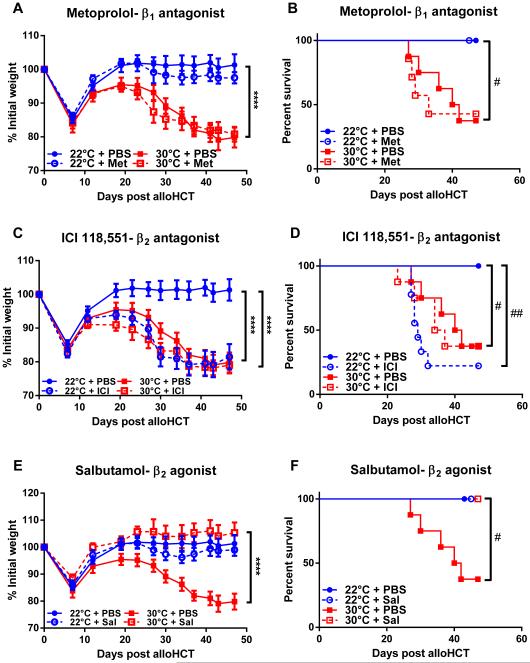
Figure 5. β2- but not β1-adrenergic receptor signaling reduces GVHD
BALB/c mice were transplanted and treated as described in Materials and Methods. Mice were treated daily with metoprolol, ICI 118,551, salbutamol or PBS while weight (A, C, D) and survival (B, D, F) were monitored. (A, C, E) Data presented as mean ± SEM (n = 5-10; **** p < 0.0001; Two-way ANOVA). (B, D, F) Data presented as percent survival (n = 5-10; # p < 0.05, ## p < 0.01; Mantel-Cox test).
Figure 6
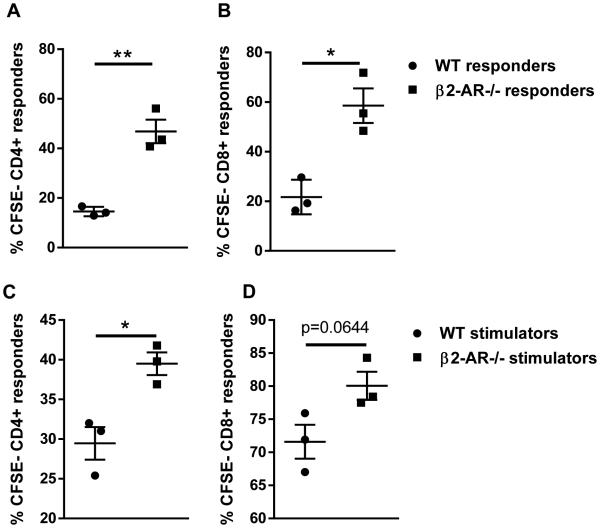
Figure 6. β2-AR signaling decreases T cell proliferation in mixed lymphocyte reactions
(A-B) WT or β2-AR−/− BALB/c responders were CFSE stained and co-cultured with irradiated WT C57BL/6 stimulators for 96 hours. CFSE dilution in H-2Kd+CD4+ and H-2Kd+CD8+ T cells was analyzed. (C-D) WT C57BL/6 responders were CFSE stained and co-cultured with irradiated WT or β2-AR−/− BALB/c stimulators for 96 hours. CFSE dilution in H-2Kb+CD4+ and H-2Kb+CD8+ T cells was analyzed. Data are presented as mean ± SEM (*p < 0.05;**p <0.01 Student’s t test). Representative data from 1 of 2 individual experiments is presented.
Figure 7
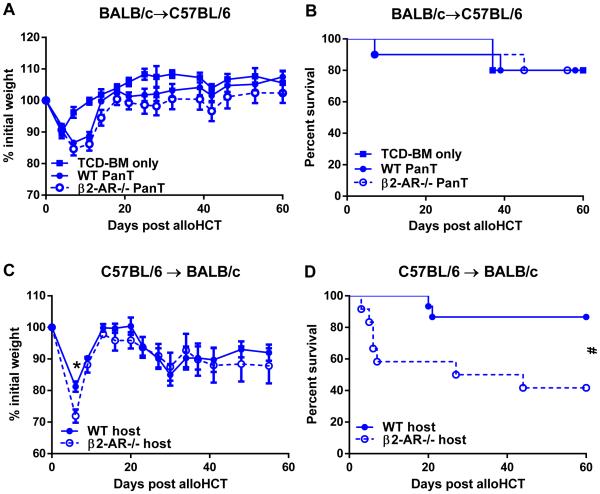
Figure 7. Host-, but not donor T cell-, derived β2-AR signaling is essential for controlling GVHD
(A-B) WT C57BL/6 host mice were housed at 22°C and transplanted with BALB/c-derived TCD-BM + PanT as described in Materials and Methods. Weight loss (A) and survival (B) of C57BL/6 hosts were monitored. (C-D) WT or β2-AR−/− BALB/c host mice were housed at 22°C and transplanted with C57BL/6-derived total BM cells as described in Material and Methods. Weight loss (C) and survival (D) of WT and β2-AR−/− BALB/c hosts were monitored. (A, C) Data presented as mean ± SEM (n = 5-10; *p<0.05; Two-way ANOVA). (B, D) Data presented as percent survival (n = 9-10; # p < 0.05, Mantel-Cox test).

References

    1. Hahn T, McCarthy PL, Jr., Zhang MJ, Wang D, Arora M, Frangoul H, Gale RP, Hale GA, Horan J, Isola L, Maziarz RT, van Rood JJ, Gupta V, Halter J, Reddy V, Tiberghien P, Litzow M, Anasetti C, Pavletic S, Ringden O. Risk factors for acute graft-versus-host disease after human leukocyte antigen-identical sibling transplants for adults with leukemia. JClin Oncol. 2008;26:5728–5734. - PMC - PubMed
    1. Socie G, Blazar BR. Acute graft-versus-host disease: from the bench to the bedside. Blood. 2009;114:4327–4336. - PMC - PubMed
    1. Zeng D, Lewis D, Dejbakhsh-Jones S, Lan F, Garcia-Ojeda M, Sibley R, Strober S. Bone marrow NK1.1(−) and NK1.1(+) T cells reciprocally regulate acute graft versus host disease. The Journal of experimental medicine. 1999;189:1073–1081. - PMC - PubMed
    1. Korngold R, Sprent J. Lethal graft-versus-host disease after bone marrow transplantation across minor histocompatibility barriers in mice. Prevention by removing mature T cells from marrow. The Journal of experimental medicine. 1978;148:1687–1698. - PMC - PubMed
    1. Palathumpat V, Dejbakhsh-Jones S, Holm B, Strober S. Different subsets of T cells in the adult mouse bone marrow and spleen induce or suppress acute graft-versus-host disease. J Immunol. 1992;149:808–817. - PubMed

Publication types

MeSH terms

Substances