


Does successful smoking cessation reduce anxious arousal among treatment-seeking smokers?
- PMID: 26460537
- PMCID: PMC4658244
- DOI: 10.1016/j.janxdis.2015.07.009
Does successful smoking cessation reduce anxious arousal among treatment-seeking smokers?
Abstract
Introduction: There is limited work that has examined the effect of quitting smoking on anxious arousal, an underlying dimension of anxiety symptoms and psychopathology.
Method: Smokers (n=185, 54.1% female) enrolled in a smoking cessation treatment trial were monitored post-cessation in terms of abstinence status (biochemically verified; at Weeks 1, 2, and Month 1 post-quit) and severity of panic-relevant symptoms (self-reported; at Month 1 and 3 post-quit). Structural equation models were conducted, adjusting for participant sex, age, treatment condition, and pre-cessation nicotine dependence, presence of depressive/anxiety disorders, anxious arousal, and anxiety sensitivity.
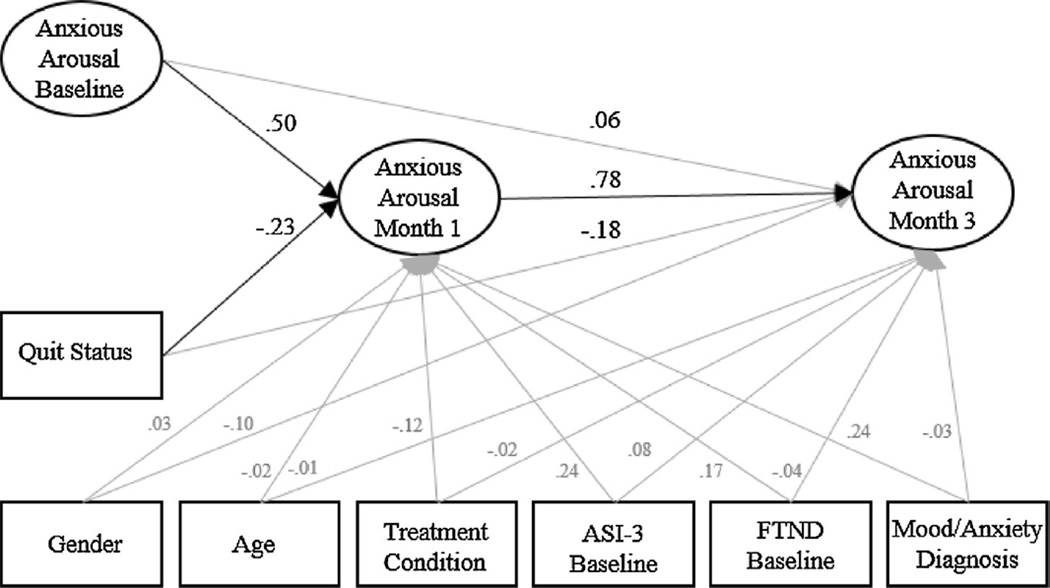
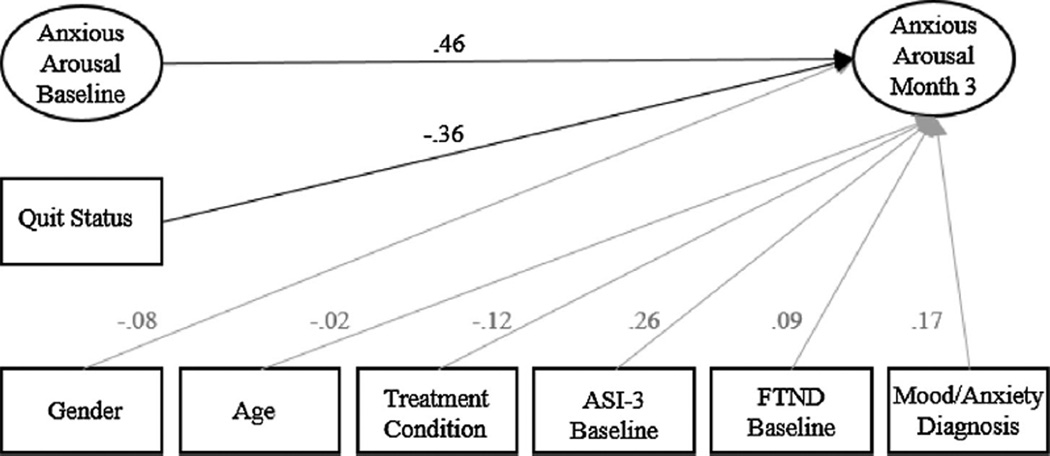
Results: After adjusting for covariates, participants who remained abstinent for one month (n=80; 43.2%) relative to those who did not (n=105; 56.8%) demonstrated significant reductions in anxious arousal at Month 1 (β=-.26, p=.04) and Month 3 post-quit (β=-.36, p=.006); abstinence status had a non-significant effect on anxious arousal severity at Month 3 after controlling for Month 1 anxious arousal (β=-.18, p=.09).
Discussion: Findings align with theoretical models of smoking-anxiety interplay and suggest that smoking cessation can result in reductions in anxious arousal.
Keywords: Hyperarousal; Prevention; Smoking cessation; Tobacco.
Copyright © 2015 Elsevier Ltd. All rights reserved.
Conflict of interest statement
No authors have any conflicts of interests or financial disclosures to report.
Figures
References
-
- Amering M, Bankier B, Berger P, Griengl H, Windhaber J, Katschnig H. Panic disorder and cigarette smoking behavior. Comprehensive Psychiatry. 1999;40(1):35–38. - PubMed
-
- Bernstein A, Zvolensky MJ, Schmidt NB, Sachs-Ericcson N. Developmental course(s) of lifetime cigarette use and panic attack comorbidity: an equifinal phenomenon? Behavior Modification. 2007;31(1):117–135. - PubMed
-
- Becoña E, Vázquez FL, Míguez MDC. Smoking cessation and anxiety in a clinical sample. Personality and Individual Differences. 2002;32(3):489–494. http://dx.doi.org/10.1016/S0191-8869(01)50-2. - DOI
-
- Berlin I, Chen H, Covey LS. Depressive mood, suicide ideation and anxiety in smokers who do and smokers who do not manage to stop smoking after a target quit day. Addiction. 2010;105(12):2209–2216. http://dx.doi.org/10.1111/j.1360-0443.2010.03109.x. - DOI - PubMed
Publication types
MeSH terms
Grants and funding
LinkOut - more resources
Full Text Sources
Other Literature Sources
Medical
