The coupling of nicotine and stimulant craving during treatment for stimulant dependence
- PMID: 26460569
- PMCID: PMC4760905
- DOI: 10.1037/ccp0000054
The coupling of nicotine and stimulant craving during treatment for stimulant dependence
Abstract
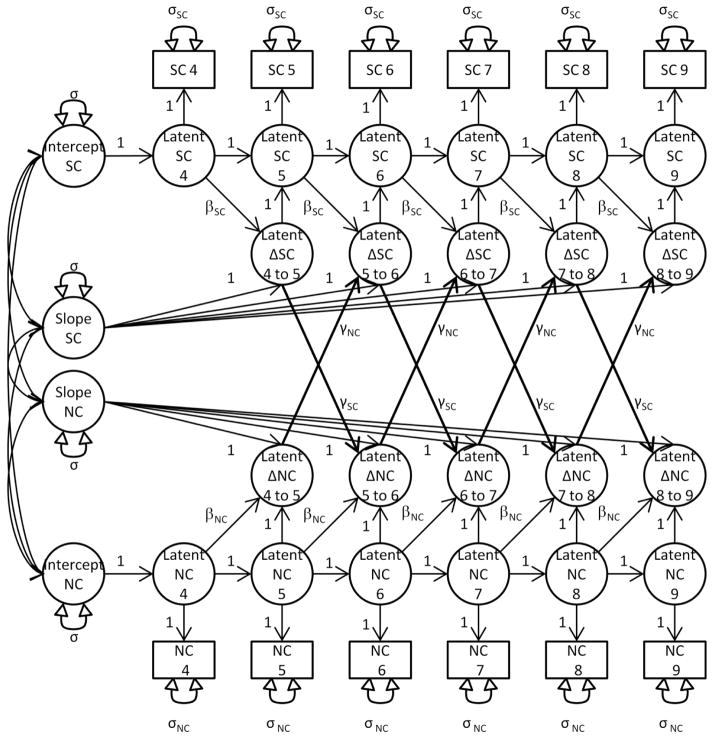
Objective: Smoking prevalence is high among substance abusers, making it important to understand when nicotine abstinence will aid, impair, or not affect abstinence from other substances. This study tested novel hypotheses about the coupling of nicotine and stimulant craving over time during stimulant dependence treatment.
Method: Adults (N = 538) with cocaine and/or methamphetamine dependence completed a 10-week randomized controlled trial of substance use treatment with or without smoking cessation treatment. Participants reported nicotine and stimulant craving weekly and use twice per week.
Results: Latent change score modeling tested the association between weekly increases in nicotine craving and subsequent weekly changes in stimulant craving. Interestingly, results revealed a "substitution" effect: increases in nicotine craving predicted subsequent decreases in stimulant craving, γ = -.37, p = .001. Additionally, increases in nicotine craving predicted subsequent increases in nicotine use, γ = 1.26, p = .04, and decreases in stimulant use, γ = -.07, p = .03. As expected, the substitution effect between nicotine and stimulant craving was stronger when stimulants were administered through the same route as nicotine (i.e., smoking), γ = -.56, p = .005, versus other routes, γ = -.32, p = .06. Finally, smoking cessation treatment eliminated the coupling between nicotine craving and stimulant craving, γ = -.07, p = .39.
Conclusions: Contrary to concerns about nicotine abstinence during substance dependence treatment, increases in nicotine craving may be associated with later reductions in stimulant craving and use, and unrelated when smoking cessation treatment is introduced. Weekly changes in nicotine craving convey information that can help clinicians to predict and understand shifts in stimulant craving and use during substance use disorder treatment.
(c) 2016 APA, all rights reserved).
Figures
References
-
- Carter B, Tiffany S. Meta-analysis of cue-reactivity in addiction research. Addiction. 1999;94:327–340. Retrieved from http://onlinelibrary.wiley.com/doi/10.1046/j.1360-0443.1999.9433273.x/full. - DOI - PubMed
-
- Cronbach LJ, Furby L. How we should measure “change” - or should we? Psychological Bulletin. 1970;74(1):68–80. doi: 10.1037/h0029382. - DOI
Publication types
MeSH terms
Substances
Grants and funding
- UG1 DA020024/DA/NIDA NIH HHS/United States
- U10-DA013045/DA/NIDA NIH HHS/United States
- U10 DA020036/DA/NIDA NIH HHS/United States
- U10 DA020024/DA/NIDA NIH HHS/United States
- UG1 DA013727/DA/NIDA NIH HHS/United States
- U10-DA013727/DA/NIDA NIH HHS/United States
- U10 DA013045/DA/NIDA NIH HHS/United States
- U10 DA013720/DA/NIDA NIH HHS/United States
- U10-DA015815/DA/NIDA NIH HHS/United States
- U10-DA013720/DA/NIDA NIH HHS/United States
- U10-DA020024/DA/NIDA NIH HHS/United States
- U10-DA020036/DA/NIDA NIH HHS/United States
- U10 DA013732/DA/NIDA NIH HHS/United States
- U10 DA013727/DA/NIDA NIH HHS/United States
- UG1 DA013732/DA/NIDA NIH HHS/United States
- U10-DA013732/DA/NIDA NIH HHS/United States
- U10 DA015815/DA/NIDA NIH HHS/United States
LinkOut - more resources
Full Text Sources
Other Literature Sources
Medical