. 2015 Oct 20;6(32):33849-66.
doi: 10.18632/oncotarget.5292.

Primary CNS lymphoproliferative disease, mycophenolate and calcineurin inhibitor usage

Affiliations

Primary CNS lymphoproliferative disease, mycophenolate and calcineurin inhibitor usage

Genevieve M Crane et al. Oncotarget. .

Abstract

Immunosuppression for solid organ transplantation increases lymphoproliferative disease risk. While central nervous system (CNS) involvement is more rare, we noticed an increase in primary CNS (PCNS) disease. To investigate a potential association with the immunosuppressive regimen we identified all post-transplant lymphoproliferative disease (PTLD) cases diagnosed over a 28-year period at our institution (174 total, 29 PCNS) and all similar cases recorded in a United Network for Organ Sharing-Organ Procurement and Transplant Network (UNOS-OPTN) datafile. While no PCNS cases were diagnosed at our institution between 1986 and 1997, they comprised 37% of PTLD cases diagnosed from 2011-2014. PCNS disease was more often associated with renal vs. other organ transplant, Epstein-Barr virus, large B-cell morphology and mycophenolate mofetil (MMF) as compared to PTLD that did not involve the CNS. Calcineurin inhibitors were protective against PCNS disease when given alone or in combination with MMF. A multivariate analysis of a larger UNOS-OPTN dataset confirmed these findings, where both MMF and lack of calcineurin inhibitor usage were independently associated with risk for development of PCNS PTLD. These findings have significant implications for the transplant community, particularly given the introduction of new regimens lacking calcineurin inhibitors. Further investigation into these associations is warranted.

Keywords: Epstein-Barr virus; calcineurin inhibitors; mycophenolate mofetil; post-transplant lymphoproliferative disorder; primary central nervous system lymphoma.


Conflict of interest statement

CONFLICTS OF INTEREST

The authors declare no conflicts of interest.

Figures
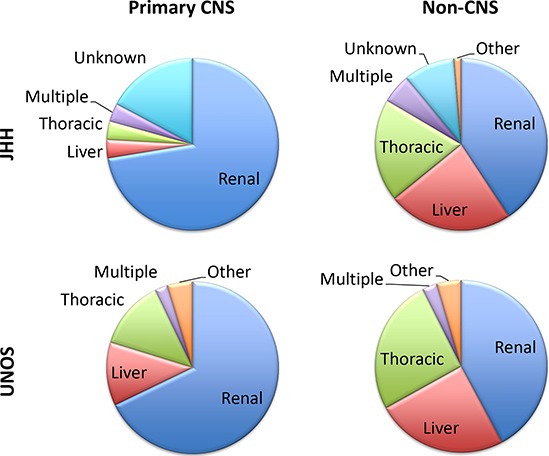
Figure 1
Figure 1. Distribution of PTLD cases according to type of transplanted organ for both JHH and UNOS-OPTN datasets
PCNS PTLD was more strongly associated with renal transplant than expected based on the number of renal transplants performed (59% of all solid organ transplants) with a similar trend in both the JHH and UNOS-OPTN datasets. Non-CNS PTLD occurred more often in liver and thoracic transplant patients including heart, lung and combined heart/lung recipients, similar to previous reports [1].
Figure 2
Figure 2. The incidence of PCNS lymphoproliferative disease is rising
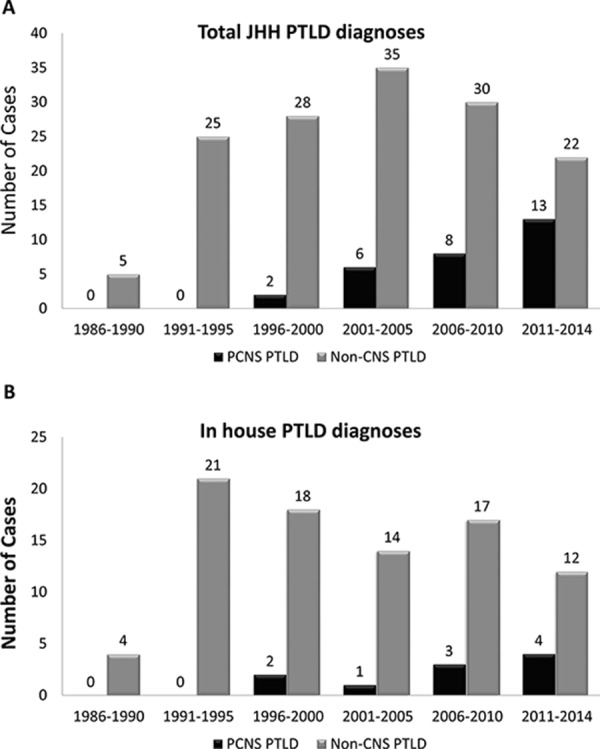
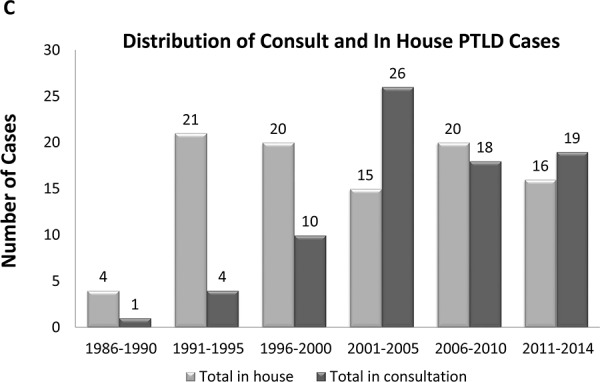
While the number of PTLD cases seen in consultation also increased since 1995, they have remained stable over the past 15 years. Evaluation of all PTLD cases diagnosed over a 28-year period at our institution (10/1986–8/2014) demonstrated a rise in the absolute and relative incidence of PCNS lymphoproliferative disease compared to non-CNS sites A. A similar trend was observed when considering only in house (surgical pathology and autopsy) PTLD cases B. While the number of PTLD cases seen in consultation also increased since 1995, they have remained stable over the past 15 years C. Two of the 3 patients with secondary involvement of the CNS from a systemic PTLD were diagnosed between 1986 and 1997 and one between 1998 and 2014. No rise in secondary CNS involvement of PTLD was identified in this study.
Figure 2
Figure 2. The incidence of PCNS lymphoproliferative disease is rising
While the number of PTLD cases seen in consultation also increased since 1995, they have remained stable over the past 15 years. Evaluation of all PTLD cases diagnosed over a 28-year period at our institution (10/1986–8/2014) demonstrated a rise in the absolute and relative incidence of PCNS lymphoproliferative disease compared to non-CNS sites A. A similar trend was observed when considering only in house (surgical pathology and autopsy) PTLD cases B. While the number of PTLD cases seen in consultation also increased since 1995, they have remained stable over the past 15 years C. Two of the 3 patients with secondary involvement of the CNS from a systemic PTLD were diagnosed between 1986 and 1997 and one between 1998 and 2014. No rise in secondary CNS involvement of PTLD was identified in this study.
Figure 3
Figure 3. Primary CNS and non-CNS PTLD were predominantly large B-cell lymphomas
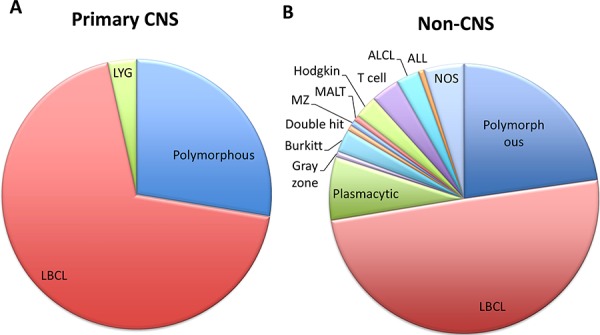
Seventy-two percent of PCNS PTLD were monomorphic, including one case of lymphomatoid granulomatosis (LyG), an aggressive and angiodestructive form of B-cell lymphoma, and the remainder were large B-cell lymphomas (LBCL), A. Non-CNS PTLDs were 77% monomorphic, within which they were more morphologically diverse compared to PCNS PTLD B. While LyG was not seen in the set of non-CNS PTLD cases in this series, it has been reported in the post-transplant setting with either systemic or primary CNS involvement [49, 50]. Not otherwise specified (NOS) refers to diagnoses rendered as “PTLD” or “atypical lymphocytic proliferation consistent with PTLD” where the slides were not available for further subclassification. Additional abbreviations: anaplastic large cell lymphoma (ALCL) and acute lymphoblastic leukemia (ALL).
Figure 4
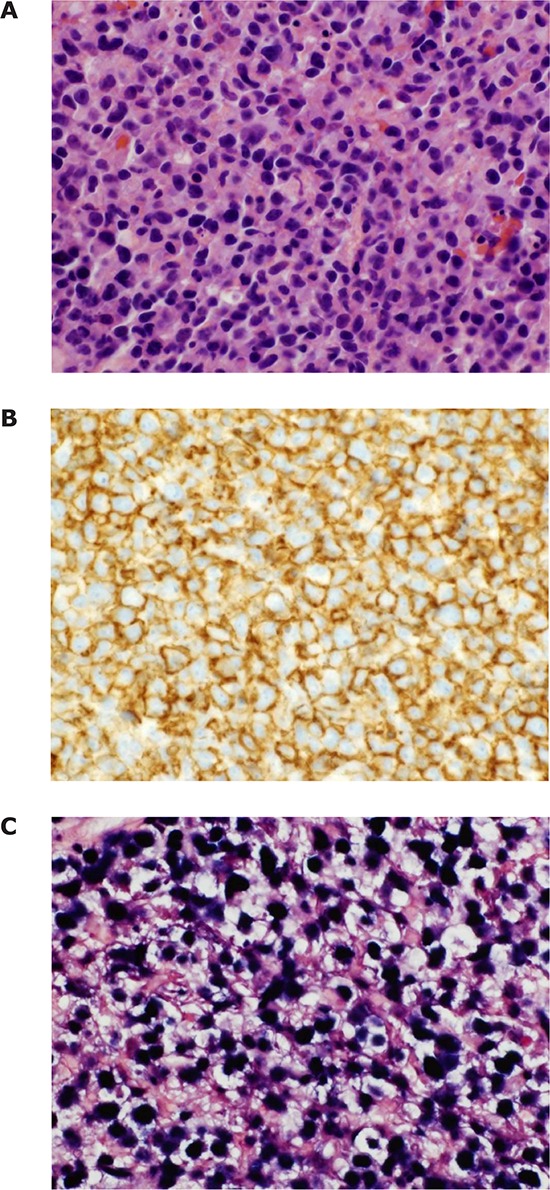
Figure 4. Histopathologic features of a monomorphic PCNS PTLD with large B-cell morphology
This PTLD arose in a patient on a more recently introduced renal transplant regimen, including belatacept and MMF, designed to be given in the absence of CNIs. The brain parenchyma is diffusely replaced by a cellular infiltrate with atypical lymphoid cells that are predominantly large cells with vesicular chromatin and have a sheet-like growth pattern (A. H&E, 400X) with surrounding necrosis (not shown). The atypical cells are diffusely positive for CD20 (B. 400X) and EBV as detected by in situ hybridization for EBV-Barr virus encoded small RNAs (EBER). (C. 400X).
Figure 5
Figure 5. PCNS PTLD was more strongly associated with EBV than disease arising within other sites
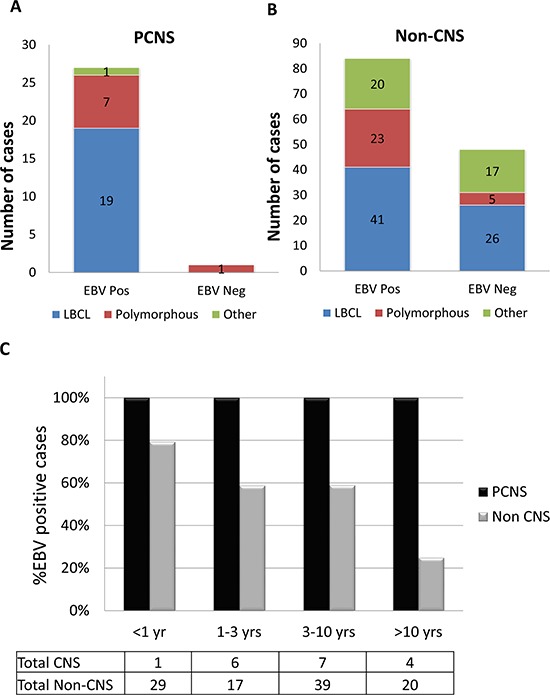
Nearly all PCNS PTLD cases were EBV-positive (96%), A. compared to 64% of cases arising in non-CNS sites B. (Chi square test, p < 0.005). Differences in EBV status between PCNS and non-CNS cases were not attributable to differences morphologic type. Where time from transplant was known, PCNS PTLDs were EBV-associated, while in non-CNS cases, the fraction of EBV-negative cases increased with time from transplant C. The total number of cases of each PTLD for which both time from transplant and EBV status were known is tabulated.
Figure 6
Figure 6. Drugs included in the immunosuppressive regimens of JHH and UNOS-OPTN patients
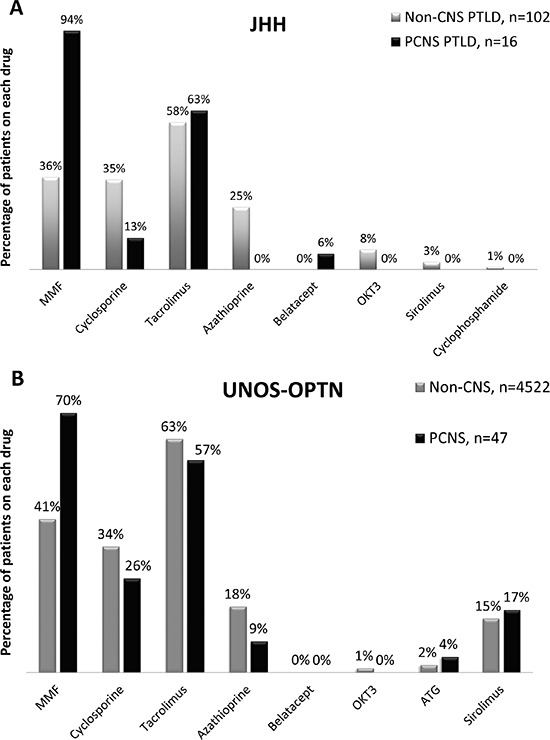
JHH PTLD patients who developed PCNS PTLD A. were significantly more likely to be taking MMF (15/16) compared to patients who developed non-CNS PTLD (37/102, p < 0.0001). Analysis of a larger UNOS-OPTN datafile also identified an association with inclusion of MMF in the immunosuppressive drug regimen and PCNS compared to non-CNS disease B. Percentages are greater than 100% as the majority of patients were on multi-drug regimens. The total number of patients with drug data available is indicated. Data for less common drugs were not tabulated. The majority of patients were taking prednisone prior to diagnosis (not shown).
Figure 7
Figure 7. Standard MMF dosing did not vary between patient groups
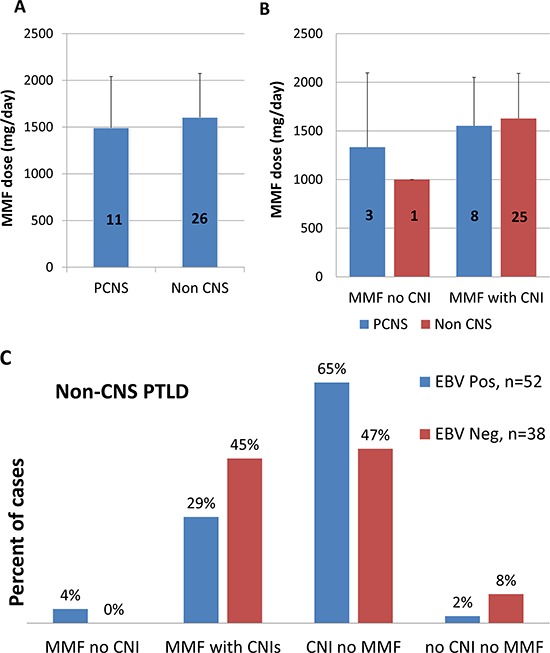
JHH patients who developed PCNS versus non-CNS PTLD did not differ significantly in the dose of MMF that they received A. Similarly, MMF dosing did not differ significantly between patients who received MMF without CNIs compared to MMF with CNIs in either PCNS or non-CNS sites B. The number of cases for which data were available is indicated on each bar. Both recommended and recorded MMF dosing in children differed substantially from that recommended for immunosuppression in the adult. Children were, therefore, excluded from this portion of the analysis. This resulted in the exclusion of 4 children (ages 2–10) from the non-CNS cases, and zero children from the PCNS cases. While both EBV and MMF were significantly associated with PCNS PTLD, no clear association between the drug regimen and EBV was identified in non-CNS PTLD patients C. There was no evidence for a protective effect of CNIs against the development of EBV-associated PTLD in non-CNS sites.
Figure 8
Figure 8. A logistic regression model of the UNOS-OPTN data demonstrates a protective effect of CNIs against PCNS PTLD and an independent association of PCNS PTLD with MMF
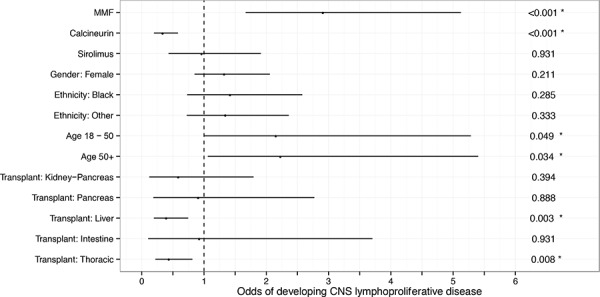
Using Firth's penalized regression method, the odds of PCNS disease were significantly higher for patients taking MMF compared to those not taking MMF regardless of whether they were taking a CNI or their age, sex or transplant type. Patients taking CNIs had significantly reduced odds of PCNS PTLD compared to patients not taking CNIs. Evaluation of transplant type demonstrated significantly reduced odds of PCNS PTLD in liver and thoracic transplant recipients compared to kidney recipients. Age was divided into categories of age < 18, age 18–50 and age > 50 with age 18–50 or > 50 conferring borderline increased risk of PCNS PTLD compared to age < 18. Gender and ethnicity differences did not alter odds of PCNS PTLD.

References

    1. Opelz G, Döhler B. Lymphomas after solid organ transplantation: a collaborative transplant study report. American journal of transplantation : official journal of the American Society of Transplantation and the American Society of Transplant Surgeons. 2004;4:222–230. - PubMed
    1. Opelz G, Henderson R. Incidence of non-Hodgkin lymphoma in kidney and heart transplant recipients. Lancet. 1993;342:1514–1516. - PubMed
    1. Cherikh WS, Kauffman HM, McBride MA, Maghirang J, Swinnen LJ, Hanto DW. Association of the type of induction immunosuppression with posttransplant lymphoproliferative disorder, graft survival, and patient survival after primary kidney transplantation. Transplantation. 2003;76:1289–1293. - PubMed
    1. Swinnen LJ, Costanzo-Nordin MR, Fisher SG, O'Sullivan EJ, Johnson MR, Heroux AL, Dizikes GJ, Pifarre R, Fisher RI. Increased incidence of lymphoproliferative disorder after immunosuppression with the monoclonal antibody OKT3 in cardiac-transplant recipients. The New England journal of medicine. 1990;323:1723–1728. - PubMed
    1. Caillard S, Dharnidharka V, Agodoa L, Bohen E, Abbott K. Posttransplant lymphoproliferative disorders after renal transplantation in the United States in era of modern immunosuppression. Transplantation. 2005;80:1233–1243. - PubMed

Publication types

MeSH terms

LinkOut - more resources