


Integration of a Radiosensitivity Molecular Signature Into the Assessment of Local Recurrence Risk in Breast Cancer
- PMID: 26461005
- PMCID: PMC5811194
- DOI: 10.1016/j.ijrobp.2015.06.021
Integration of a Radiosensitivity Molecular Signature Into the Assessment of Local Recurrence Risk in Breast Cancer
Abstract
Purpose: Recently, we developed radiosensitivity (RSI), a clinically validated molecular signature that estimates tumor radiosensitivity. In the present study, we tested whether integrating RSI with the molecular subtype refines the classification of local recurrence (LR) risk in breast cancer.
Methods and materials: RSI and molecular subtype were evaluated in 343 patients treated with breast-conserving therapy that included whole-breast radiation therapy with or without a tumor bed boost (dose range 45-72 Gy). The follow-up period for patients without recurrence was 10 years. The clinical endpoint was LR-free survival.
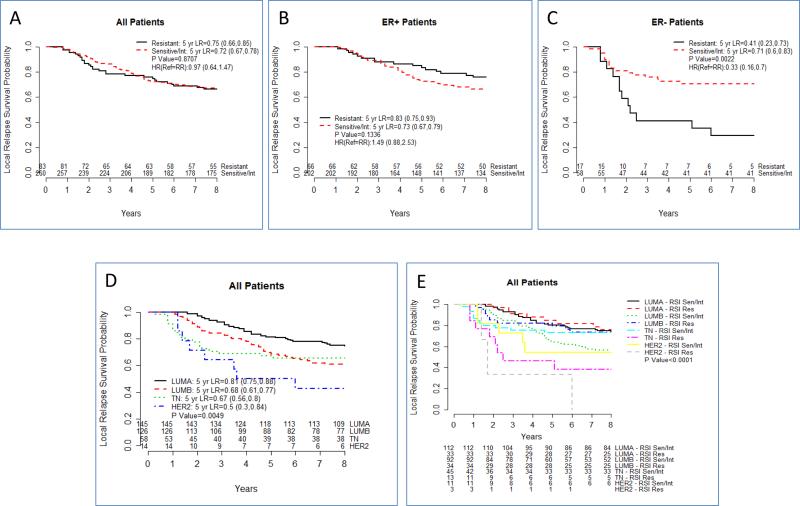
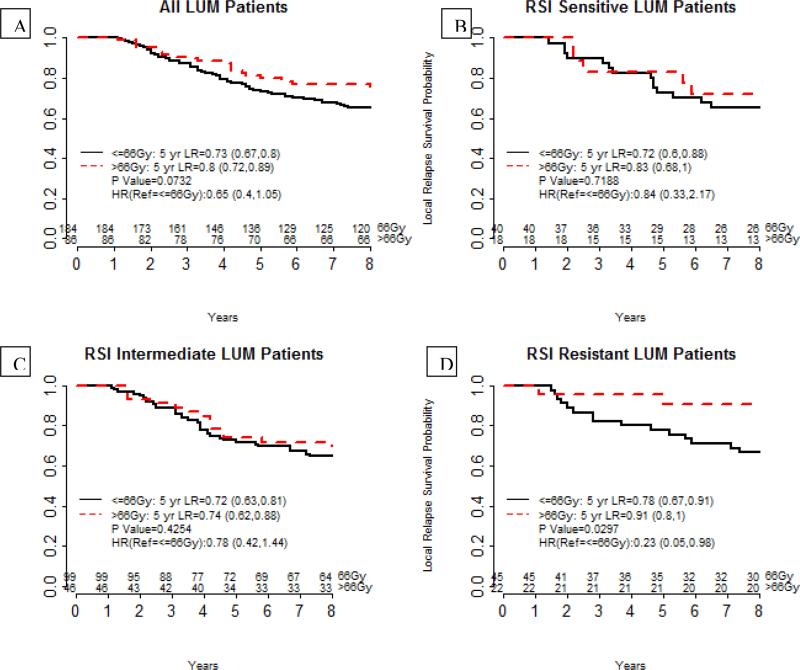
Results: Although RSI did not uniformly predict for LR across the entire cohort, combining RSI and the molecular subtype identified a subpopulation with an increased risk of LR: triple negative (TN) and radioresistant (reference TN-radioresistant, hazard ratio [HR] 0.37, 95% confidence interval [CI] 0.15-0.92, P=.02). TN patients who were RSI-sensitive/intermediate had LR rates similar to those of luminal (LUM) patients (HR 0.86, 95% CI 0.47-1.57, P=.63). On multivariate analysis, combined RSI and molecular subtype (P=.004) and age (P=.001) were the most significant predictors of LR. In contrast, integrating RSI into the LUM subtype did not identify additional risk groups. We hypothesized that radiation dose escalation was affecting radioresistance in the LUM subtype and serving as a confounder. An increased radiation dose decreased LR only in the luminal-resistant (LUM-R) subset (HR 0.23, 95% CI 0.05-0.98, P=.03). On multivariate analysis, the radiation dose was an independent variable only in the LUMA/B-RR subset (HR 0.025, 95% CI 0.001-0.946, P=.046), along with age (P=.008), T stage (P=.004), and chemotherapy (P=.008).
Conclusions: The combined molecular subtype-RSI identified a novel molecular subpopulation (TN and radioresistant) with an increased risk of LR after breast-conserving therapy. We propose that the combination of RSI and molecular subtype could be useful in guiding radiation therapy-based decisions in breast cancer.
Copyright © 2015 Elsevier Inc. All rights reserved.
Figures
Comment in
-
Radiosensitivity in the breast cancer management scenario: another step forward?J Thorac Dis. 2016 Oct;8(10):E1361-E1363. doi: 10.21037/jtd.2016.10.24. J Thorac Dis. 2016. PMID: 27867628 Free PMC article. No abstract available.
References
-
- Fisher B, Anderson S, Bryant J, Margolese RG, Deutsch M, Fisher ER, Jeong JH, Wolmark N. Twenty-year follow-up of a randomized trial comparing total mastectomy, lumpectomy, and lumpectomy plus irradiation for the treatment of invasive breast cancer. N Engl J Med. 2002 Oct 17;347(16):1233–41. - PubMed
-
- Clarke M, Collins R, Darby S, Davies C, Elphinstone P, Evans E, Godwin J, Gray R, Hicks C, James S, MacKinnon E, McGale P, McHugh T, Peto R, Taylor C, Wang Y. Effects of radiotherapy and of differences in the extent of surgery for early breast cancer on local recurrence and 15-year survival: an overview of the randomised trials. Lancet. 2005 Dec 17;366(9503):2087–106. - PubMed
-
- Darby S, McGale P, Correa C, Taylor C, Arriagada R, Clarke M, Cutter D, Davies C, Ewertz M, Godwin J, Gray R, Pierce L, Whelan T, Wang Y, Peto R. Effect of radiotherapy after breast-conserving surgery on 10-year recurrence and 15-year breast cancer death: meta-analysis of individual patient data for 10,801 women in 17 randomised trials. Lancet. 2011 Nov 12;378(9804):1707–16. - PMC - PubMed
-
- Bartelink H, Horiot JC, Poortmans PM, Struikmans H, Van den Bogaert W, Fourquet A, Jager JJ, Hoogenraad WJ, Oei SB, Warlam-Rodenhuis CC, Pierart M, Collette L. Impact of a higher radiation dose on local control and survival in breast-conserving therapy of early breast cancer: 10-year results of the randomized boost versus no boost EORTC 22881-10882 trial. J Clin Oncol. 2007 Aug 1;25(22):3259–65. - PubMed
-
- Eschrich SA, Pramana J, Zhang H, Zhao H, Boulware D, Lee JH, Bloom G, Rocha-Lima C, Kelley S, Calvin DP, Yeatman TJ, Begg AC, Torres-Roca JF. A gene expression model of intrinsic tumor radiosensitivity: prediction of response and prognosis after chemoradiation. Int J Radiat Oncol Biol Phys. 2009 Oct 1;75(2):489–96. - PMC - PubMed
Publication types
MeSH terms
Substances
Grants and funding
LinkOut - more resources
Full Text Sources
Other Literature Sources
Medical
Miscellaneous
