VSL#3 induces and maintains short-term clinical response in patients with active microscopic colitis: a two-phase randomised clinical trial
- PMID: 26462271
- PMCID: PMC4599154
- DOI: 10.1136/bmjgast-2014-000018
VSL#3 induces and maintains short-term clinical response in patients with active microscopic colitis: a two-phase randomised clinical trial
Abstract
Background: The probiotic mixture VSL#3 has proven efficacious in inflammatory bowel diseases and irritable bowel syndrome; however, its efficacy in microscopic colitis (MC) is being investigated.
Objective: To evaluate the safety and efficacy of a multistrain probiotic, VSL#3, in inducing clinical remission and achieving clinical response, as compared with mesalamine, in patients with active MC.
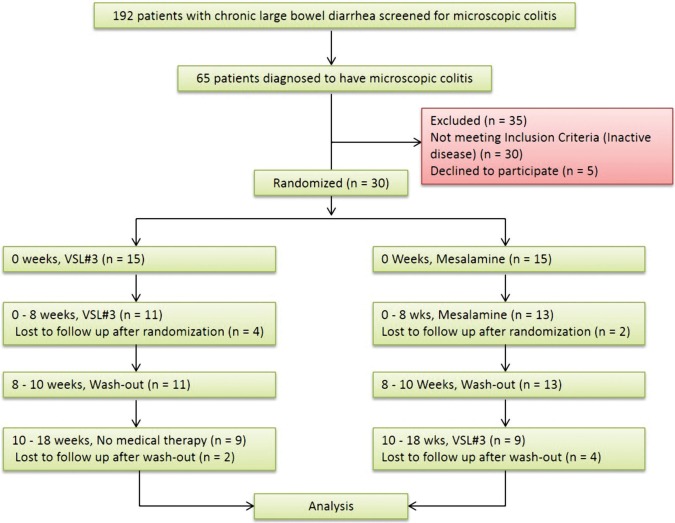
Methods: A randomised, open labelled study comparing the efficacy of 900 billion colony-forming units/day of VSL#3 (group (Gp) A) or 1.6 g of mesalamine/day (Gp B) for 8 weeks in 30 patients with MC was conducted. After a washout period of 2 weeks, Gp B received 8 weeks of VSL#3 and Gp A was off medication for the next 8 weeks. The primary end points were clinical remission and clinical response at 8 weeks.
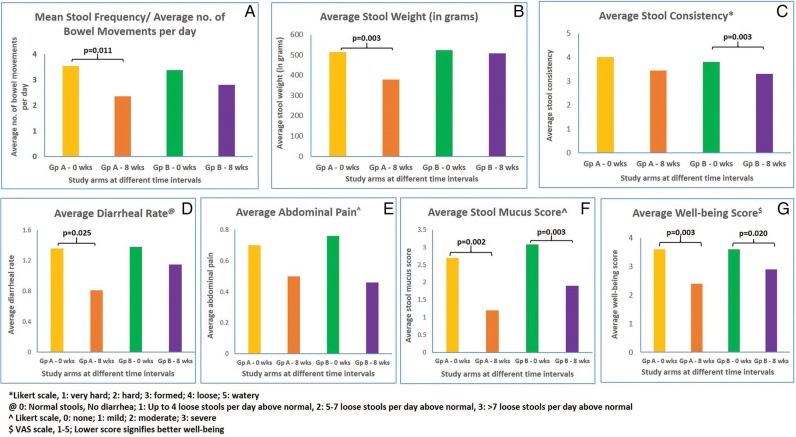
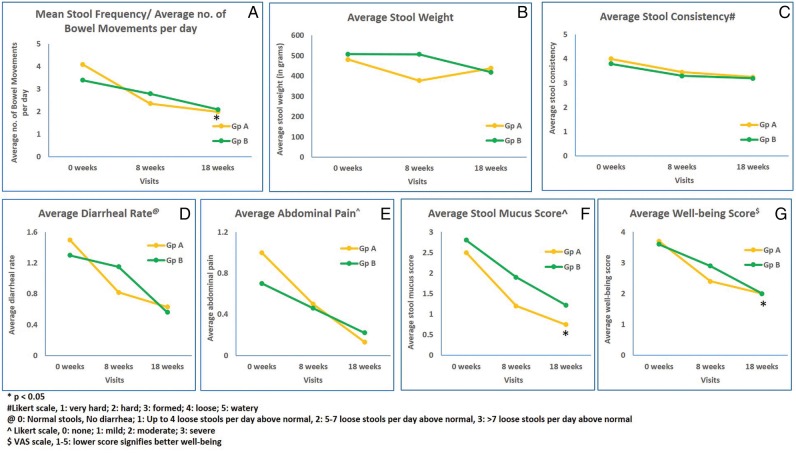
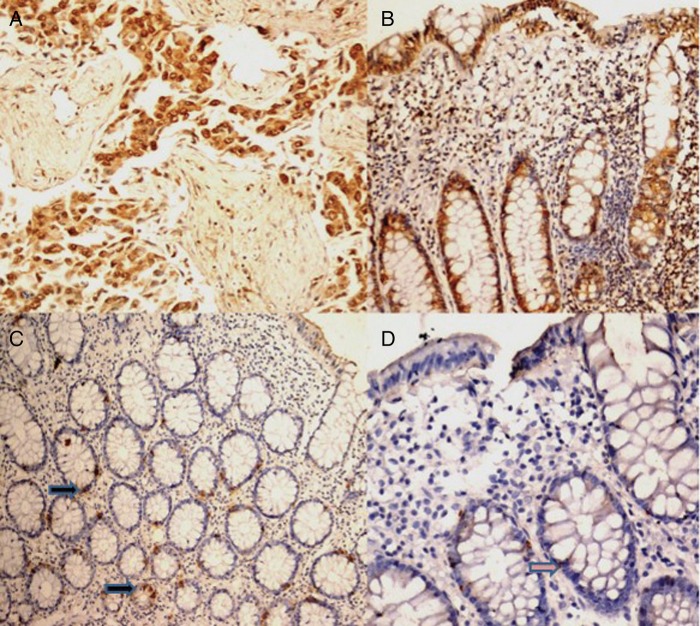
Results: Of 30 patients, 15 were randomised in each arm. 11 patients in Gp A and 13 patients in Gp B completed 8 weeks of treatment. 5 (46%) of 11 patients in Gp A and 1 (8%) of 13 patients in Gp B attained clinical remission (p=0.022). Clinical response was seen in Gp A, as evidenced by a lower stool weight (377.6±104.5 g) as compared with Gp B (507±168.2 g; p=0.03). VSL#3 was effective in maintaining clinical response up to 10 weeks, even after discontinuation of therapy. Secondary end points like stool parameters, histology and well-being improved in both treatment groups.
Conclusions: The probiotic VSL#3 was found to offer the benefit of inducing as well as maintaining short-term clinical response in patients with active MC.
Trial registration number: The clinical trial is registered with CLINICAL TRIAL REGISTRY INDIA; http://ctri.nic.in, CTRI No. "CTRI/2008/091/000086" (registered on: 23/06/2008).
Keywords: 5-AMINOSALICYLIC ACID (5-ASA); MICROSCOPIC COLITIS; PROBIOTICS.
Figures
References
-
- Pardi DS. Microscopic colitis: an update. Inflamm Bowel Dis 2004;10:860–70. doi:10.1097/00054725-200411000-00020 - DOI - PubMed
-
- Chang F, Deere H, Vu C. Atypical forms of microscopic colitis: morphological features and review of the literature. Adv Anat Pathol 2005;12:203–11. doi:10.1097/01.pap.0000175115.63165.6b - DOI - PubMed
-
- Goldstein NS, Bhanot P. Paucicellular and asymptomatic lymphocytic colitis: expanding the clinicopathologic spectrum of lymphocytic colitis. Am J Clin Pathol 2004;122:405–11. doi:10.1309/3FBBCY4TVUYECD55 - DOI - PubMed
-
- Warren BF, Edwards CM, Travis SP ‘Microscopic colitis’: classification and terminology. Histopathology 2002;40:374–6. doi:10.1046/j.1365-2559.2002.01341.x - DOI - PubMed
-
- Falodia S, Makharia GK, Sateesh J, et al. Spectrum of microscopic colitis in a tertiary care centre in India. Trop Gastroenterol 2007;28:121–5. - PubMed
LinkOut - more resources
Full Text Sources
Other Literature Sources