Tacrolimus or infliximab for severe ulcerative colitis: short-term and long-term data from a retrospective observational study
- PMID: 26462273
- PMCID: PMC4599165
- DOI: 10.1136/bmjgast-2014-000021
Tacrolimus or infliximab for severe ulcerative colitis: short-term and long-term data from a retrospective observational study
Abstract
Objective: Treatment of severe ulcerative colitis (UC) is challenging. Although the efficacy of tacrolimus (TAC) and infliximab (IFX) have been evaluated in patients with severe UC, the safety and efficacy levels of sequential therapies (TAC→IFX/IFX→TAC) in these patients remain unclear. The aim of this study was to assess short-term and long-term outcomes in patients with severe UC treated with TAC and IFX.
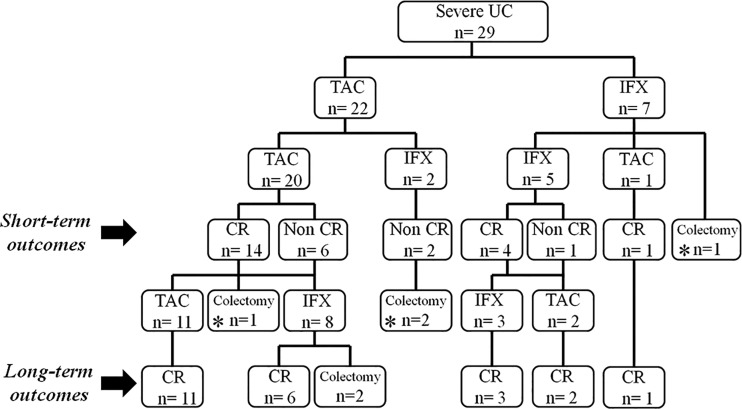
Methods: From October 2001 to February 2014, 29 patients with consecutive severe UC treated with TAC or IFX were retrospectively evaluated. Median follow-up duration was 27 months (range 0.5-118 months). The primary end point was short-term outcomes at 8 weeks after induction of TAC (TAC group, n=22) or IFX (IFX group, n=7). The secondary end point included long-term outcomes and colectomy-free survival. The clinical response was evaluated based on a partial Mayo score.
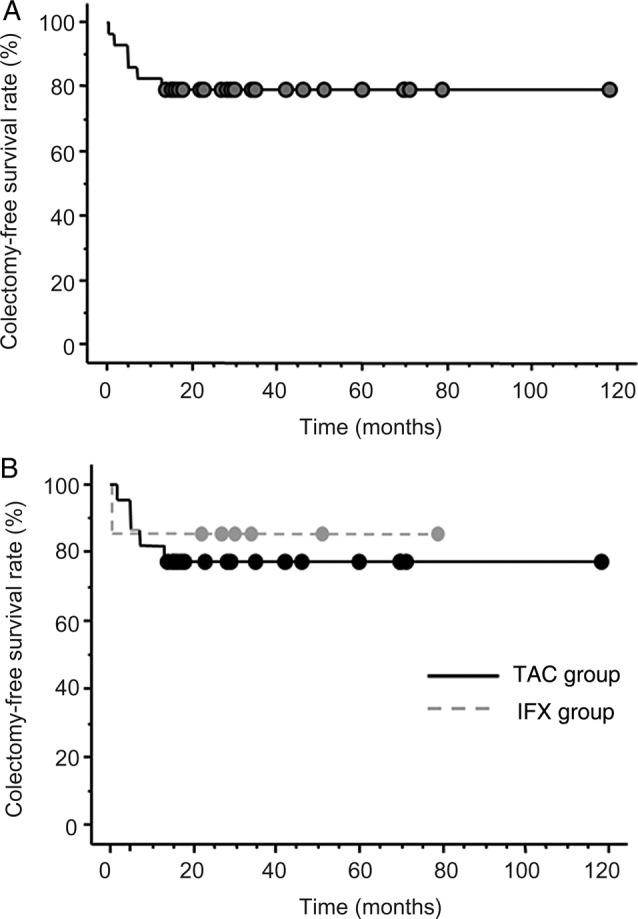
Results: The clinical remission (CR) rate at 8 weeks in the TAC and IFX groups was 63.6% and 71.4%, respectively. In 13 of the 29 patients (10 in the TAC group, 3 in the IFX group), sequential therapies were used in their clinical courses. In 9 of these 13 patients (6 in the TAC group, 3 in the IFX group), CR was achieved and maintained by sequential therapies. Overall cumulative colectomy-free survival was 79.3% at 118 months.
Conclusions: TAC and IFX had similar effects on remission induction in patients with severely active UC. Sequential therapies could rescue patients with UC who failed initial treatment with TAC or IFX. In clinical practice, sequential therapies might be deliberately performed.
Keywords: IBD CLINICAL; INFLAMMATORY BOWEL DISEASE; ULCERATIVE COLITIS.
Figures
References
-
- Baumgart DC, Sandborn WJ. Inflammatory bowel disease: clinical aspects and established and evolving therapies. Lancet 2007;369:1641–57. doi:10.1016/S0140-6736(07)60751-X - DOI - PubMed
-
- Dnesen LC, Walsh AJ, Protic MN, et al. The pattern and outcome of acute severe colitis. J Crohns Colitis 2010;4:431–7. doi:10.1016/j.crohns.2010.02.001 - DOI - PubMed
-
- Turner D, Walsh CM, Steinhart AH, et al. Response to corticosteroids in severe ulcerative colitis: a systematic review of the literature and a meta-regression. Clin Gastroenterol Hepatol 2007;5:103–10. doi:10.1016/j.cgh.2006.09.033 - DOI - PubMed
-
- Lichtiger S, Present DH, Kornbluth A, et al. Cyclosporine in severe ulcerative colitis refractory to steroid therapy. N Engl J Med 1994;330:1841–5. doi:10.1056/NEJM199406303302601 - DOI - PubMed
-
- D'Haens G, Lemmens L, Geboes K, et al. Intravenous cyclosporine versus intravenous corticosteroids as single therapy for severe attacks of ulcerative colitis. Gastroenterology 2001;120:1323–9. doi:10.1053/gast.2001.23983 - DOI - PubMed
LinkOut - more resources
Full Text Sources
Other Literature Sources