


The evolutionary dynamics of haplodiploidy: Genome architecture and haploid viability
- PMID: 26462452
- PMCID: PMC4989469
- DOI: 10.1111/evo.12792
The evolutionary dynamics of haplodiploidy: Genome architecture and haploid viability
Abstract
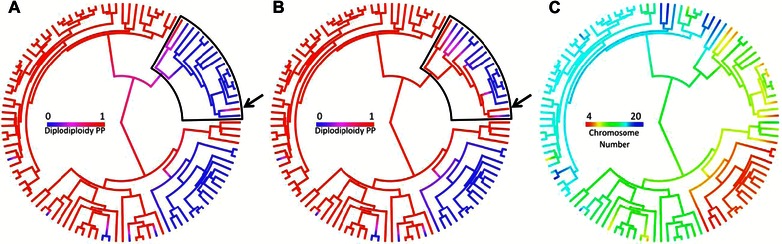
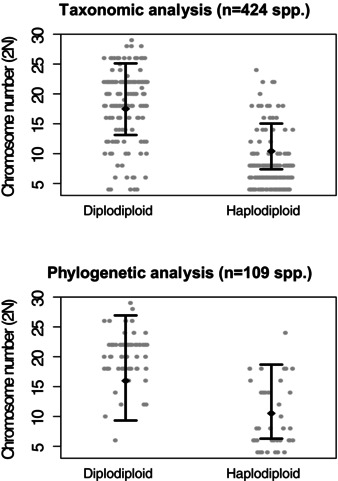
Haplodiploid reproduction, in which males are haploid and females are diploid, is widespread among animals, yet we understand little about the forces responsible for its evolution. The current theory is that haplodiploidy has evolved through genetic conflicts, as it provides a transmission advantage to mothers. Male viability is thought to be a major limiting factor; diploid individuals tend to harbor many recessive lethal mutations. This theory predicts that the evolution of haplodiploidy is more likely in male heterogametic lineages with few chromosomes, as genes on the X chromosome are often expressed in a haploid environment, and the fewer the chromosome number, the greater the proportion of the total genome that is X-linked. We test this prediction with comparative phylogenetic analyses of mites, among which haplodiploidy has evolved repeatedly. We recover a negative correlation between chromosome number and haplodiploidy, find evidence that low chromosome number evolved prior to haplodiploidy, and that it is unlikely that diplodiploidy has reevolved from haplodiploid lineages of mites. These results are consistent with the predicted importance of haploid male viability.
Keywords: Acari; chromosomal evolution; haplodiploidy; reproductive strategies; sex determination.
© 2015 The Author(s). Evolution published by Wiley Periodicals, Inc. on behalf of The Society for the Study of Evolution.
Figures
References
-
- Borgia, G. 1980. Evolution of haplodiploidy – models for inbred and outbred systems. Theor. Popul. Biol. 17:103–128. - PubMed
-
- Bull, J. 1979. An advantage for the evolution of male haploidy and systems with similar genetic transmission. Heredity 43:361–381.
-
- Bull, J. J. 1983. The evolution of sex determining mechanisms. Benjamin Cummings, Menlo Park, CA.
Publication types
MeSH terms
LinkOut - more resources
Full Text Sources
Other Literature Sources