


Associations of circulating plasma microRNAs with age, body mass index and sex in a population-based study
- PMID: 26462558
- PMCID: PMC4604724
- DOI: 10.1186/s12920-015-0136-7
Associations of circulating plasma microRNAs with age, body mass index and sex in a population-based study
Abstract
Background: Non-cellular blood circulating microRNAs (plasma miRNAs) represent a promising source for the development of prognostic and diagnostic tools owing to their minimally invasive sampling, high stability, and simple quantification by standard techniques such as RT-qPCR. So far, the majority of association studies involving plasma miRNAs were disease-specific case-control analyses. In contrast, in the present study, plasma miRNAs were analysed in a sample of 372 individuals from a population-based cohort study, the Study of Health in Pomerania (SHIP).
Methods: Quantification of miRNA levels was performed by RT-qPCR using the Exiqon Serum/Plasma Focus microRNA PCR Panel V3.M covering 179 different miRNAs. Of these, 155 were included in our analyses after quality-control. Associations between plasma miRNAs and the phenotypes age, body mass index (BMI), and sex were assessed via a two-step linear regression approach per miRNA. The first step regressed out the technical parameters and the second step determined the remaining associations between the respective plasma miRNA and the phenotypes of interest.
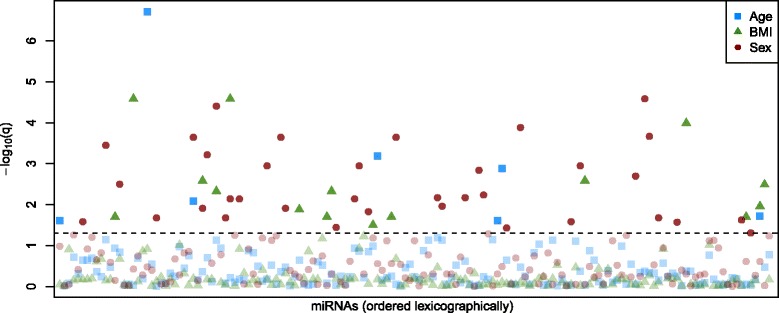
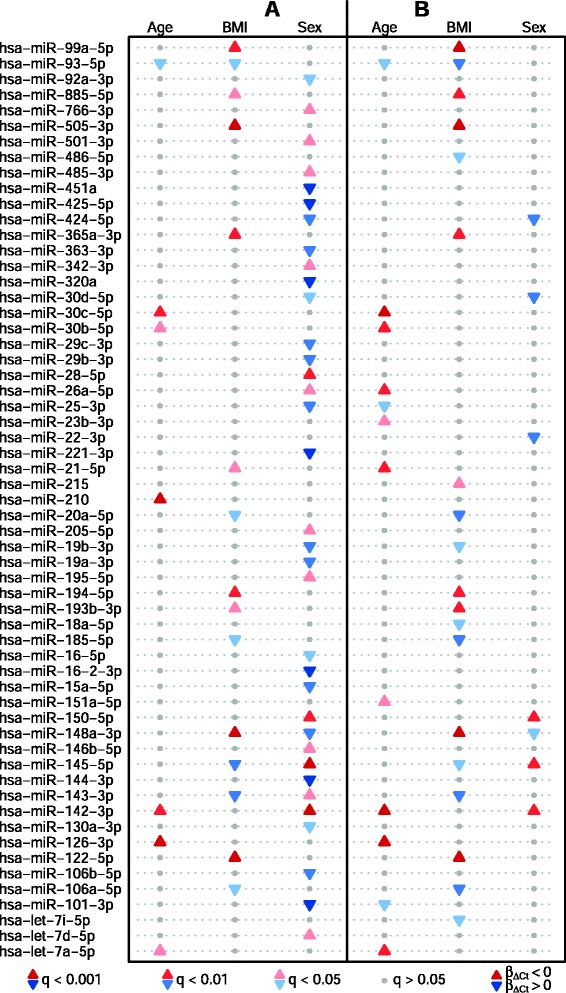
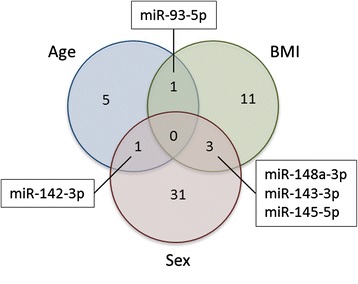
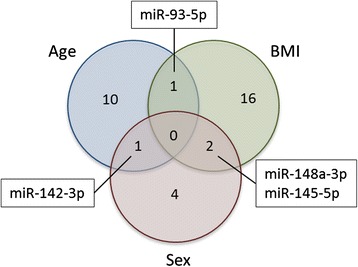
Results: After regressing out technical parameters and adjusting for the respective other two phenotypes, 7, 15, and 35 plasma miRNAs were significantly (q < 0.05) associated with age, BMI, and sex, respectively. Additional adjustment for the blood cell parameters identified 12 and 19 miRNAs to be significantly associated with age and BMI, respectively. Most of the BMI-associated miRNAs likely originate from liver. Sex-associated differences in miRNA levels were largely determined by differences in blood cell parameters. Thus, only 7 as compared to originally 35 sex-associated miRNAs displayed sex-specific differences after adjustment for blood cell parameters.
Conclusions: These findings emphasize that circulating miRNAs are strongly impacted by age, BMI, and sex. Hence, these parameters should be considered as covariates in association studies based on plasma miRNA levels. The established experimental and computational workflow can now be used in future screening studies to determine associations of plasma miRNAs with defined disease phenotypes.
Figures
References
-
- De Guire V, Robitaille R, Tetreault N, Guerin R, Menard C, Bambace N, et al. Circulating miRNAs as sensitive and specific biomarkers for the diagnosis and monitoring of human diseases: promises and challenges. Clin Biochem. 2013;46(10-11):846–60. doi: 10.1016/j.clinbiochem.2013.03.015. - DOI - PubMed
Publication types
MeSH terms
Substances
LinkOut - more resources
Full Text Sources
Other Literature Sources
Medical
