


Gonadotropin-Releasing Hormone Agonist Cotreatment During Chemotherapy May Increase Pregnancy Rate in Survivors
- PMID: 26463871
- PMCID: PMC4718431
- DOI: 10.1634/theoncologist.2015-0223
Gonadotropin-Releasing Hormone Agonist Cotreatment During Chemotherapy May Increase Pregnancy Rate in Survivors
Abstract
Background: The use of gonadotropin-releasing hormone analogs (GnRHas) for fertility preservation is not unequivocally accepted. It is controversial whether GnRHa can increase the pregnancy rate in survivors.
Patients and methods: This is a retrospective cohort study. Every patient referred for fertility preservation was offered cryopreservation of embryos, ova, and ovarian tissue and GnRHa. The patients were consecutively included. The primary outcome was spontaneous pregnancies. The secondary outcome was cyclic ovarian function (COF) versus premature ovarian failure (POF). These outcomes were assessed 2 years or more after chemotherapy.
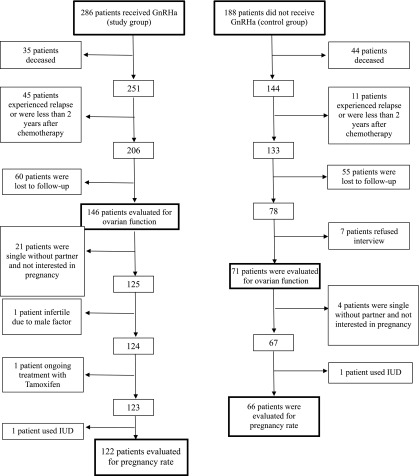
Results: We compared 286 patients who received gonadotropin-releasing hormone agonist (GnRHa) with chemotherapy with 188 patients who were treated with chemotherapy alone. Ovarian function could be determined in 217 patients. Overall, 87% (127 of 146) of the patients in the GnRHa group retained COF and 13% (19 of 146) suffered POF, whereas in the control group, 49% (35 of 71) experienced COF and 51% (36 of 71) suffered POF (p = .0001). The odds ratio (OR) for preserving COF was 6.87 for the patients who received GnRHa (95% confidence interval [CI] 3.4-13.4). Overall 60% (112 of 188) of the survivors conceived: 69.3% (84 of 122) of the patients in the GnRHa group compared with 42.4% (28 of 66) in the control group (p = .006). In the GnRHa group, 123 healthy newborns were delivered, versus 40 in the controls. Spontaneous pregnancies occurred in 65.6% (80 of 122) of the survivors in the GnRHa group versus 37.9% (25 of 66) in the control group (p = .0004, OR 3.12, 95% CI 1.7-5.8).
Conclusion: Adding GnRHa to chemotherapy significantly increases the OR for spontaneous conception, in addition to COF. It is suggested that GnRHa cotreatment should be added before and during gonadotoxic chemotherapy.
Implications for practice: The use of gonadotropin-releasing hormone analogs (GnRHa) for fertility preservation is not unequivocally accepted and is even controversial. This study compared 286 patients who received GnRHa with chemotherapy with 188 patients who were treated with chemotherapy alone. Ovarian function could be determined in 217 patients. The odds ratio for preserving cyclic ovarian function was 6.87 for the patients who received GnRHa. Furthermore, the total and spontaneous pregnancy rate was significantly higher for those who received the agonist (p = .006). Adding GnRHa to chemotherapy significantly increased the odds ratio for spontaneous conception, in addition to preserving regular ovarian function. It is suggested that GnRHa cotreatment should be administered to young women in conjunction with gonadotoxic chemotherapy.
Keywords: Fertility preservation; Gonadotropin-releasing hormone agonist; Pregnancies after gonadotoxic chemotherapy; Premature ovarian failure.
©AlphaMed Press.
Conflict of interest statement
Disclosures of potential conflicts of interest may be found at the end of this article.
Figures
Comment in
-
Temporary Ovarian Suppression With Gonadotropin-Releasing Hormone Agonist During Chemotherapy for Fertility Preservation: Toward the End of the Debate?Oncologist. 2015 Nov;20(11):1233-5. doi: 10.1634/theoncologist.2015-0373. Epub 2015 Oct 13. Oncologist. 2015. PMID: 26463868 Free PMC article.
References
-
- Blumenfeld Z, Katz G, Evron A. ‘An ounce of prevention is worth a pound of cure’: The case for and against GnRH-agonist for fertility preservation. Ann Oncol. 2014;25:1719–1728. - PubMed
-
- Blumenfeld Z. How to preserve fertility in young women exposed to chemotherapy?: The role of GnRH agonist in addition to cryopreservation of embryos, oocytes, or ovaries. The Oncologist. 2007;12:1044–1054. - PubMed
-
- Blumenfeld Z, von Wolff M. GnRH-analogues and oral contraceptives for fertility preservation in women during chemotherapy. Hum Reprod Update. 2008;14:543–552. - PubMed
MeSH terms
Substances
LinkOut - more resources
Full Text Sources
Other Literature Sources
Medical
