. 2016 Jan;67(1):207-25.
doi: 10.1093/jxb/erv449. Epub 2015 Oct 13.

Epigenomics and bolting tolerance in sugar beet genotypes

Affiliations

Epigenomics and bolting tolerance in sugar beet genotypes

Claire Hébrard et al. J Exp Bot. 2016 Jan.

Abstract

In sugar beet (Beta vulgaris altissima), bolting tolerance is an essential agronomic trait reflecting the bolting response of genotypes after vernalization. Genes involved in induction of sugar beet bolting have now been identified, and evidence suggests that epigenetic factors are involved in their control. Indeed, the time course and amplitude of DNA methylation variations in the shoot apical meristem have been shown to be critical in inducing sugar beet bolting, and a few functional targets of DNA methylation during vernalization have been identified. However, molecular mechanisms controlling bolting tolerance levels among genotypes are still poorly understood. Here, gene expression and DNA methylation profiles were compared in shoot apical meristems of three bolting-resistant and three bolting-sensitive genotypes after vernalization. Using Cot fractionation followed by 454 sequencing of the isolated low-copy DNA, 6231 contigs were obtained that were used along with public sugar beet DNA sequences to design custom Agilent microarrays for expression (56k) and methylation (244k) analyses. A total of 169 differentially expressed genes and 111 differentially methylated regions were identified between resistant and sensitive vernalized genotypes. Fourteen sequences were both differentially expressed and differentially methylated, with a negative correlation between their methylation and expression levels. Genes involved in cold perception, phytohormone signalling, and flowering induction were over-represented and collectively represent an integrative gene network from environmental perception to bolting induction. Altogether, the data suggest that the genotype-dependent control of DNA methylation and expression of an integrative gene network participate in bolting tolerance in sugar beet, opening up perspectives for crop improvement.

Keywords: Bolting tolerance; differentially expressed gene; differentially methylated region; epigenomics; microarray; sugar beet; vernalization..


Figures

Fig. 1.
Fig. 1.
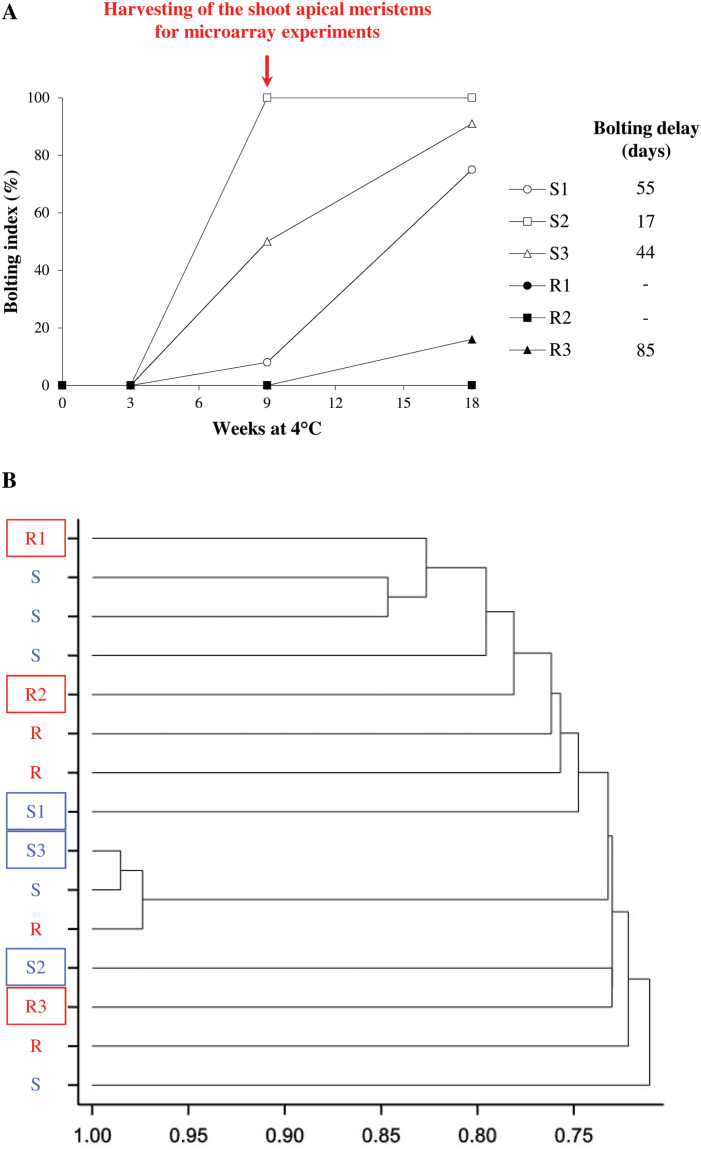
Characterization of the six sugar beet genotypes during vernalization. (A) Bolting index of genotypes after 0, 3, 9, or 18 weeks of vernalization treatment (4 °C). S1, S2, and S3 (open circles, squares, and triangles) were considered as bolting sensitive, while R1, R2, and R3 (filled circles, squares, and triangles) were considered as bolting resistant. On the right is indicated the bolting delay after 18 weeks of vernalization for each genotype. (B) Genetic clustering based on 708 single nucleotide polymorphisms for the three bolting-resistant (R1–R3) genotypes, the three bolting-sensitive (S1–S3) genotypes, and nine other genotypes with distinct bolting tolerance levels after 9 weeks of vernalization treatment.
Fig. 2.
Fig. 2.
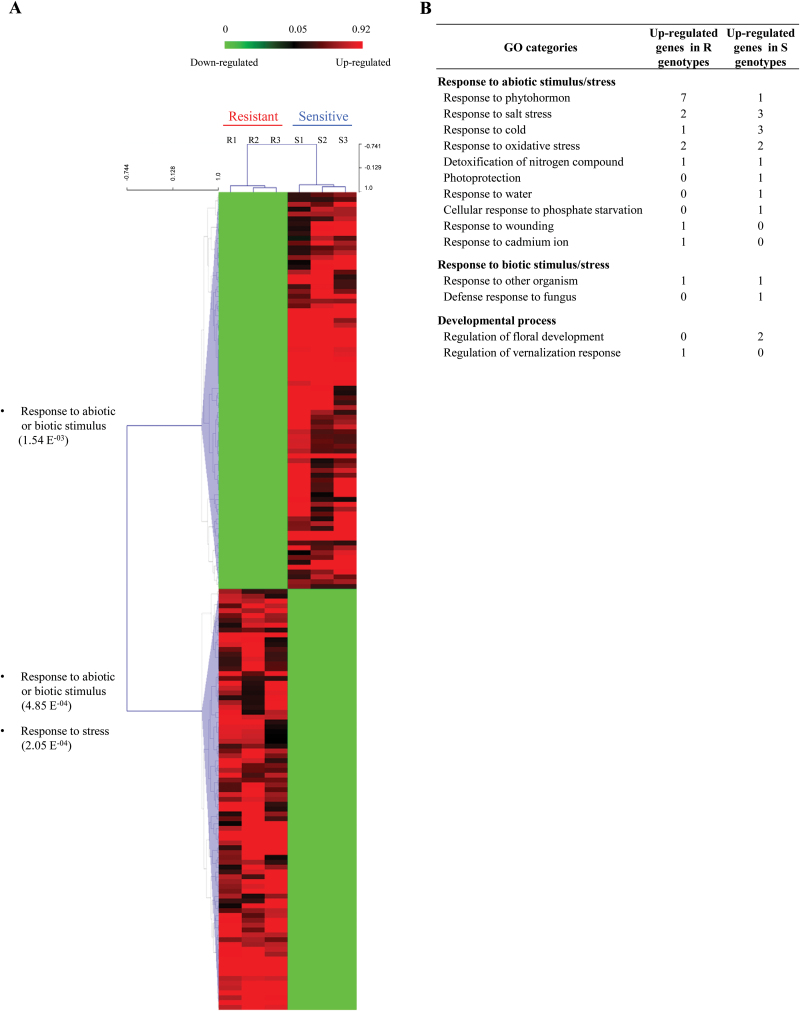
Transcriptomic characterization of the shoot apical meristem in sugar beet genotypes after vernalization. (A) Heatmap representation of the 169 differentially expressed genes (fold change R versus S >2 and t-test P-value <0.05) between bolting-resistant (R1–R3) and bolting-sensitive (S1–S3) genotypes after 9 weeks of vernalization treatment. On the left are indicated the main biological processes in which sequences could be involved and the corresponding P-value. (B) GO categories for genes involved in response to abiotic or biotic stimulus/stress and developmental process. (This figure is available in colour at JXB online.)
Fig. 3.
Fig. 3.
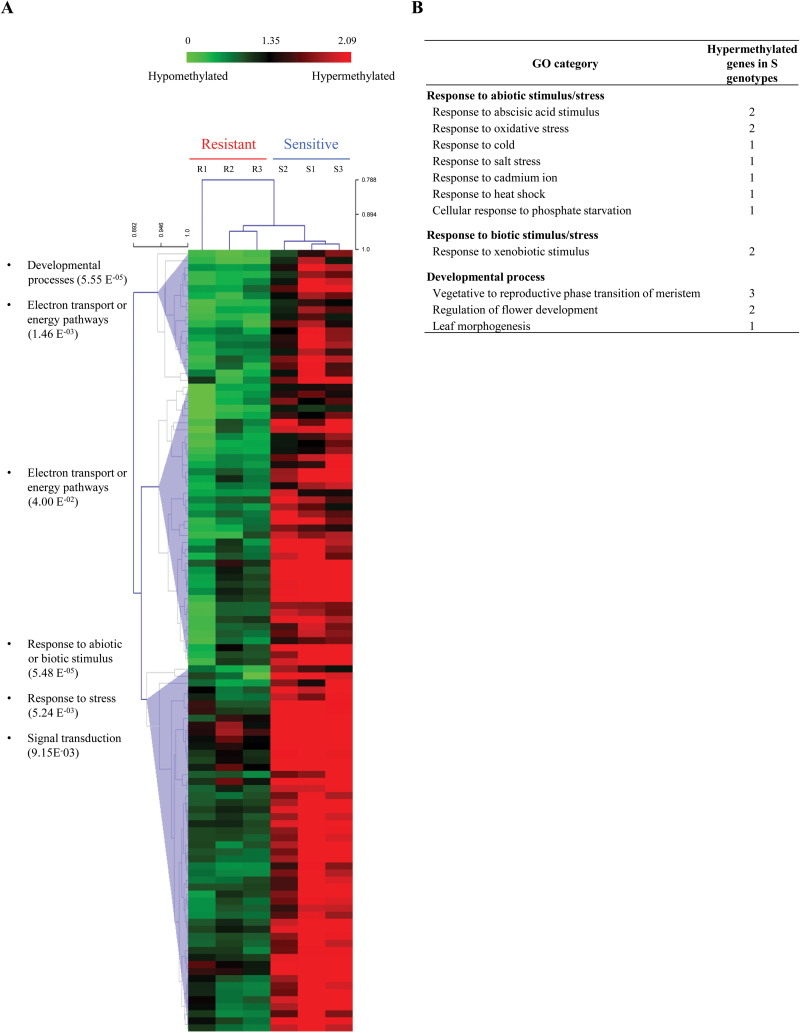
Methylation characterization of the shoot apical meristem in sugar beet genotypes after vernalization. (A) Heatmap representation of the 111 differentially methylated regions (fold change R versus S >2 and t-test P-value < 0.01) between bolting-resistant (R1–R3) and bolting-sensitive (S1–S3) genotypes after 9 weeks of vernalization treatment. On the left are indicated the main biological processes in which sequences could be involved and the corresponding P-value. (B) GO categories for genes involved in response to abiotic or biotic stimulus/stress and developmental process. (This figure is available in colour at JXB online.)
Fig. 4.
Fig. 4.
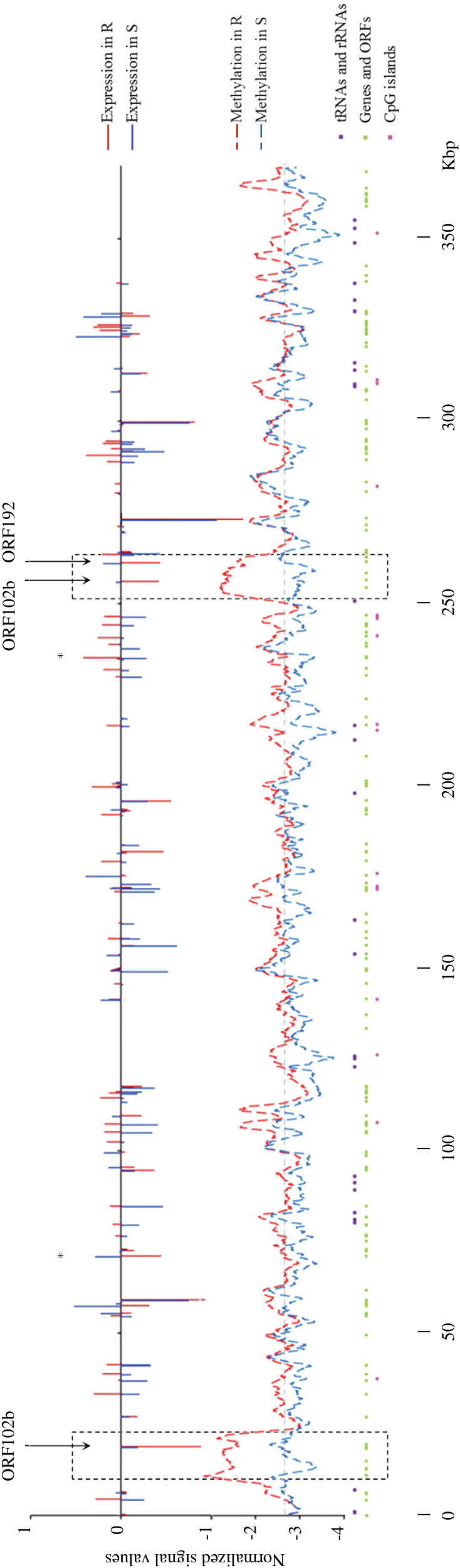
Expression and DNA methylation level analysis in the mitochondrial genome of sugar beet genotypes after vernalization. The three bolting-resistant (R, red lines) and the three bolting-sensitive (S, blue lines) genotypes have the same mitochondrial haplotype (‘O’ type, i.e. normal type mitochondrial genome leading to fertility, in contrast to the cytoplasmic male-sterile type) and were vernalized during 9 weeks at 4 °C. Green squares represent ORFs, purple squares represent rRNAs and tRNAs, and pink squares represent CpG islands. Black frames correspond to differentially methylated region-rich loci. Significantly different values for transcriptomic probes are marked with an asterisk (*P<0.05).
Fig. 5.
Fig. 5.
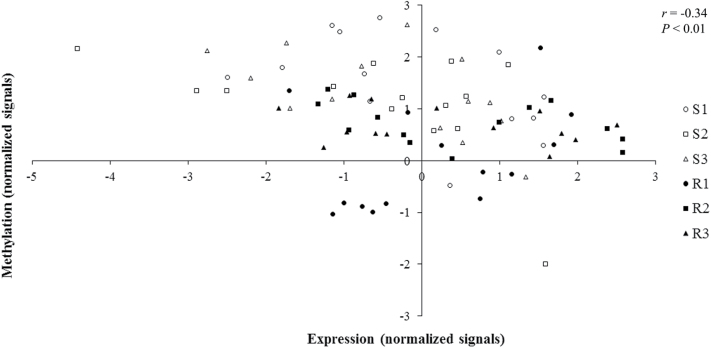
Relationship between methylation and expression in sugar beet genotypes after 9 weeks of vernalization treatment for the 14 sequences that are both differentially methylated (fold change R versus S >2) and differentially expressed (fold change R versus S >2 and P<0.05) between resistant and sensitive genotypes. The x- and y-axis correspond to expression and methylation normalized signals, respectively. Open circles, squares, and triangles represent the three bolting-sensitive genotypes, filled circles, squares, and triangles correspond to the bolting-resistant genotypes.
Fig. 6.
Fig. 6.
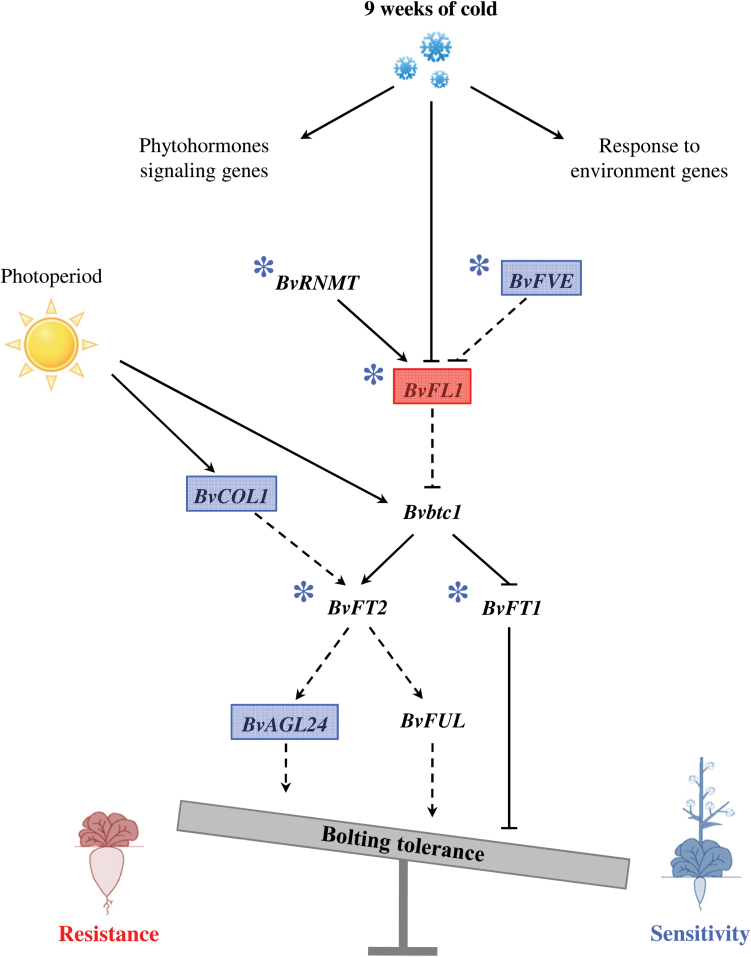
Bolting/flowering model in sugar beet. BvAGL24, AGAMOUS-LIKE 24; Bvbtc1, bolting time control 1; BvCOL1, CONSTANS-LIKE 1; BvFL1, FLOWERING LOCUS C; BvFT1 andt BvFT2, FLOWERING LOCUS T 1 and 2; BvFVE, FLOWERING LOCUS VE; BvFUL, FRUITFUL; BvRNMT, RNA METHYLTRANSFERASE. Arrows and a dotted line indicated a hypothetical control based on the Arabidopsis flowering pathway. Genes coloured in blue are floral inducers overexpressed in bolting-sensitive genotypes. BvFL1, in red, is a floral inhibitor overexpressed in bolting-resistant genotypes. Asterisks (*) indicate hypermethylated genes in bolting-sensitive genotypes.

References

    1. Abe M, Kobayashi Y, Yamamoto S, Daimon Y, Yamaguchi A, Ikeda Y, Ichinoki H, Notaguchi M, Goto K, Araki T. 2005. FD, a bZIP protein mediating signals from the floral pathway integrator FT at the shoot apex. Science 309, 1052–1056. - PubMed
    1. Abegg FA. 1936. A genetic factor for the annual habit in beets and linkage relationships. Journal of Agricultural Research 53, 493–511.
    1. Abou-Elwafa SF, Buttner B, Kopisch-Obuch FJ, Jung C, Muller AE. 2012. Genetic identification of a novel bolting locus in Beta vulgaris which promotes annuality independently of the bolting gene B. Molecular Breeding 29, 9.
    1. Adetunji I, Willems G, Tschoep H, Bürkholz A, Barnes S, Boer M, Malosetti M, Horemans S, van Eeuwijk F. 2014. Genetic diversity and linkage disequilibrium analysis in elite sugar beet breeding lines and wild beet accessions. Theoretical and Applied Genetics 127, 559–571. - PubMed
    1. Andrés F, Coupland G. 2012. The genetic basis of flowering responses to seasonal cues. Nature Reviews Genetics 13, 627–639. - PubMed

Publication types