Risk Prediction Models for Colorectal Cancer: A Systematic Review
- PMID: 26464100
- PMCID: PMC7610622
- DOI: 10.1158/1940-6207.CAPR-15-0274
Risk Prediction Models for Colorectal Cancer: A Systematic Review
Abstract
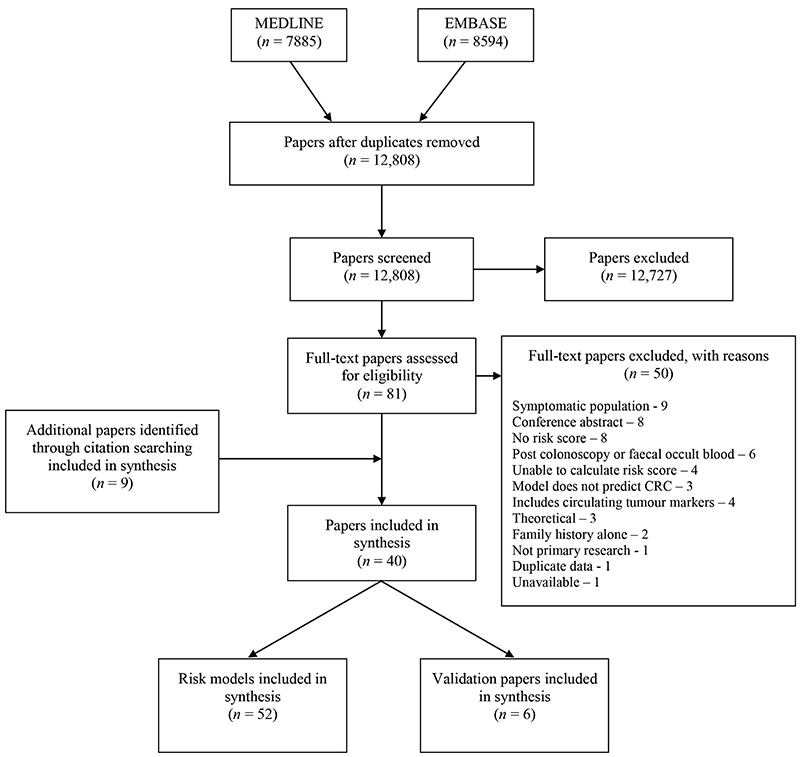
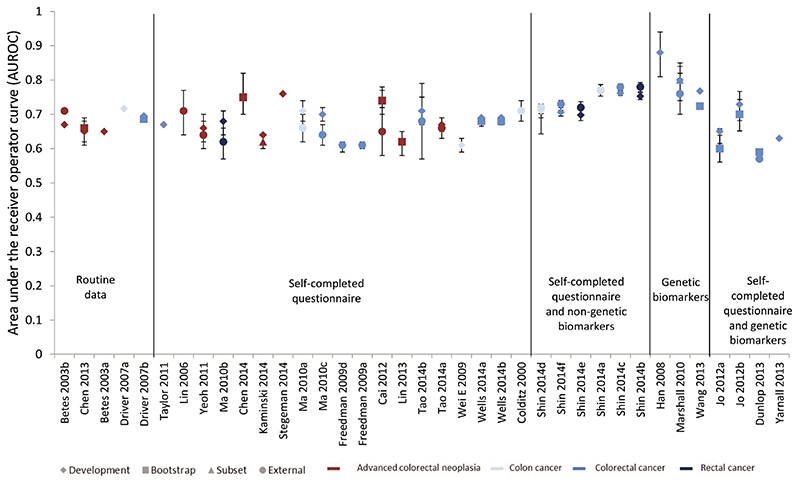
Colorectal cancer is the second leading cause of cancer-related death in Europe and the United States. Survival is strongly related to stage at diagnosis and population-based screening reduces colorectal cancer incidence and mortality. Stratifying the population by risk offers the potential to improve the efficiency of screening. In this systematic review we searched Medline, EMBASE, and the Cochrane Library for primary research studies reporting or validating models to predict future risk of primary colorectal cancer for asymptomatic individuals. A total of 12,808 papers were identified from the literature search and nine through citation searching. Fifty-two risk models were included. Where reported (n = 37), half the models had acceptable-to-good discrimination (the area under the receiver operating characteristic curve, AUROC >0.7) in the derivation sample. Calibration was less commonly assessed (n = 21), but overall acceptable. In external validation studies, 10 models showed acceptable discrimination (AUROC 0.71-0.78). These include two with only three variables (age, gender, and BMI; age, gender, and family history of colorectal cancer). A small number of prediction models developed from case-control studies of genetic biomarkers also show some promise but require further external validation using population-based samples. Further research should focus on the feasibility and impact of incorporating such models into stratified screening programmes.
©2015 American Association for Cancer Research.
Conflict of interest statement
Figures
Comment in
-
Risk Factor Models and Personalized Health: Opportunities and Challenges for Asymptomatic Individuals.Cancer Prev Res (Phila). 2016 Jan;9(1):11-2. doi: 10.1158/1940-6207.CAPR-15-0401. Epub 2015 Dec 23. Cancer Prev Res (Phila). 2016. PMID: 26701663 No abstract available.
References
-
- Ferlay J, Soerjomataram II, Dikshit R, Eser S, Mathers C, Rebelo M, et al. Cancer incidence and mortality worldwide: sources, methods and major patterns in GLOBOCAN 2012. Int J Cancer. 2014;136:E359–86. - PubMed
-
- Cancer Research UK. By stage at diagnosis. Cancer Research UK; London: 2009.
-
- Hardcastle JD, Chamberlain JO, Robinson MH, Moss SM, Amar SS, Balfour TW, et al. Randomised controlled trial of faecal-occult-blood screening for colorectal cancer. Lancet. 1996;348:1472–7. - PubMed
-
- Kronborg O, Fenger C, Olsen J, Jørgensen OD, Søndergaard O. Randomised study of screening for colorectal cancer with faecal-occult-blood test. Lancet. 1996;348:1467–71. - PubMed
Publication types
MeSH terms
Substances
Grants and funding
LinkOut - more resources
Full Text Sources
Other Literature Sources
Medical