


Central precocious puberty following the diagnosis and treatment of paediatric cancer and central nervous system tumours: presentation and long-term outcomes
- PMID: 26464129
- PMCID: PMC4755813
- DOI: 10.1111/cen.12964
Central precocious puberty following the diagnosis and treatment of paediatric cancer and central nervous system tumours: presentation and long-term outcomes
Abstract
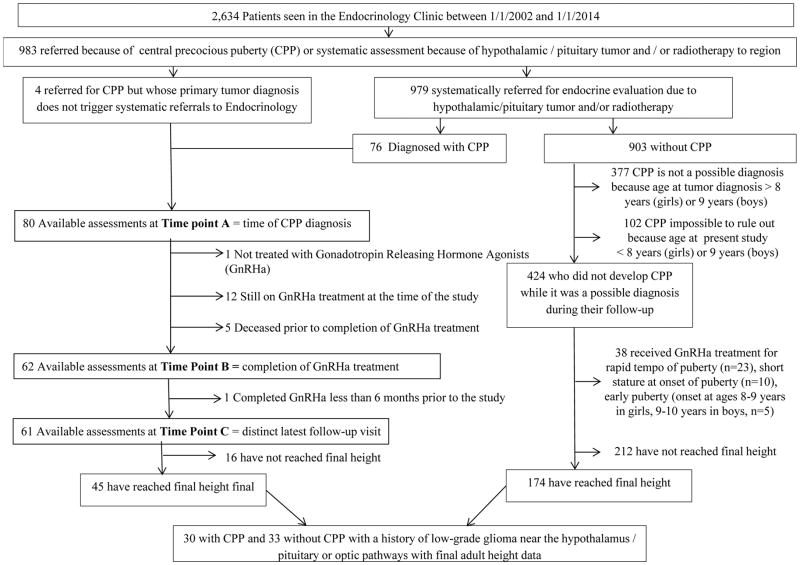
Objectives: To estimate the prevalence of central precocious puberty (CPP) after treatment for tumours and malignancies involving the central nervous system (CNS) and examine repercussions on growth and pubertal outcomes.
Design: Retrospective study of patients with tumours near and/or exposed to radiotherapy to the hypothalamus/pituitary axis (HPA).
Patients and measurements: Patients with CPP were evaluated at puberty onset, completion of GnRH agonist treatment (GnRHa) and last follow-up. Multivariable analysis was used to test associations between tumour location, sex, age at CPP, GnRHa duration and a diagnosis of CPP with final height <-2SD score (SDS), gonadotropin deficiency (LH/FSHD) and obesity, respectively.
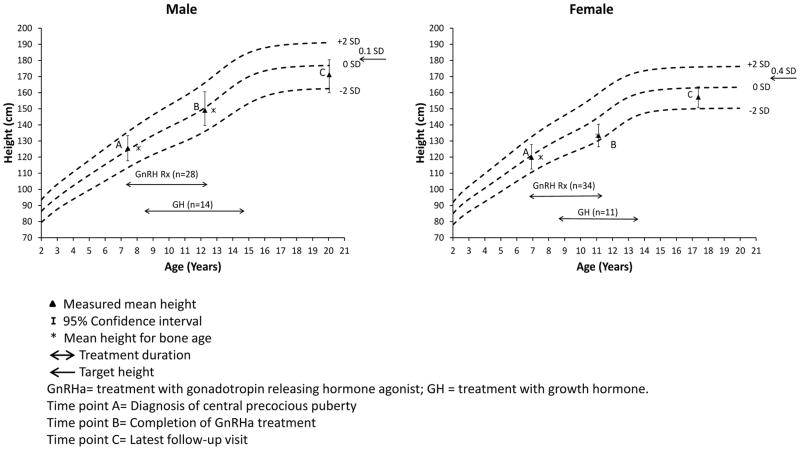
Results: Eighty patients (47 females) had CPP and were followed for 11·4 ± 5·0 years (mean ± SD). The prevalence of CPP was 15·2% overall, 29·2% following HPA tumours and 6·6% after radiotherapy for non-HPA tumours. Height <-2SDS was more common at the last follow-up than at the puberty onset (21·4% vs 2·4%, P = 0·005). Obesity was more prevalent at the last follow-up than at the completion of GnRHa or the puberty onset (37·7%, 22·6% and 20·8%, respectively, P = 0·03). Longer duration of GnRHa was associated with increased odds of final height <-2SDS (OR = 2·1, 95% CI 1·0-4·3) and longer follow-up with obesity (OR = 1·3, 95% CI 1·1-1·6). LH/FSHD was diagnosed in 32·6%. There was no independent association between CPP and final height <-2SDS, and LH/FSHD and obesity in the subset of patients with HPA low-grade gliomas.
Conclusions: Patients with organic CPP experience an incomplete recovery of growth and a high prevalence of LH/FSHD and obesity. Early diagnosis and treatment of CPP may limit further deterioration of final height prospects.
© 2015 John Wiley & Sons Ltd.
Conflict of interest statement
Figures
References
-
- Ojeda SR, Lomniczi A, Mastronardi C, et al. Minireview: the neuroendocrine regulation of puberty: is the time ripe for a systems biology approach? Endocrinology. 2006;147(3):1166–1174. - PubMed
-
- Chemaitilly W, Trivin C, Adan L, et al. Central precocious puberty: clinical and laboratory features. Clin Endocrinol (Oxf) 2001;54(3):289–294. - PubMed
-
- Gan HW, Phipps K, Aquilina K, et al. Neuroendocrine morbidity after pediatric optic gliomas: a longitudinal analysis of 166 children over 30 years. J Clin Endocrinol Metab. 2015:jc20152028. - PubMed
-
- Brauner R, Czernichow P, Rappaport R. Precocious puberty after hypothalamic and pituitary irradiation in young children. N Engl J Med. 1984;311(14):920. - PubMed
-
- Constine LS, Woolf PD, Cann D, et al. Hypothalamic-pituitary dysfunction after radiation for brain tumors. N Engl J Med. 1993;328(2):87–94. - PubMed
Publication types
MeSH terms
Substances
Grants and funding
LinkOut - more resources
Full Text Sources
Other Literature Sources
