


Community environment, cognitive impairment and dementia in later life: results from the Cognitive Function and Ageing Study
- PMID: 26464419
- PMCID: PMC4621236
- DOI: 10.1093/ageing/afv137
Community environment, cognitive impairment and dementia in later life: results from the Cognitive Function and Ageing Study
Abstract
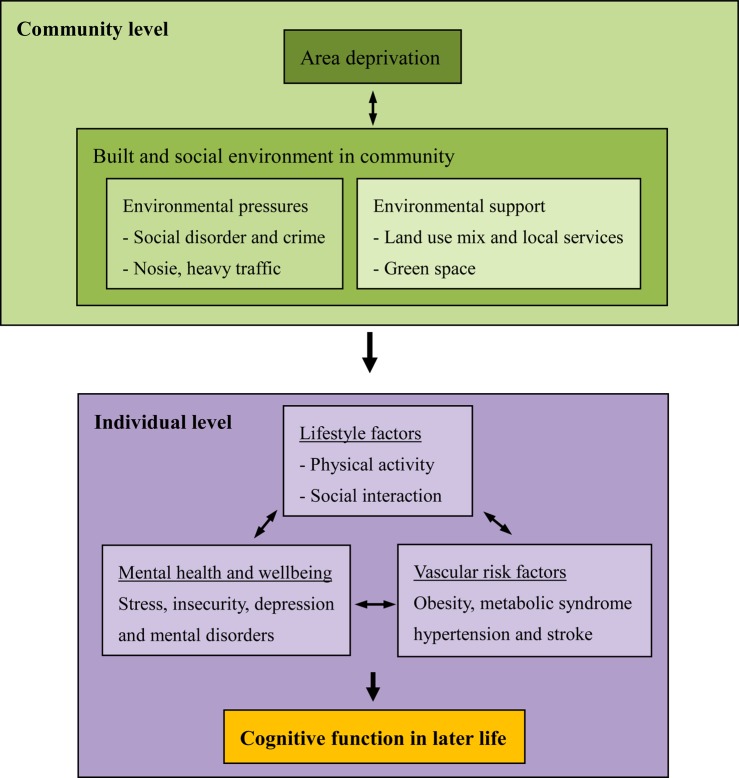
Background: Few studies have investigated the impact of the community environment, as distinct from area deprivation, on cognition in later life. This study explores cross-sectional associations between cognitive impairment and dementia and environmental features at the community level in older people.
Method: The postcodes of the 2,424 participants in the year-10 interview of the Cognitive Function and Ageing Study in England were mapped into small area level geographical units (Lower-layer Super Output Areas) and linked to environmental data in government statistics. Multilevel logistic regression was conducted to investigate associations between cognitive impairment (defined as MMSE ≤ 25), dementia (organicity level ≥3 in GMS-AGECAT) and community level measurements including area deprivation, natural environment, land use mix and crime. Sensitivity analyses tested the impact of people moving residence within the last two years.
Results: Higher levels of area deprivation and crime were not significantly associated with cognitive impairment and dementia after accounting for individual level factors. Living in areas with high land use mix was significantly associated with a nearly 60% reduced odds of dementia (OR: 0.4; 95% CI: 0.2, 0.8) after adjusting for individual level factors and area deprivation, but there was no linear trend for cognitive impairment. Increased odds of dementia (OR: 2.2, 95% CI: 1.2, 4.2) and cognitive impairment (OR: 1.4, 95% CI: 1.0, 2.0) were found in the highest quartile of natural environment availability. Findings were robust to exclusion of the recently relocated.
Conclusion: Features of land use have complex associations with cognitive impairment and dementia. Further investigations should focus on environmental influences on cognition to inform health and social policies.
Keywords: cognitive impairment; dementia; neighbourhood/community environment; older people.
© The Author 2015. Published by Oxford University Press on behalf of the British Geriatrics Society.
Figures
References
-
- World Health Organisation. Dementia: a public health priority, 2012. http://www.who.int/mental_health/publications/dementia_report_2012/en/ (1 October 2015, date last accessed).
-
- Dening T, Thomas A. Oxford Textbook of Old Age Psychiatry. Oxford: Oxford University Press, 2013.
-
- Hofman A, Rocca WA, Brayne C et al. The prevalence of dementia in Europe: a collaborative study of 1980–1990 findings. EURODEM Prevalence Research Group. Int J Epidemiol 1991; 20: 736–48. - PubMed
-
- Hendrie HC, Albert MS, Butters MA et al. The NIH Cognitive and Emotional Health Project: Report of the Critical Evaluation Study Committee. Alzheimer's Dement 2006; 2: 12–32. - PubMed
MeSH terms
LinkOut - more resources
Full Text Sources
Other Literature Sources
Medical
Molecular Biology Databases
