. 2013:2013:523974.
doi: 10.1155/2013/523974. Epub 2013 Nov 27.

The Injury/Illness Performance Project (IIPP): A Novel Epidemiological Approach for Recording the Consequences of Sports Injuries and Illnesses

Affiliations

The Injury/Illness Performance Project (IIPP): A Novel Epidemiological Approach for Recording the Consequences of Sports Injuries and Illnesses

Debbie Palmer-Green et al. J Sports Med (Hindawi Publ Corp). 2013.

Abstract

Background. Describing the frequency, severity, and causes of sports injuries and illnesses reliably is important for quantifying the risk to athletes and providing direction for prevention initiatives. Methods. Time-loss and/or medical-attention definitions have long been used in sports injury/illness epidemiology research, but the limitations to these definitions mean that some events are incorrectly classified or omitted completely, where athletes continue to train and compete at high levels but experience restrictions in their performance. Introducing a graded definition of performance-restriction may provide a solution to this issue. Results. Results from the Great Britain injury/illness performance project (IIPP) are presented using a performance-restriction adaptation of the accepted surveillance consensus methodologies. The IIPP involved 322 Olympic athletes (males: 172; female: 150) from 10 Great Britain Olympic sports between September 2009 and August 2012. Of all injuries (n = 565), 216 were classified as causing time-loss, 346 as causing performance-restriction, and 3 were unclassified. For athlete illnesses (n = 378), the majority (P < 0.01) resulted in time-loss (270) compared with performance-restriction (101) (7 unclassified). Conclusions. Successful implementation of prevention strategies relies on the correct characterisation of injury/illness risk factors. Including a performance-restriction classification could provide a deeper understanding of injuries/illnesses and better informed prevention initiatives.


Figures
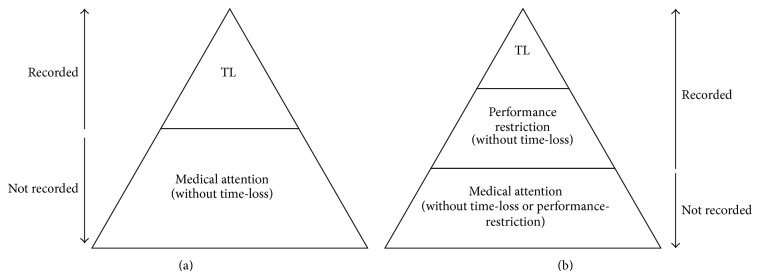
Figure 1
Figure 1
(a) Traditional hierarchy of injury/illness definition classification. (b) Alternative hierarchy of injury/illness definition classification. TL = time-loss; ∗ classification of an injury or illness is based on the initial status of the injury and not on any subsequent change of status during the time course of its recovery and ∗∗ while injuries/illnesses are always required to be classified as either time-loss or medical-attention (or performance-restriction) is should be noted that there can and always will be overlap between categories.
Figure 2
Figure 2
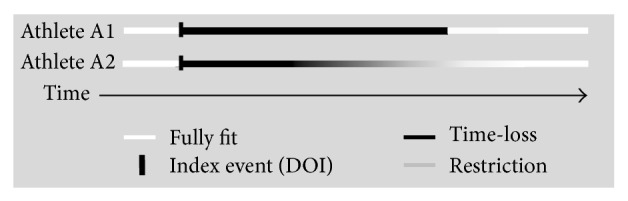
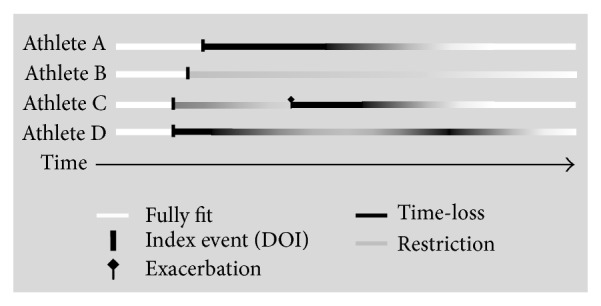
Traditional time-loss definition compared to the inclusion of a performance-restriction injury/illness classification and change of injury/illness status.
Figure 3
Figure 3
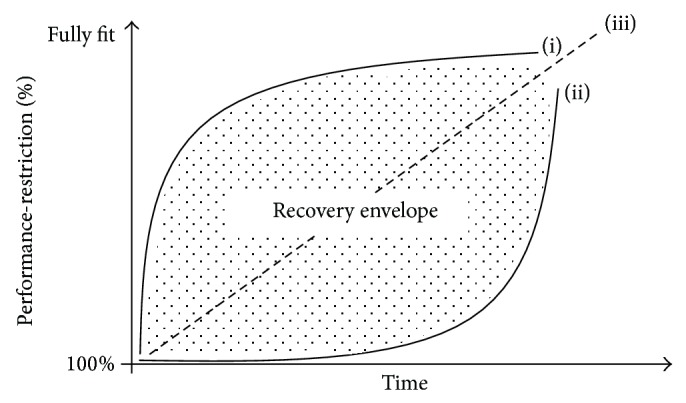
The performance-restriction injury/illness recovery envelope. (i) Fast/slow recovery; (ii) slow/fast recovery; and (iii) linear recovery.
Figure 4
Figure 4
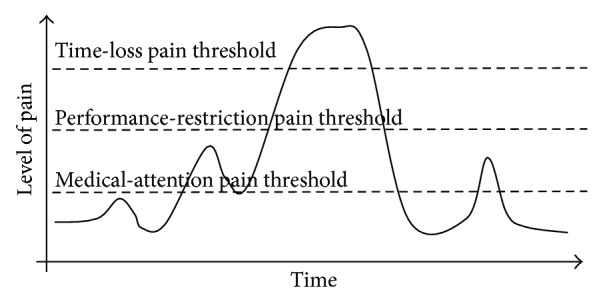
Theoretical model of pain and injury consequence (adapted from Bahr, [20]).
Figure 5
Figure 5
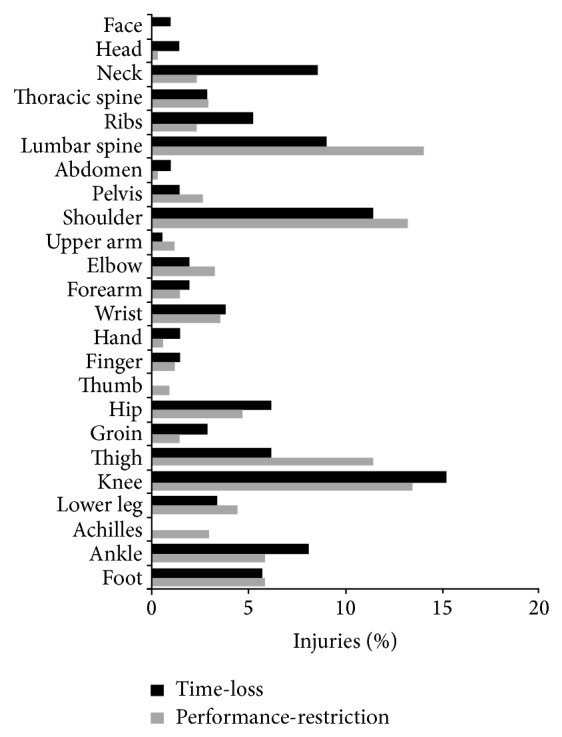
Percentage of injuries by location, as a function of injury status.
Figure 6
Figure 6
Examples of injury/illness occurrences collected during the IIPP based on time-loss and performance-restriction status.
Figure 7
Figure 7
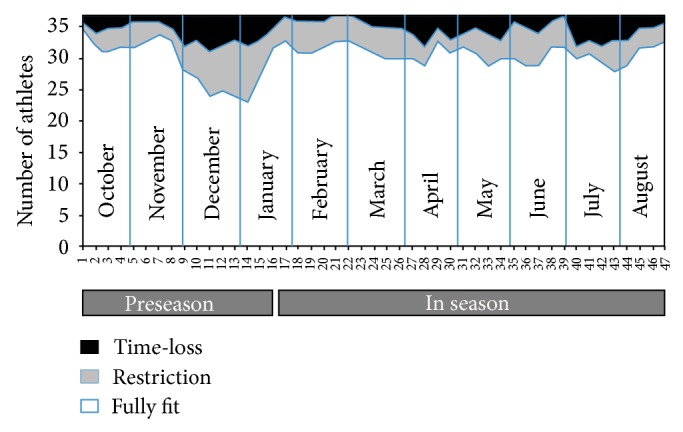
Great Britain sport (water-based) squad status 2010/11.
Figure 8
Figure 8
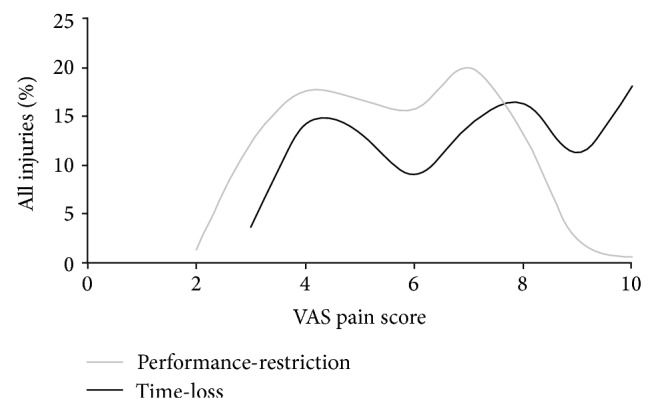
IIPP VAS pain score (at DOI) distribution for time-loss and performance-restriction injuries recorded between 2009 and 2012.

References

    1. Langevoort G., Myklebust G., Dvorak J., Junge A. Handball injuries during major international tournaments. Scandinavian Journal of Medicine and Science in Sports. 2007;17(4):400–407. doi: 10.1111/j.1600-0838.2006.00587.x. - DOI - PubMed
    1. Alonso J. M., Junge A., Renström P., Engebretsen L., Mountjoy M., Dvorak J. Sports injuries surveillance during the 2007 IAAF world athletics championships. Clinical Journal of Sport Medicine. 2009;19(1):26–32. doi: 10.1097/JSM.0b013e318191c8e7. - DOI - PubMed
    1. Junge A., Engebretsen L., Mountjoy M. L., et al. Sports injuries during the Summer Olympic Games 2008. American Journal of Sports Medicine. 2009;37(11):2165–2172. doi: 10.1177/0363546509339357. - DOI - PubMed
    1. Alonso J.-M., Tscholl P. M., Engebretsen L., Mountjoy M., Dvorak J., Junge A. Occurrence of injuries and illnesses during the 2009 IAAF World Athletics Championships. British Journal of Sports Medicine. 2010;44(15):1100–1105. doi: 10.1136/bjsm.2010.078030. - DOI - PubMed
    1. Mountjoy M., Junge A., Alonso J. M., et al. Sports injuries and illnesses in the 2009 FINA World Championships (aquatics) British Journal of Sports Medicine. 2010;44(7):522–527. doi: 10.1136/bjsm.2010.071720. - DOI - PubMed

LinkOut - more resources