. 2015 Oct 14;10(10):e0140508.
doi: 10.1371/journal.pone.0140508. eCollection 2015.

Metabolic Engineering of Klebsiella pneumoniae for the Production of 2-Butanone from Glucose

Affiliations

Metabolic Engineering of Klebsiella pneumoniae for the Production of 2-Butanone from Glucose

Zhen Chen et al. PLoS One. .

Abstract

2-Butanone is an important commodity chemical of wide application in different areas. In this study, Klebsiella pneumoniae was engineered to directly produce 2-butanone from glucose by extending its native 2, 3-butanediol synthesis pathway. To identify the potential enzyme for the efficient conversion of 2, 3-butanediol to 2-butanone, we screened different glycerol dehydratases and diol dehydratases. By introducing the diol dehydratase from Lactobacillus brevis and deleting the ldhA gene encoding lactate dehydrogenase, the engineered K. pneumoniae was able to accumulate 246 mg/L of 2-butanone in shake flask. With further optimization of culture condition, the titer of 2-butanone was increased to 450 mg/L. This study lays the basis for developing an efficient biological process for 2-butanone production.


Conflict of interest statement

Competing Interests: The authors have declared that no competing interests exist.

Figures

Fig 1
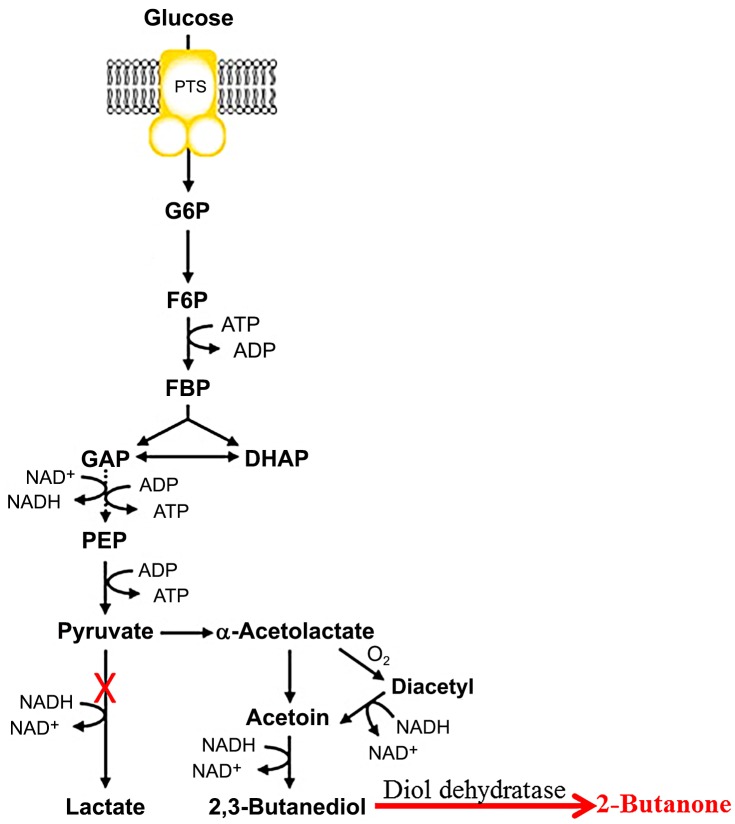
Fig 1. Metabolic pathway for 2-butanone production in Klebsiella pneumoniae.
Fig 2
Fig 2. Effect of coenzyme B12 addition for 2-butanone production by Klebsiella pneumoniae LDH526/pHSG-lbpdu.
(A) 2,3-butanediol production; (B) Cell growth; (C) 2-butanone synthesis; (D) glucose consumption. The cells were cultivated in 250 ml shake flask with 100 ml of fermentation medium with (1 μM) or without coenzyme B12 at 37°C, 250 rpm.

References

    1. Nakamura CE, Whited GM. Metabolic engineering for the microbial production of 1,3-propanediol. Curr Opin Biotechnol. 2003;14: 454–459. 10.1016/j.copbio.2003.08.005 - DOI - PubMed
    1. Yim H, Haselbeck R, Niu W, Pujol-Baxley C, Burgard A, Boldt J, et al. Metabolic engineering of Escherichia coli for direct production of 1,4-butanediol. Nat Chem Biol. Nature Publishing Group; 2011;7: 445–452. 10.1038/nchembio.580 - DOI - PubMed
    1. Chen Z, Liu HJ, Zhang JA, Liu DH. Elementary mode analysis for the rational design of efficient succinate conversion from glycerol by Escherichia coli . J Biomed Biotechnol. 2010;2010: 518743 10.1155/2010/518743 - DOI - PMC - PubMed
    1. Chen Z, Zeng A-P. Protein design in systems metabolic engineering for industrial strain development. Biotechnol J. 2013;8: 523–533. 10.1002/biot.201200238 - DOI - PubMed
    1. Chen Z, Geng F, Zeng A-P. Protein design and engineering of a de novo pathway for microbial production of 1,3-propanediol from glucose. Biotechnol J. 2015; 10:284–289. 10.1002/biot.201400235 - DOI - PubMed

Publication types

LinkOut - more resources