


Measuring Diversity and Inclusion in Academic Medicine: The Diversity Engagement Survey
- PMID: 26466376
- PMCID: PMC5823241
- DOI: 10.1097/ACM.0000000000000921
Measuring Diversity and Inclusion in Academic Medicine: The Diversity Engagement Survey
Abstract
Purpose: To produce a physician and scientific workforce that advances high-quality research and culturally competent care, academic medical centers (AMCs) must assess their capacity for diversity and inclusion and leverage opportunities for improvement. The Diversity Engagement Survey (DES) is presented as a diagnostic and benchmarking tool.
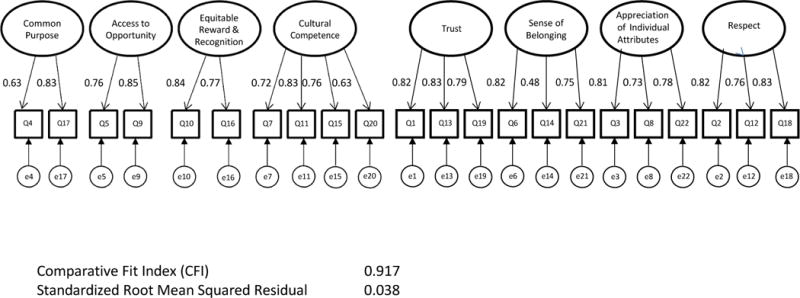
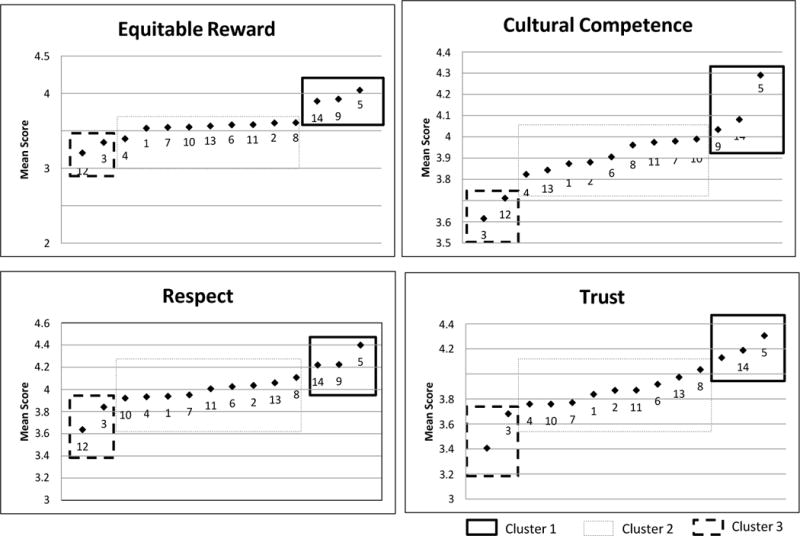
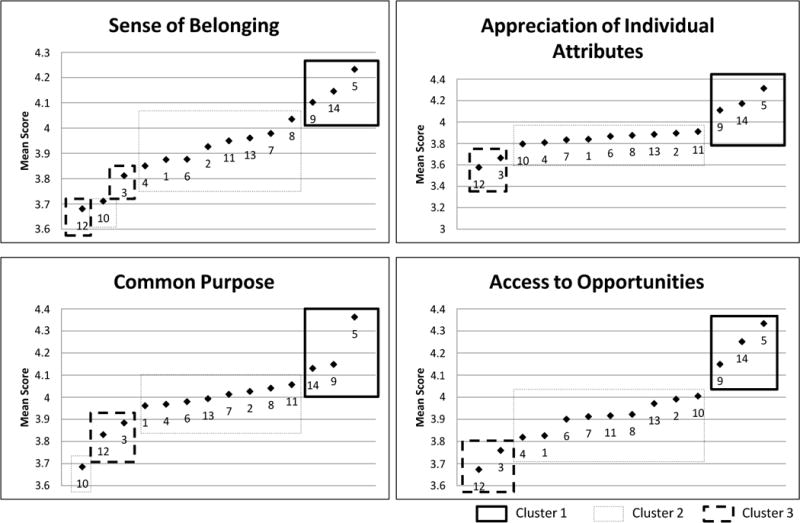
Method: The 22-item DES consists of eight factors that connect engagement theory to inclusion and diversity constructs. It was piloted at 1 AMC and then administered at 13 additional U.S. AMCs in 2011-2012. Face and content validity were assessed through a review panel. Cronbach alpha was used to assess internal consistency. Confirmatory factor analysis (CFA) was used to establish construct validity. Cluster analysis was conducted to establish ability of the DES to distinguish between institutions' degrees of engagement and inclusion. Criterion validity was established using observed differences in scores for demographic groups as suggested by the literature.
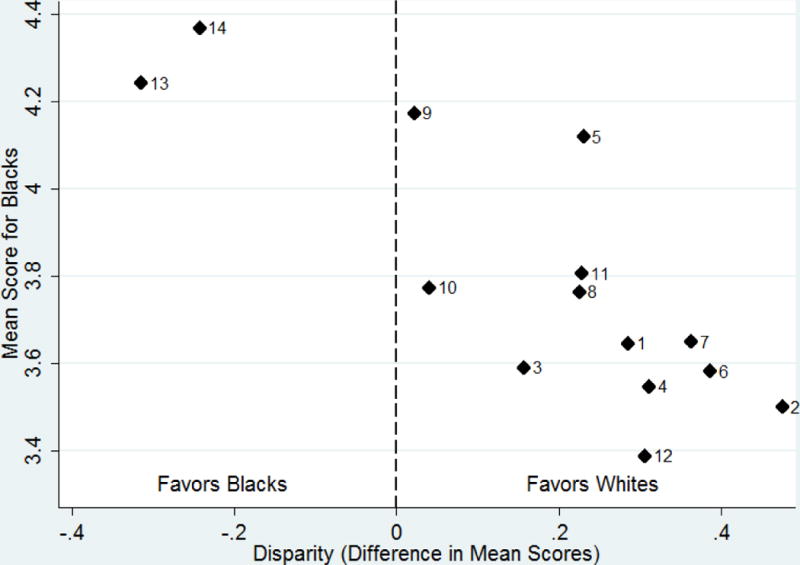
Results: The sample included 13,694 respondents across 14 AMCs. Cronbach alphas for the engagement and inclusion factors (range: 0.68-0.85), CFA fit indices, and item correlations with latent constructs indicated an acceptable model fit and that items measured the intended concepts. Cluster analysis of DES scores distinguished institutions with higher, middle, and lower degrees of engagement and inclusion by their respondents. Consistent with the literature, black, Hispanic/Latino, female, and LGBTQ (lesbian, gay, bisexual, transgender, queer) respondents reported lower degrees of engagement than their counterparts.
Conclusions: The DES is a reliable and valid instrument for assessment, evaluation, and external benchmarking of institutional engagement and inclusion.
Figures
Comment in
-
More on Diversity and Inclusion in Academic Medicine: The Isolation of Black Females.Acad Med. 2016 Jul;91(7):896. doi: 10.1097/ACM.0000000000001215. Acad Med. 2016. PMID: 27351812 No abstract available.
References
-
- Kocher R, Emmanuel EJ, DeParle NM. The affordable care act and the future of clinical medicine: The opportunities and challenges. Ann Intern Med. 2010;135:536–539. - PubMed
-
- Ely RJ, Thomas DA. Cultural diversity at work: The effects of diversity perspectives on work group processes and outcomes. Adm Sci Q. 2001;46:229–262.
-
- Cooke RA, Szumal JL. Measuring normative beliefs and shared behavioral expectations in organizations: The reliability and validity of the organizational culture inventory. Psychol Rep. 1993;72:1299–1330.
-
- Mor Barak ME, Cherin DA, Berkman S. Organizational and personal dimensions in diversity climate: Ethnic and gender differences in employee perceptions. J Appl Behav Sci. 1998;34:82–104.
-
- AAMC Group on Diversity and Inclusion. Definitions. https://www.aamc.org/members/gdi/about/. Accessed January 2, 2014.
Publication types
MeSH terms
Grants and funding
LinkOut - more resources
Full Text Sources
