Review
. 2012 Jan 31;3(1):91-119.
doi: 10.3390/insects3010091.

Polydnaviruses of Parasitic Wasps: Domestication of Viruses To Act as Gene Delivery Vectors

Affiliations
Review

Polydnaviruses of Parasitic Wasps: Domestication of Viruses To Act as Gene Delivery Vectors

Gaelen R Burke et al. Insects. .

Abstract

Symbiosis is a common phenomenon in which associated organisms can cooperate in ways that increase their ability to survive, reproduce, or utilize hostile environments. Here, we discuss polydnavirus symbionts of parasitic wasps. These viruses are novel in two ways: (1) they have become non-autonomous domesticated entities that cannot replicate outside of wasps; and (2) they function as a delivery vector of genes that ensure successful parasitism of host insects that wasps parasitize. In this review we discuss how these novelties may have arisen, which genes are potentially involved, and what the consequences have been for genome evolution.

Keywords: evolution; parasitoid; symbiosis.


Figures
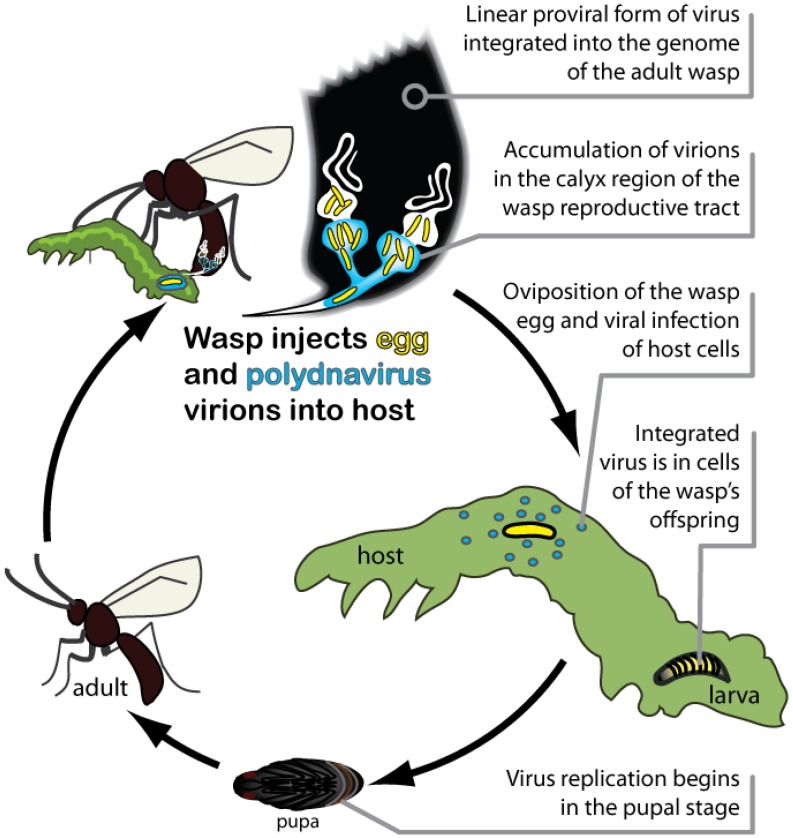
Figure 1
Figure 1
Life cycle of parasitoid wasps and Polydnaviruses (PDVs) parasitizing a lepidopteran larval host.
Figure 2
Figure 2
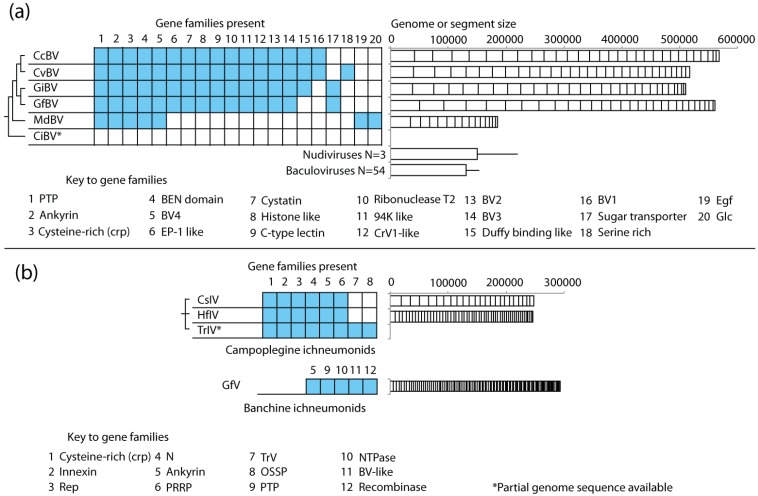
Pictorial summary of conservation of the encapsidated genomes of selected Bracovirus (BVs) (a) and Ichnovirus (IVs) (b). Gene families present in each genome are shown in blue boxes on the left side of the figure. The number of genomic segments, their size (kb), and the aggregate size of each genome are shown on the right side of the figure. The size of each genomic segment is represented by vertical bars, which are ordered by size from largest to smallest. BV gene family abbreviations: PTP, protein tyrosine phosphatase; EP-1 like, homologs of “early expressed protein 1” of CcBV; 94K-like, related to baculovirus 94K protein; Egf, epidermal growth factor-like; Glc, glycosylated central domain proteins; CrV1-like, homologs of a gene in CrBV; BV1-4, gene families of unknown function, see [31], IV gene family abbreviations: Rep, repeat element; N, homologs of genes on segment N of CsIV; TrV, homologs of TrV1 from TrIV; PRRP, prolar-residue-rich protein; BV-like, homologs of a CvBV hypothetical protein. The BV genomes shown are Cotesia congregata (CcBV) [25], Cotesia vestalis (CvBV) [23,28], Glyptapanteles indiensis (GiBV) [24], Glyptapanteles flavicoxis (GfBV) [24], Microplitis demolitor (MdBV) [26], and Chelonus inanitus (CiBV) [27]. The IV genomes are Campoletis sonorensis (CsIV) [26], Hyposoter flavicoxis (HfIV) [30], Tranosema rostrale (TrIV) [30], and Glypta fumiferanae (GfV) [29]. Some new families were identified in Dupuy et al. 2011 [31]. In (a) the cladogram of phylogenetic relationships between BVs is derived from Murphy et al. 2008 [14]. Also in (a) the average size of known nudivirus and baculovirus genomes is shown.
Figure 3
Figure 3
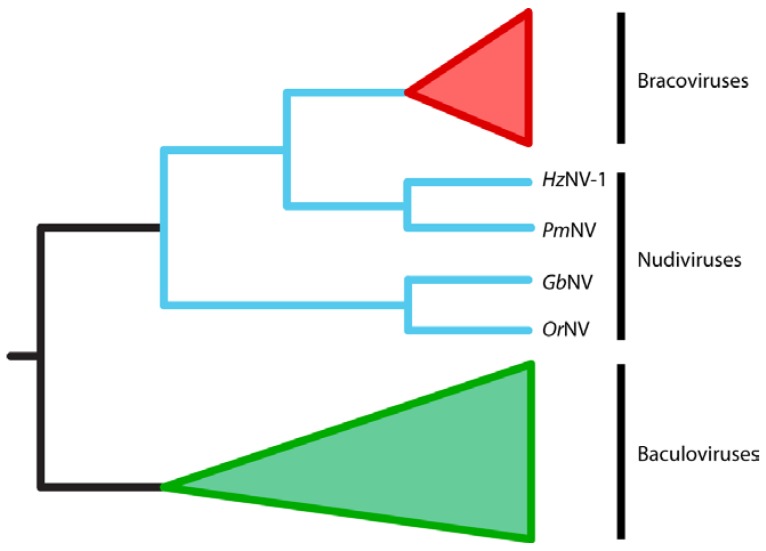
Cladogram showing the evolutionary relationships between bracoviruses (in red), nudiviruses (in blue) and baculoviruses (green). Bracoviruses evolved from within the nudivirus clade and are most closely related to HzNV-1 and PmNV. Nudiviruses and baculoviruses are sister groups of viruses. The figure is adapted from [38].
Figure 4
Figure 4
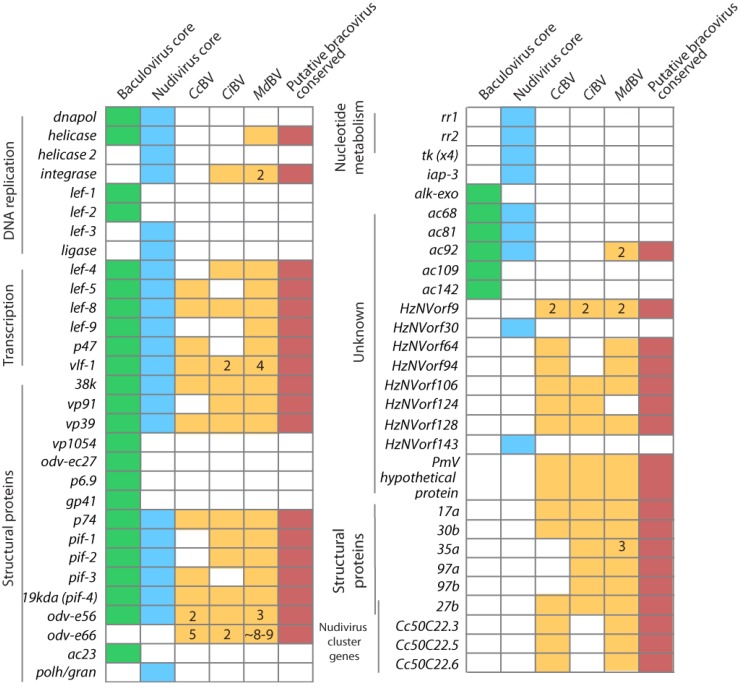
Predicted BV conserved gene set in relation to the core genes for all known baculoviruses and nudiviruses. Green and blue boxes represent core constituents of baculovirus or nudivirus genomes, respectively. Yellow boxes show homologs identified by transcript sequencing of ovaries from three species of braconid wasps. Acronyms are as described for Figure 2. Red boxes show the predicted conserved genes for BVs. Numbers within boxes indicate transcripts for which more than 1 locus was identified (duplicated genes). Adapted from [64].
Figure 5
Figure 5
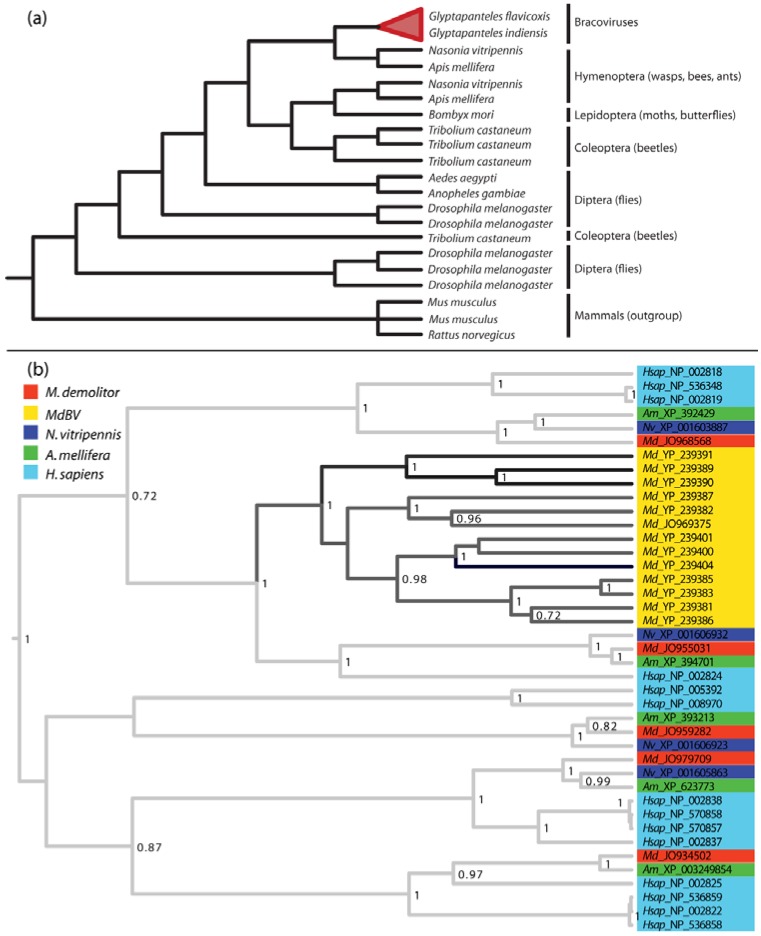
(a) Cladogram of the evolutionary relationships between insect and BV Major Facilitator System (MFS) sugar transporter genes. MFS genes from BVs of G. flavicoxis and G. indiensis clearly evolved from a hymenopteran homolog, and are more closely related to insect genes compared to those from mammals. The tree is adapted from Desjardins et al. 2008. [24], (b) Phylogenetic reconstruction of the evolution of insect and BV protein tyrosine phosphatase (PTPs). Taxa were chosen from the MdBV genome, M. demolitor transcripts, or the A. mellifera, N. vitripennis, or Homo sapiens genomes if they had a significant BLASTP hit (e-value < 0.0001) to MdBV PTP 1 (accession YP_239404). Protein sequences were aligned using MUSCLE v3.8.31 and the alignment was edited by hand in MacClade 4.06, resulting in 249 sites. The tree was built using BEAST v1.6.2 and a random local clock model for variation in the rate of evolution among branches of the tree (individual rates are estimated for each branch). Each taxon is named according to its species name and the NCBI Genbank accession number for that protein. Only posterior probability values greater than 0.7 are shown. Branches are shaded by their rate of evolution, with darker branches signifying faster rates.

References

    1. Moran N.A. Symbiosis. Curr. Biol. 2006;16:R866–R871. doi: 10.1016/j.cub.2006.09.019. - DOI - PubMed
    1. Newton I.L., Woyke T., Auchtung T.A., Dilly G.F., Dutton R.J., Fisher M.C., Fontanez K.M., Lau E., Stewart F.J., Richardson P.M., et al. The Calyptogena magnifica chemoautotrophic symbiont genome. Science. 2007;315:998–1000. - PubMed
    1. Baumann P. Biology bacteriocyte-associated endosymbionts of plant sap-sucking insects. Annu. Rev. Microbiol. 2005;59:155–189. doi: 10.1146/annurev.micro.59.030804.121041. - DOI - PubMed
    1. Aylward F.O., Currie C.R., Suen G. The evolutionary innovation of nutritional symbiosis in leaf-cutter ants. Insects. 2012;3:41–61. doi: 10.3390/insects3010041. - DOI - PMC - PubMed
    1. Nowack E.C., Melkonian M. Endosymbiotic associations within protists. Philos. Trans. R. Soc. B. 2010;365:699–712. doi: 10.1098/rstb.2009.0188. - DOI - PMC - PubMed

LinkOut - more resources