. 2015 Nov 10;6(35):38257-69.
doi: 10.18632/oncotarget.5499.

Co-expression of mitosis-regulating genes contributes to malignant progression and prognosis in oligodendrogliomas

Affiliations

Co-expression of mitosis-regulating genes contributes to malignant progression and prognosis in oligodendrogliomas

Yanwei Liu et al. Oncotarget. .

Abstract

The clinical prognosis of patients with glioma is determined by tumor grades, but tumors of different subtypes with equal malignancy grade usually have different prognosis that is largely determined by genetic abnormalities. Oligodendrogliomas (ODs) are the second most common type of gliomas. In this study, integrative analyses found that distribution of TCGA transcriptomic subtypes was associated with grade progression in ODs. To identify critical gene(s) associated with tumor grades and TCGA subtypes, we analyzed 34 normal brain tissue (NBT), 146 WHO grade II and 130 grade III ODs by microarray and RNA sequencing, and identified a co-expression network of six genes (AURKA, NDC80, CENPK, KIAA0101, TIMELESS and MELK) that was associated with tumor grades and TCGA subtypes as well as Ki-67 expression. Validation of the six genes was performed by qPCR in additional 28 ODs. Importantly, these genes also were validated in four high-grade recurrent gliomas and the initial lower-grade gliomas resected from the same patients. Finally, the RNA data on two genes with the highest discrimination potential (AURKA and NDC80) and Ki-67 were validated on an independent cohort (5 NBTs and 86 ODs) by immunohistochemistry. Knockdown of AURKA and NDC80 by siRNAs suppressed Ki-67 expression and proliferation of gliomas cells. Survival analysis showed that high expression of the six genes corporately indicated a poor survival outcome. Correlation and protein interaction analysis provided further evidence for this co-expression network. These data suggest that the co-expression of the six mitosis-regulating genes was associated with malignant progression and prognosis in ODs.

Keywords: gene expression; malignant progression; oligodendrogliomas; prognosis; proliferation.


Conflict of interest statement

CONFLICTS OF INTEREST

The authors declare no conflicts of interest.

Figures
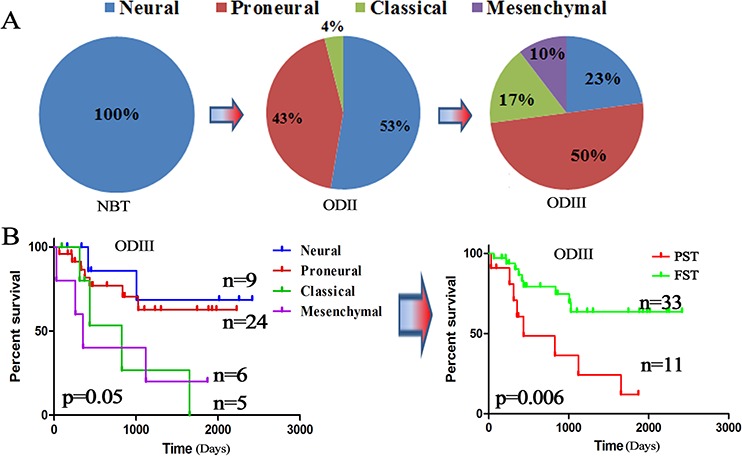
Figure 1
Figure 1. TCGA subtypes were associated with OD grades
A. The distribution of the TCGA subtypes in different grades of ODs from the CGGA dataset (5 NBTs, 76 ODIIs and 48 ODIIIs); B. Kaplan–Meier survival analysis divided the TCGA subtypes into a favorable survival subtype (FST: neural and proneural) and a poor survival subtype (PST: classical and mesenchymal) based on the CGGA dataset.
Figure 2
Figure 2. Identifying candidate genes associated with grade progression
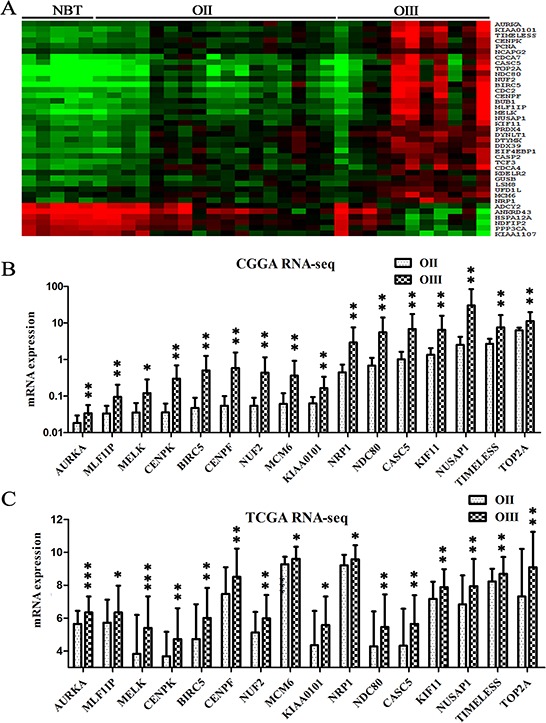
A. Transcripts levels of 39 candidate genes were identified by microarray from the CGGA dataset (5 NBTs, 17 OIIs and 11OIIIs) which showed either gradual increases (33 genes) or decreases (6 genes) in the entire grade progression from NBT to OII and OIII (p < 0.05); The 39 candidate genes were obtained by overlapping data analysis from CGGA, GES16011 and REMBRANDT datasets. B. 16 candidate genes were further confirmed by the RNA-seq data of the CGGA dataset (27 OIIs and 11 OIIIs); C. The 16 candidate genes were validated on an independent RNA-seq data of the TCGA dataset (64 OIIs and 41 OIIIs).
Figure 3
Figure 3. Candidate genes associated with TCGA subtypes were validated on additional samples
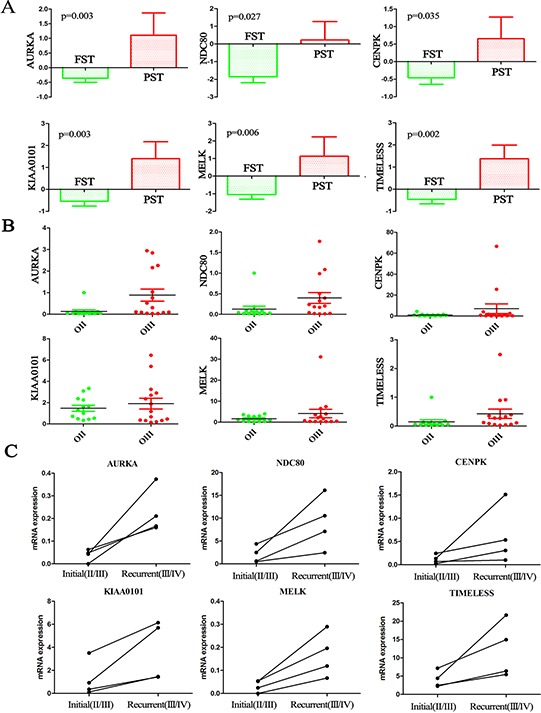
A. The expression levels of the six candidate genes showed significant differences between the FST and PST in the CGGA dataset (p < 0.05); B. The expression levels of the six genes were higher in OIII than in OII as assessed by qPCR on the additional CGGA samples (13 OIIs and 15 OIIIs). C. The expression levels of the six genes were significantly increased in four high-grade recurrent gliomas (AOA/sGBM, grade III/IV) compared with the initial lower-grade gliomas (grade II/III) resected from the same patients. The four paired samples: OA progress to AOA; OA progress to sGBM; AO progress to sGBM; AA progress to sGBM.
Figure 4
Figure 4. Co-expression of the six genes was associated with Ki-67
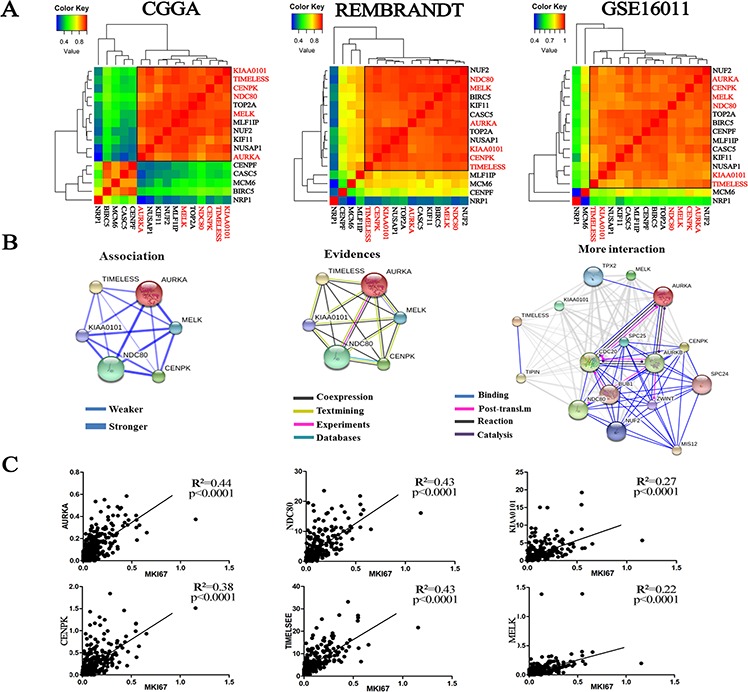
A. Correlation analysis using the 16 candidate genes in the three datasets revealed a subclass that is characterized by the six genes (CGGA: 5 NBTs, 17 OIIs and 11 OIIIs; REMBRANDT: 21 NBTs, 30 OIIs, 23 OIIIs; GSE16011: 8 NBTs, 8 OIIs, 44 OIIIs); B. The protein-protein interactions of the six candidate genes were predicted from an online database (STRING); C. The expression levels of the six genes showed a significant positive correlation with Ki-67 expression from the RNA-seq data of the CGGA dataset (109 grade II, 72 grade III and 144 grade IV gliomas).
Figure 5
Figure 5. Validation of the RNA data by IHC
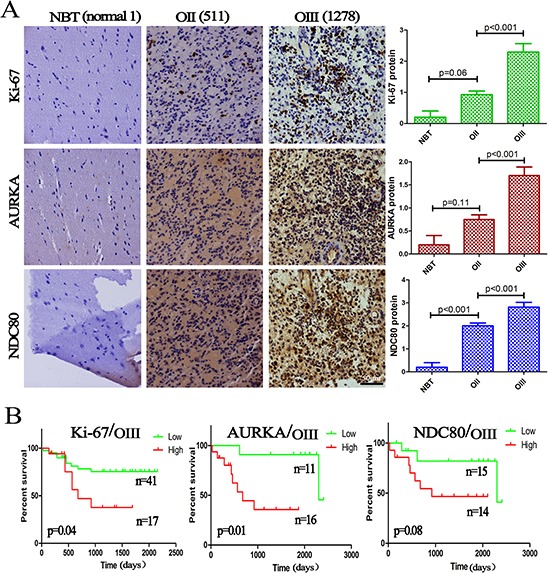
A. The protein expression of Ki-67, AURKA and NDC80 was significantly increased with increasing OD grades, and semiquantitative analysis was performed in 5 NBTs, 57 OIIs and 29 OIIIs; B. Kaplan–Meier survival analysis showed that high expression of these three proteins indicated a poor survival. The columns represent the same samples; 511 and 1278 refer to the sample ID in the CGGA dataset.
Figure 6
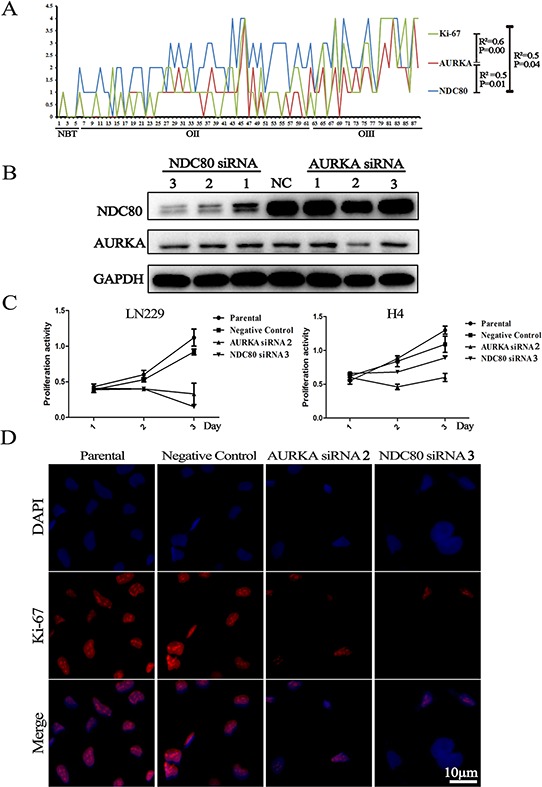
Figure 6. Deletion of the candidate genes suppressed Ki-67 expression and cell proliferation
A. The three proteins (Ki-67, AURKA and NDC80) showed similar expression levels and significantly increased with increasing tumor grades; B. Western blotting showed that suppression of the expression of AURKA and NDC80 with siRNAs significantly decreased their protein expression; C. and D. MTT assay and cell immunofluorescence showed that suppression of AURKA and NDC80 expression suppressed the malignant proliferation of glioma cells and Ki-67 expression. Parental cells are non-transfected H4 and LN229 cells; Negative Control refers to transfected H4 and LN229 cells with a scrambled siRNA sequence that will not lead to specific degradation of any known cellular mRNA.

References

    1. Louis DN, Perry A, Burger P, Ellison DW, Reifenberger G, von Deimling A, Aldape K, Brat D, Collins VP, Eberhart C, Figarella-Branger D, Fuller GN, Giangaspero F, et al. International Society Of Neuropathology—Haarlem consensus guidelines for nervous system tumor classification and grading. Brain Pathol. 2014;24:429–35. - PMC - PubMed
    1. Okamoto Y, Di Patre PL, Burkhard C, Horstmann S, Jourde B, Fahey M, Schuler D, Probst-Hensch NM, Yasargil MG, Yonekawa Y, Lutolf UM, Kleihues P, Ohgaki H. Population-based study on incidence, survival rates, and genetic alterations of low-grade diffuse astrocytomas and oligodendrogliomas. Acta Neuropathol. 2004;108:49–56. - PubMed
    1. Mukasa A, Ueki K, Matsumoto S, Tsutsumi S, Nishikawa R, Fujimaki T, Asai A, Kirino T, Aburatani H. Distinction in gene expression profiles of oligodendrogliomas with and without allelic loss of 1p. Oncogene. 2002;21:3961–8. - PubMed
    1. Tews B, Felsberg J, Hartmann C, Kunitz A, Hahn M, Toedt G, Neben K, Hummerich L, von Deimling A, Reifenberger G, Lichter P. Identification of novel oligodendroglioma-associated candidate tumor suppressor genes in 1p36 and 19q13 using microarray-based expression profiling. Int J Cancer. 2006;119:792–800. - PubMed
    1. Yan H, Parsons DW, Jin G, McLendon R, Rasheed BA, Yuan W, Kos I, Batinic-Haberle I, Jones S, Riggins GJ, Friedman H, Friedman A, Reardon D, et al. IDH1 and IDH2 mutations in gliomas. N Engl J Med. 2009;360:765–73. - PMC - PubMed

Publication types

MeSH terms