Meta-Analysis
. 2015 Oct 15;10(10):e0139547.
doi: 10.1371/journal.pone.0139547. eCollection 2015.

Use of Mesh in Laparoscopic Paraesophageal Hernia Repair: A Meta-Analysis and Risk-Benefit Analysis

Affiliations
Meta-Analysis

Use of Mesh in Laparoscopic Paraesophageal Hernia Repair: A Meta-Analysis and Risk-Benefit Analysis

Beat P Müller-Stich et al. PLoS One. .

Erratum in

Abstract

Introduction: Mesh augmentation seems to reduce recurrences following laparoscopic paraesophageal hernia repair (LPHR). However, there is an uncertain risk of mesh-associated complications. Risk-benefit analysis might solve the dilemma.

Materials and methods: A systematic literature search was performed to identify randomized controlled trials (RCTs) and observational clinical studies (OCSs) comparing laparoscopic mesh-augmented hiatoplasty (LMAH) with laparoscopic mesh-free hiatoplasty (LH) with regard to recurrences and complications. Random effects meta-analyses were performed to determine potential benefits of LMAH. All data regarding LMAH were used to estimate risk of mesh-associated complications. Risk-benefit analysis was performed using a Markov Monte Carlo decision-analytic model.

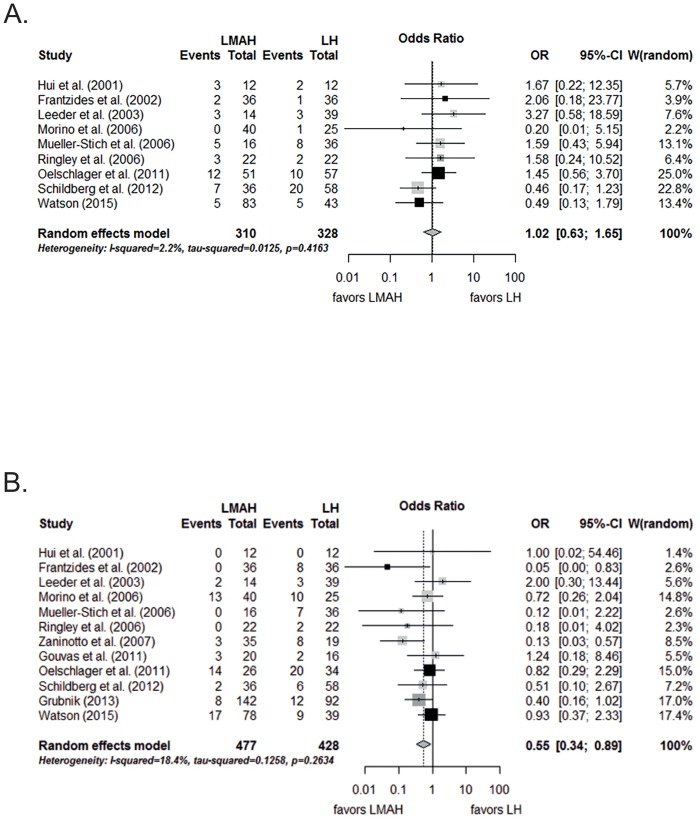
Results: Meta-analysis of 3 RCTs and 9 OCSs including 915 patients revealed a significantly lower recurrence rate for LMAH compared to LH (pooled proportions, 12.1% vs. 20.5%; odds ratio (OR), 0.55; 95% confidence interval (CI), 0.34 to 0.89; p = 0.04). Complication rates were comparable in both groups (pooled proportions, 15.3% vs. 14.2%; OR, 1.02; 95% CI, 0.63 to 1.65; p = 0.94). The systematic review of LMAH data yielded a mesh-associated complication rate of 1.9% (41/2121; 95% CI, 1.3% to 2.5%) for those series reporting at least one mesh-associated complication. The Markov Monte Carlo decision-analytic model revealed a procedure-related mortality rate of 1.6% for LMAH and 1.8% for LH.

Conclusions: Mesh application should be considered for LPHR because it reduces recurrences at least in the mid-term. Overall procedure-related complications and mortality seem to not be increased despite of potential mesh-associated complications.


Conflict of interest statement

Competing Interests: All authors have declared that no competing interests exist.

Figures

Fig 1
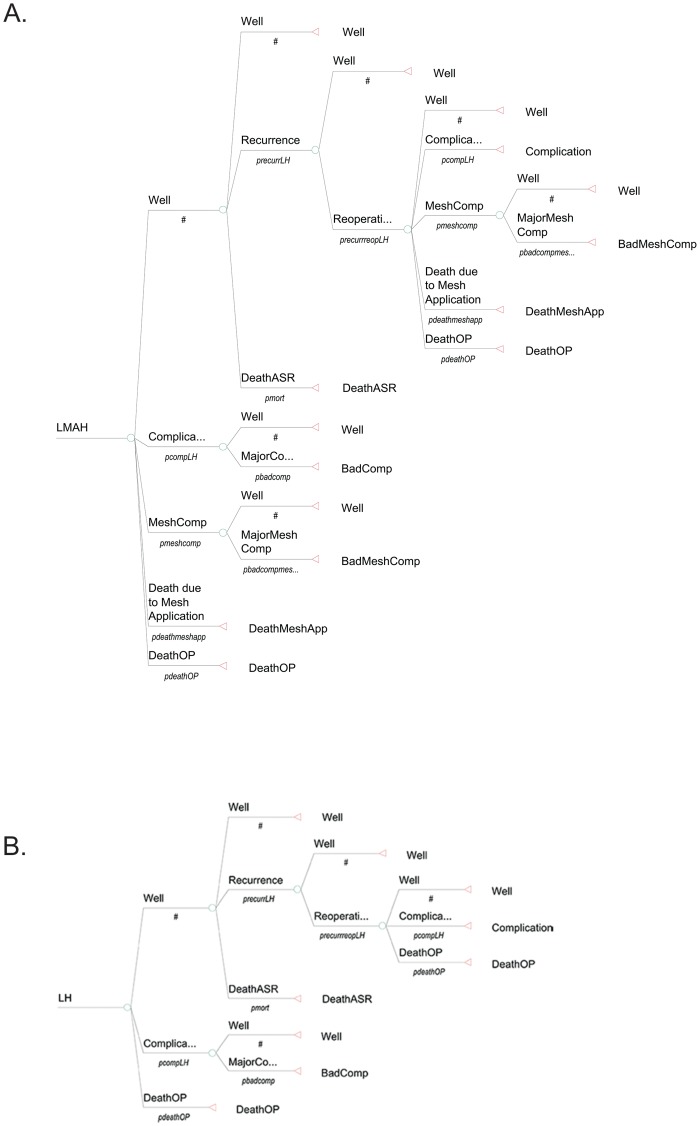
Fig 1. Decision tree analysis for the two treatment strategies A) LMAH vs. B) LH.
(The cycles of BadComp and BadMeshComp are not shown in the figure. Patients entering these states stay inside them until they die of age- or gender-related causes.) LMAH, laparoscopic mesh-augmented hiatoplasty; LH, laparoscopic mesh-free hiatoplasty; Well, state of well-being; Complication, State of having a complication after surgery; DeathOP, Death due to the operation; DeathASR, Death due to age- and sex-related causes; MajorComp, state of having a major complication, leading to BadComp; BadComp, permanently lowered quality of life due to a major complication; MeshComp, state of having a mesh-associated complication; BadMeshComp, permanently lowered quality of life due to a major mesh-associated complication.
Fig 2
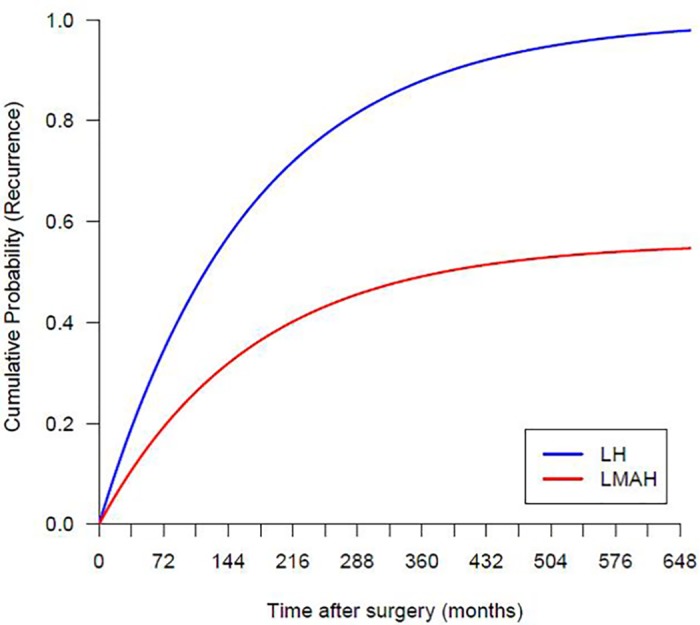
Fig 2. Cumulative probabilities of hiatal hernia recurrence calculated for the Markov Monte Carlo decision-analytic simulation.
Fig 3
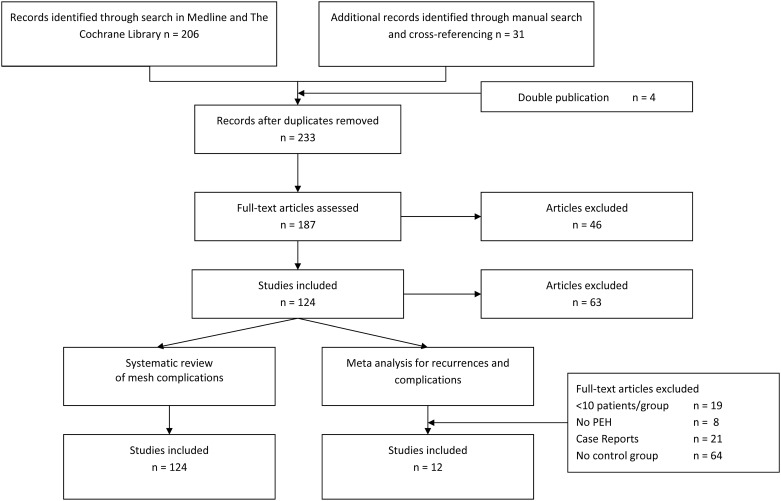
Fig 3. Flow chart of study selection.
Fig 4
Fig 4. Meta-analysis of A) hernia recurrence and B) complications after LMAH and LH.
Black rectangles are randomized controlled trials; dark gray rectangles are case control studies; light gray rectangles are case series with control group. LMAH, laparoscopic mesh augmented hiatoplasty; LH, laparoscopic hiatoplasty; OR, Odds Ratio; 95% CI, 95% confidence interval. Studies included in the meta-analysis are detailed in the supporting information files (S1 Table).
Fig 5
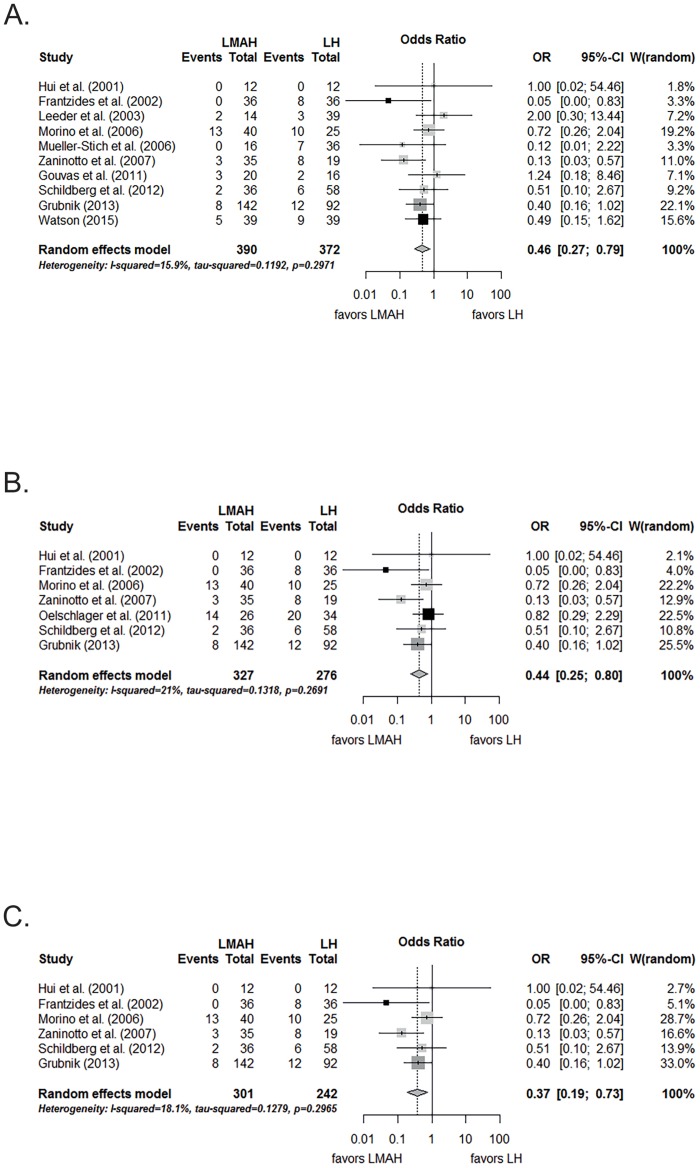
Fig 5. Meta-analysis of A) hernia recurrence for studies using synthetic meshes, B) for studies with at least 2 years of follow-up, C) for studies with both synthetic meshes and at least 2 years of follwow-up after LMAH and LH.
Black rectangles are randomized controlled trials; dark gray rectangles are case control studies; light gray rectangles are case series with control group. LMAH, laparoscopic mesh augmented hiatoplasty; LH, laparoscopic hiatoplasty; OR, Odds Ratio; 95% CI, 95% confidence interval. Studies included in the meta-analysis are detailed in the supporting information files (S1 Table).
Fig 6
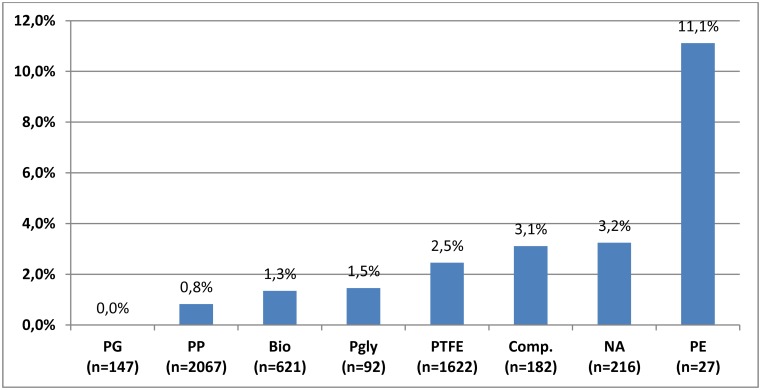
Fig 6. Mesh material-related risk of mesh associated complications.
Comp., Composite; DM, dermal matrix; PE, polyethylene; PG, polyglactine; PGly; polyglycane; PP, polypropylene; PTFE, polytetrafluorethylene; SIS, small intestinal submucosa; NA, not answered.

References

    1. Hashemi M, Peters JH, DeMeester TR, Huprich JE, Quek M, Hagen JA, et al. Laparoscopic repair of large type III hiatal hernia: objective followup reveals high recurrence rate. Journal of the American College of Surgeons. 2000;190(5):553–60; discussion 60–1. . - PubMed
    1. Antoniou SA, Koch OO, Antoniou GA, Pointner R, Granderath FA. Mesh-reinforced hiatal hernia repair: a review on the effect on postoperative dysphagia and recurrence. Langenbeck's archives of surgery / Deutsche Gesellschaft fur Chirurgie. 2012;397(1):19–27. 10.1007/s00423-011-0829-0 . - DOI - PubMed
    1. Puri V, Kakarlapudi GV, Awad ZT, Filipi CJ. Hiatal hernia recurrence: 2004. Hernia: the journal of hernias and abdominal wall surgery. 2004;8(4):311–7. 10.1007/s10029-004-0255-0 . - DOI - PubMed
    1. Targarona EM, Bendahan G, Balague C, Garriga J, Trias M. Mesh in the hiatus: a controversial issue. Archives of surgery. 2004;139(12):1286–96; discussion 96. 10.1001/archsurg.139.12.1286 . - DOI - PubMed
    1. Furnee E, Hazebroek E. Mesh in laparoscopic large hiatal hernia repair: a systematic review of the literature. Surgical endoscopy. 2013;27(11):3998–4008. 10.1007/s00464-013-3036-y . - DOI - PubMed