


Revisiting Trypanosoma rangeli Transmission Involving Susceptible and Non-Susceptible Hosts
- PMID: 26469403
- PMCID: PMC4607475
- DOI: 10.1371/journal.pone.0140575
Revisiting Trypanosoma rangeli Transmission Involving Susceptible and Non-Susceptible Hosts
Abstract
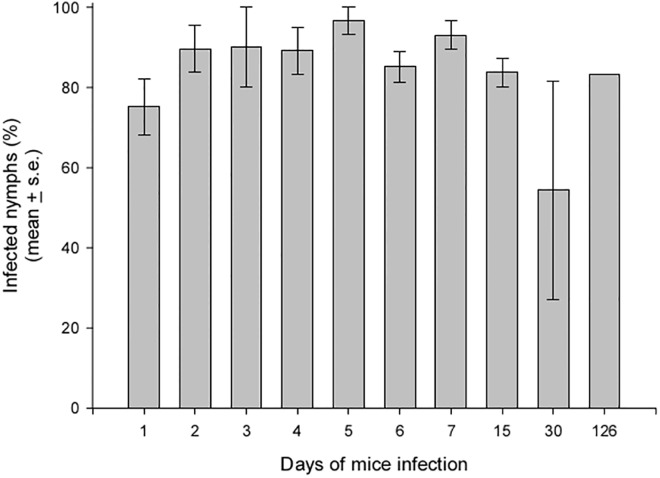
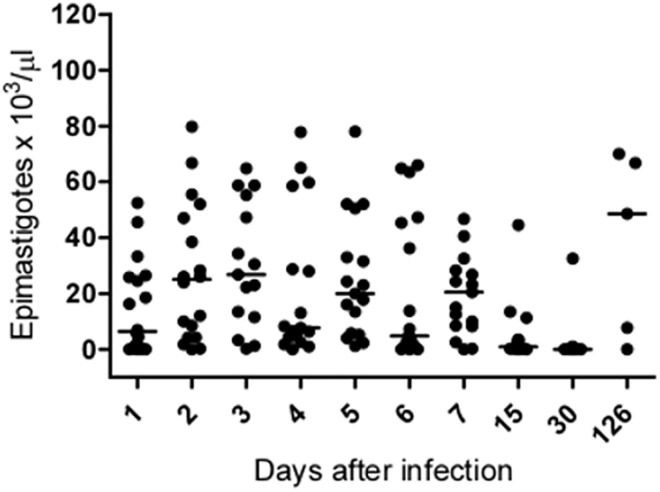
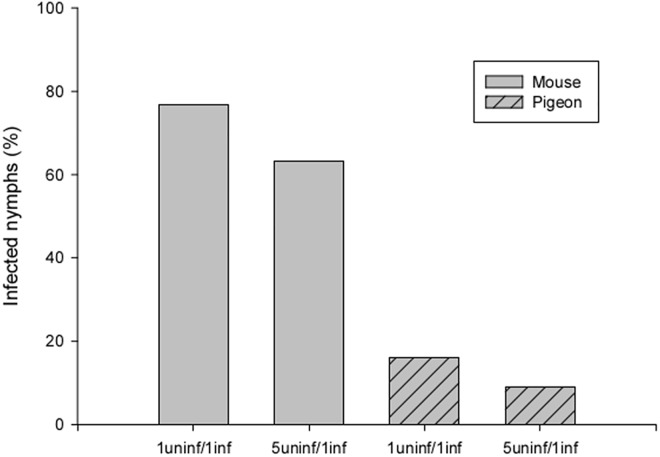
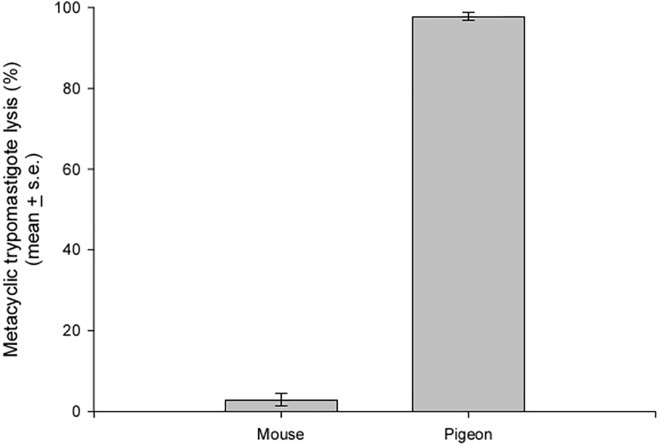
Trypanosoma rangeli infects several triatomine and mammal species in South America. Its transmission is known to occur when a healthy insect feeds on an infected mammal or when an infected insect bites a healthy mammal. In the present study we evaluated the classic way of T. rangeli transmission started by the bite of a single infected triatomine, as well as alternative ways of circulation of this parasite among invertebrate hosts. The number of metacyclic trypomastigotes eliminated from salivary glands during a blood meal was quantified for unfed and recently fed nymphs. The quantification showed that ~50,000 parasites can be liberated during a single blood meal. The transmission of T. rangeli from mice to R. prolixus was evaluated using infections started through the bite of a single infected nymph. The mice that served as the blood source for single infected nymphs showed a high percentage of infection and efficiently transmitted the infection to new insects. Parasites were recovered by xenodiagnosis in insects fed on mice with infections that lasted approximately four months. Hemolymphagy and co-feeding were tested to evaluate insect-insect T. rangeli transmission. T. rangeli was not transmitted during hemolymphagy. However, insects that had co-fed on mice with infected conspecifics exhibited infection rates of approximately 80%. Surprisingly, 16% of the recipient nymphs became infected when pigeons were used as hosts. Our results show that T. rangeli is efficiently transmitted between the evaluated hosts. Not only are the insect-mouse-insect transmission rates high, but parasites can also be transmitted between insects while co-feeding on a living host. We show for the first time that birds can be part of the T. rangeli transmission cycle as we proved that insect-insect transmission is feasible during a co-feeding on these hosts.
Conflict of interest statement
Figures
References
-
- Tejera E. Un nouveau flagella de Rhodnius prolixus. Trypanosoma (ou Crithidia) rangeli n.sp . Bull Soc Path Exot. 1920; 13: 527–530.
-
- D’Alessandro-Bacigalupo A, Saraiva NG. Trypanosoma rangeli In: Kreier JP, Baker J, editors. Parasitic Protozoa. California: Academic Press; 1992. pp. 1–54.
-
- Brecher G, Wigglesworth VB. The transmission of Actinomyces rhodnii Erikson in Rhodnius prolixus Stal (Hemiptera) and its influence on the growth of the host. Parasitology. 1944; 35: 220–224.
-
- Lake P, Friend WG. A monoxenic relationship, Nocardia rhodnii Erikson in the gut of Rhodnius prolixus Stal (Hemiptera: Reduviidae). Proc Entomol Soc Ont. 1967; 98: 53–57.
-
- Grewal MS. Pathogenicity of Trypanosoma rangeli Tejera, in the invertebrate host. Exp Parasitol. 1957; 6: 123–130. - PubMed
Publication types
MeSH terms
LinkOut - more resources
Full Text Sources
Other Literature Sources
