Contribution of HIV to Maternal Morbidity Among Refugee Women in Canada
- PMID: 26469648
- PMCID: PMC4638260
- DOI: 10.2105/AJPH.2015.302886
Contribution of HIV to Maternal Morbidity Among Refugee Women in Canada
Abstract
Objectives: We compared severe maternal morbidity (SMM) and SMM subtypes, including HIV, of refugee women with those of nonrefugee immigrant and nonimmigrant women.
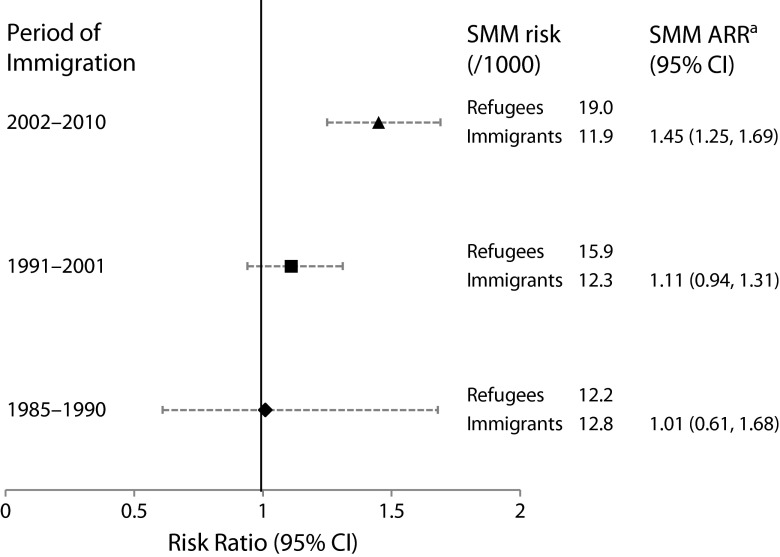
Methods: We linked 1,154,421 Ontario hospital deliveries (2002-2011) to immigration records (1985-2010) to determine the incidence of an SMM composite indicator and its subtypes. We determined SMM incidence according to immigration periods, which were characterized by lifting restrictions for all HIV-positive immigrants (in 1991) and refugees who may place "excessive demand" on government services (in 2002).
Results: Refugees had a higher risk of SMM (17.1 per 1000 deliveries) than did immigrants (12.1 per 1000) and nonimmigrants (12.4 per 1000). Among SMM subtypes, refugees had a much higher risk of HIV than did immigrants (risk ratio [RR] = 7.94; 95% confidence interval [CI] = 5.64, 11.18) and nonimmigrants (RR = 17.37; 95% CI = 12.83, 23.53). SMM disparities were greatest after the 2002 policy came into effect. After exclusion of HIV cases, SMM disparities disappeared.
Conclusions: An apparent higher risk of SMM among refugee women in Ontario, Canada is explained by their high prevalence of HIV, which increased over time parallel to admission policy changes favoring humanitarian protection.
Figures
References
-
- United Nations High Commissioner for Refugees. UNHCR mid-year trends in 2014. 2014 Available at: http://unhcr.org/54aa91d89.html. Accessed April 9, 2015.
-
- United Nations Relief and Works Agency. UNRWA in figures as of 1 July 2014. 2014 Available at: http://www.unrwa.org/sites/default/files/in_figures_july_2014_en_06jan20.... Accessed April 9, 2015.
-
- United Nations High Commissioner for Refugees. Displacement—the new 21st century challenge: UNHCR global trends 2012. 2013 Available at: http://unhcr.org/globaltrendsjune2013/UNHCR%20GLOBAL%20TRENDS%202012_V05.... Accessed May 15, 2015.
-
- Citizenship and Immigration Canada. Facts and figures 2013—immigration overview: permanent residents. 2014. Available at: http://www.cic.gc.ca/english/resources/statistics/facts2013/permanent/12.... Accessed May 1, 2015.
-
- Citizenship and Immigration Canada. Canada facts and figures: immigration overview permanent and temporary residents 2011. 2012 Available at: http://www.cic.gc.ca/english/pdf/research-stats/facts2011.pdf. Accessed May 15, 2015.
Publication types
MeSH terms
Grants and funding
LinkOut - more resources
Full Text Sources
Medical