


Editorial
doi: 10.1164/rccm.201507-1426ED.
Spotlight on Inflammation in Pulmonary Hypertension
Affiliations
- PMID: 26469840
- PMCID: PMC4642212
- DOI: 10.1164/rccm.201507-1426ED
Item in Clipboard
Editorial
Spotlight on Inflammation in Pulmonary Hypertension
Am J Respir Crit Care Med.
.
No abstract available
Figures
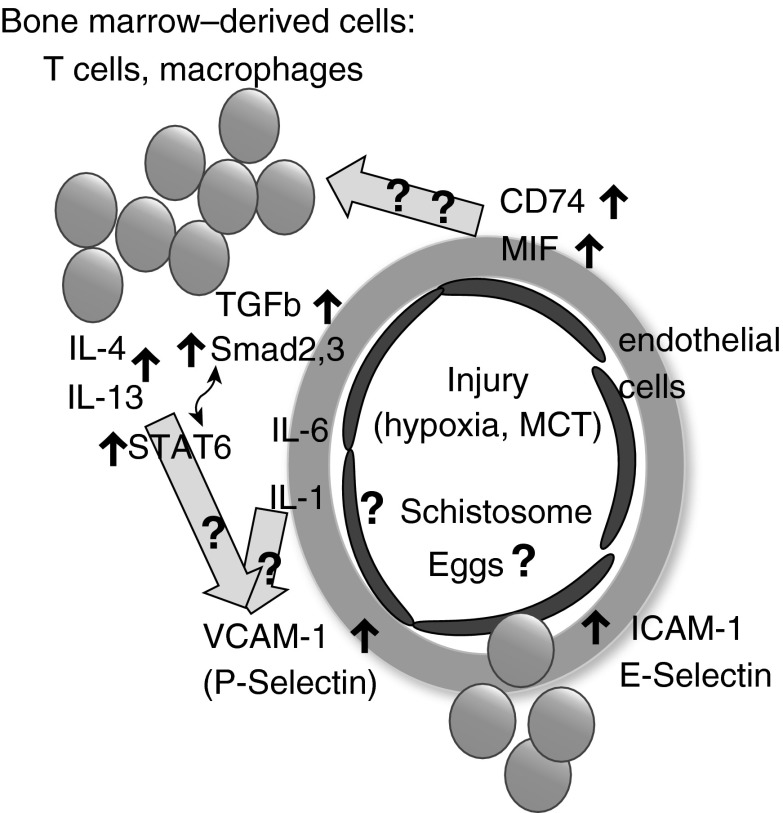
Networks of mediators of inflammation in pulmonary arterial hypertension identified by Le Hiress and colleagues (2) and by Kumar and colleagues (1). The figure schematically shows several cell types in a pulmonary artery from pulmonary arterial hypertension lungs: endothelial cells (dark); leukocytes, among them T cells and macrophages (dark); and the remodeled artery wall of smooth muscle cells and connective tissue (gray shaded circle). The articles by Le Hiress and colleagues (2) and by Kumar and colleagues (1) focused on the contributions of the endothelial cell–CD74–MIF axis (2) and the bone marrow–derived leukocytes–IL-4–IL-13–transforming growth factor β axis (1), respectively. The groups identified shared cells (T cells), mediators (IL-6), and processes (leukocyte migration). Block arrows with question marks indicate potential additional links between the networks studied by the two research groups. Although these additional molecular links could exist, it is possible that the processes studied by Le Hiress and colleagues (2) and Kumar and colleagues (1) are distinct because the initializing events were distinct (hypoxia, monocrotaline, idiopathic pulmonary arterial hypertension, and heritable pulmonary arterial hypertension vs. Schistosoma-associated pulmonary arterial hypertension). ICAM-1 = intercellular adhesion molecule 1; MCT = monocrotaline; MIF = macrophage inhibitory factor; STAT6 = signal transducer and activator of transcription 6; TGF-β = transforming growth factor β; VCAM-1 = vascular cell adhesion protein 1.
Comment on
-
The Causal Role of IL-4 and IL-13 in Schistosoma mansoni Pulmonary Hypertension.Am J Respir Crit Care Med. 2015 Oct 15;192(8):998-1008. doi: 10.1164/rccm.201410-1820OC. Am J Respir Crit Care Med. 2015. PMID: 26192556 Free PMC article.
-
Proinflammatory Signature of the Dysfunctional Endothelium in Pulmonary Hypertension. Role of the Macrophage Migration Inhibitory Factor/CD74 Complex.Am J Respir Crit Care Med. 2015 Oct 15;192(8):983-97. doi: 10.1164/rccm.201402-0322OC. Am J Respir Crit Care Med. 2015. PMID: 26203495
References
-
- Le Hiress M, Tu L, Ricard N, Phan C, Thuillet R, Fadel E, Dorfmüller P, Montani D, de Man F, Humbert M, et al. Proinflammatory signature of the dysfunctional endothelium in pulmonary hypertension: role of the macrophage migration inhibitory factor/CD74 complex. Am J Respir Crit Care Med. 2015;192:983–997. - PubMed
-
- Becker H, Willeke P, Schotte H, Domschke W, Gaubitz M. Macrophage migration inhibitory factor may contribute to vasculopathy in systemic sclerosis. Clin Rheumatol. 2008;27:1307–1311. - PubMed
-
- Zhang B, Luo Y, Liu ML, Wang J, Xu DQ, Dong MQ, Liu Y, Xu M, Dong HY, Zhao PT, et al. Macrophage migration inhibitory factor contributes to hypoxic pulmonary vasoconstriction in rats. Microvasc Res. 2012;83:205–212. - PubMed
Publication types
MeSH terms
Substances
Grants and funding
LinkOut - more resources
Full Text Sources
Medical
