. 2015 Dec;42(12):3105-16.
doi: 10.1111/ejn.13103.

Chemogenetic manipulation of ventral pallidal neurons impairs acquisition of sign-tracking in rats

Affiliations

Chemogenetic manipulation of ventral pallidal neurons impairs acquisition of sign-tracking in rats

Stephen E Chang et al. Eur J Neurosci. 2015 Dec.

Abstract

Cues associated with rewarding events acquire value themselves as a result of the incentive value of the reward being transferred to the cue. Consequently, presentation of a reward-paired cue can trigger reward-seeking behaviours towards the cue itself (i.e. sign-tracking). The ventral pallidum (VP) has been demonstrated to be involved in a number of motivated behaviours, both conditioned and unconditioned. However, its contribution to the acquisition of incentive value is unknown. Using a discriminative autoshaping procedure with levers, the effects of disrupting VP activity in rats on the emergence of sign-tracking was investigated using chemogenetics, i.e. Designer Receptors Exclusively Activated by Designer Drugs (DREADDs). Transient disruption of VP neurons [activation of the inhibitory hM4D(Gi) DREADD through systemic injections of clozapine N-oxide (CNO) prior to each autoshaping session] impaired acquisition of sign-tracking (lever press rate) without having any effect on approach to the site of reward delivery (i.e. goal-tracking) or on the expression of sign-tracking after it was acquired. In addition, electrophysiological recordings were conducted in freely behaving rats following VP DREADD activation. The majority of VP units that were responsive to CNO injections exhibited rapid inhibition relative to baseline, a subset of CNO-responsive units showed delayed excitation, and a smaller subset displayed a mixed response of inhibition and excitation following CNO injections. It is argued that disruption of VP during autoshaping specifically disrupted the transfer of incentive value that was attributed to the lever cue, suggesting a surprisingly fundamental role for the VP in acquiring, compared with expressing, Pavlovian incentive values.

Keywords: DREADDs; reward; sign-tracking; ventral pallidum.


Figures

Figure 1
Figure 1
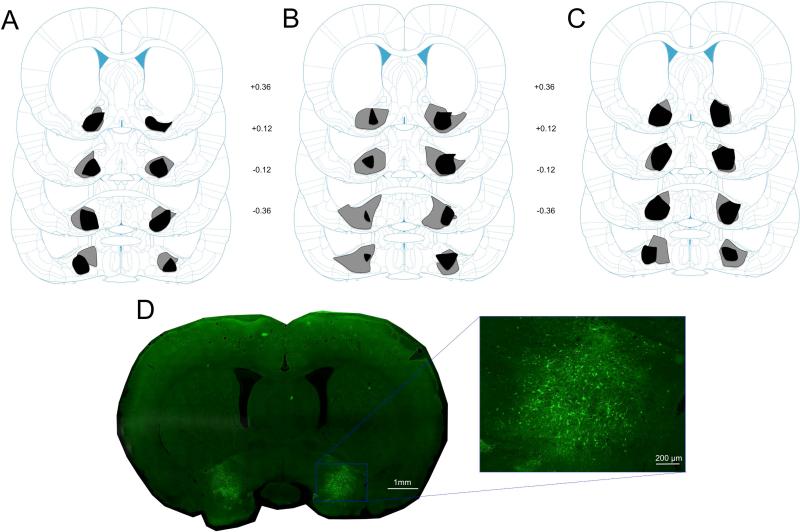
Histological results. (A) Schematic representation of hM4D(Gi)-mCitrine expression in the VP showing the minimum (black) and maximum (gray) amount of expression in rats from Group Gi-CNO (n = 7) from Experiment 1. (B) Schematic representation of hM4D(Gi)-mCitrine expression in the VP showing the minimum (black) and maximum (gray) amount of expression in rats from Group Gi-CNO (n = 7) from Experiment 2. (C) Schematic representation of hM4D(Gi)-mCitrine expression in the VP showing the minimum (black) and maximum (gray) amount of expression in rats from Group Gi-CNO (n = 6) from Experiment 3. (D) Representative brain slice showing hM4D(Gi)-mCitrine expression in the VP. Numbers represent the number of mm from bregma. Coronal slices adapted from Paxinos & Watson (2009).
Figure 2
Figure 2
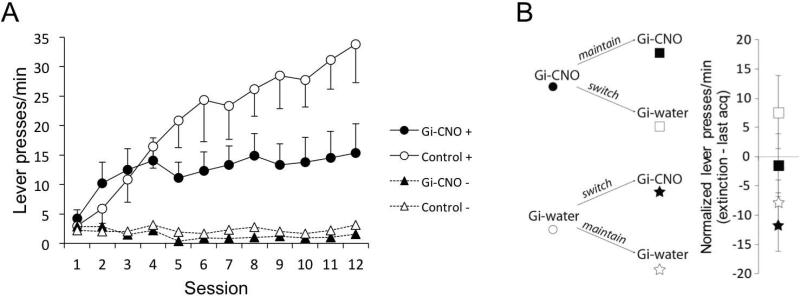
Behavioral results. (A) Gi-CNO rats showed attenuated levels of sign-tracking compared to Control rats as measured by lever presses per minute in Experiment 1. (B) Switching rats from Experiment 1 onto or off of CNO had no effect on expression of sign-tracking. This CNO/water reassignment procedure maintained n's of 8 for the main comparisons. Error bars represent ±SEM.
Figure 3
Figure 3
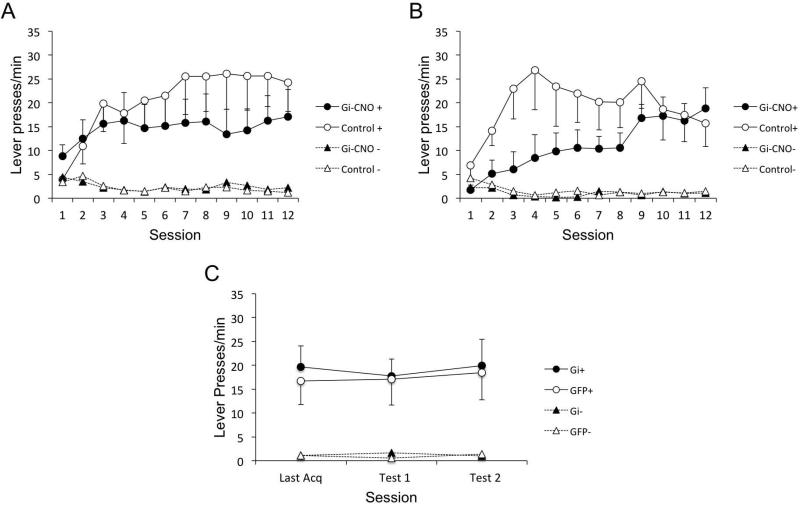
Behavioral results. (A) Gi-CNO rats showed attenuated levels of sign-tracking compared to Control rats as measured by lever presses per minute in Experiment 2. (B) Gi-CNO rats show slower acquisition of sign-tracking compared to Control rats in Experiment 3. (C) Switching rats from Experiment 3 off of CNO had no effect on expression of sign-tracking. Error bars represent ±SEM.
Figure 4
Figure 4
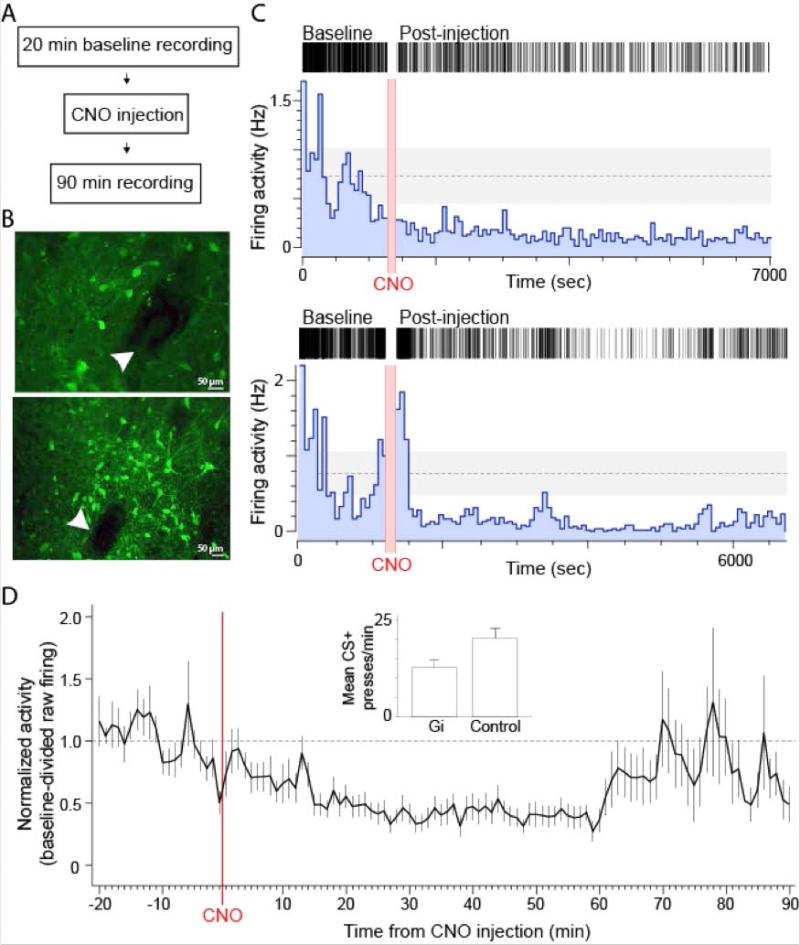
CNO-evoked inhibition of VP activity in behaving rats. (A) Recording timeline. (B) Two example photomicrographs showing VP neurons expressing hM4D(Gi)-mCitrine adjacent to tetrode lesion marks (white arrowheads). (C) Two example raster and histogram plots of VP units exhibiting a suppression of firing activity after CNO injection. (D) Baseline-divided activity (mean ±SEM) of the population of inhibited units. Insert graph: average CS+ lever presses for all Gi and Control rats combined (comparison: F(1, 42) = 5.25, p = 0.027) for reference to recording data.
Figure 5
Figure 5
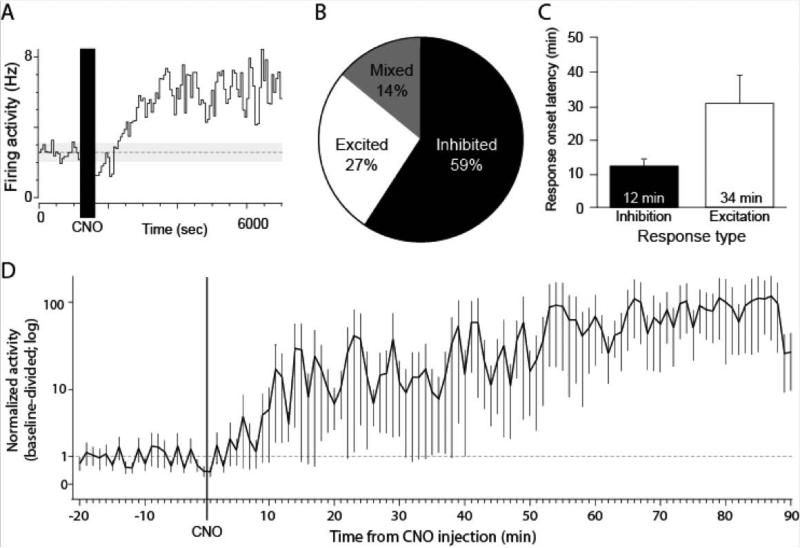
Mixed effects of CNO on VP activity. (A) Example VP unit exhibiting long-latency firing excitation after CNO injection. (B) Population distribution of VP units responsive to CNO. (C) Average response latency after CNO in inhibited and excited units. (D) Baseline-divided activity (mean ±SEM) of the population of excited units.

References

    1. Anikeeva P, Andalman AS, Witten I, Warden M, Goshen I, Grosenick L, et al. Optetrode: A multichannel readout for optogenetic control in freely moving mice. Nat Neurosci. 2011;15:163–170. - PMC - PubMed
    1. Armbruster BN, Li X, Pausch MH, Herlitze S, Roth BL. Evolving the lock to fit the key to create a family of G protein-coupled receptors potently activated by an inert ligand. Proc Natl Acad Sci USA. 2007;104:5163–5168. - PMC - PubMed
    1. Beaver JD, Lawrence AD, van Ditzhuijzen J, Davis MH, Woods A, Calder AJ. Individual differences in reward drive predict neural responses to images of food. J Neurosci. 2006;26:5160–5166. - PMC - PubMed
    1. Berridge KC. Motivation concepts in behavioral neuroscience. Physiol Behav. 2004;81:179–209. - PubMed
    1. Berridge KC, Robinson TE, Aldridge JW. Dissecting components of reward: ‘liking’, ‘wanting’, and learning. Curr Opin Pharmacol. 2009;9:65–73. - PMC - PubMed

Publication types

MeSH terms

LinkOut - more resources