. 2016 Oct;34(10):2084-101.
doi: 10.1080/07391102.2015.1108231. Epub 2016 Jan 28.

Analysis of non-peptidic compounds as potential malarial inhibitors against Plasmodial cysteine proteases via integrated virtual screening workflow

Affiliations

Analysis of non-peptidic compounds as potential malarial inhibitors against Plasmodial cysteine proteases via integrated virtual screening workflow

Thommas M Musyoka et al. J Biomol Struct Dyn. 2016 Oct.

Abstract

Falcipain-2 (FP-2) and falcipain-3 (FP-3), haemoglobin-degrading enzymes in Plasmodium falciparum, are validated drug targets for the development of effective inhibitors against malaria. However, no commercial drug-targeting falcipains has been developed despite their central role in the life cycle of the parasites. In this work, in silico approaches are used to identify key structural elements that control the binding and selectivity of a diverse set of non-peptidic compounds onto FP-2, FP-3 and homologues from other Plasmodium species as well as human cathepsins. Hotspot residues and the underlying non-covalent interactions, important for the binding of ligands, are identified by interaction fingerprint analysis between the proteases and 2-cyanopyridine derivatives (best hits). It is observed that the size and chemical type of substituent groups within 2-cyanopyridine derivatives determine the strength of protein-ligand interactions. This research presents novel results that can further be exploited in the structure-based molecular-guided design of more potent antimalarial drugs.

Keywords: docking; falcipains; homology modelling; malaria; molecular dynamics.


Figures

Figure 1
Figure 1
Graphical workflow for identification of FP-2/3 homologs (sequence and structure) and analysis of non-peptidic compounds as potential inhibitors via in silico approaches. Bold and in brackets are the key databases, web-servers and tools used.
Figure 2
Figure 2
2-D structures of the different sets of non-peptidic compounds used in this study.
Figure 3
Figure 3
Sequence analysis and subsite amino acid composition of FP-2, FP-3 and homologs. (a) MAFFT multiple sequence output of FP-2/3 and homologs showing conservation of functional and structural residues. The Clan CA characteristic catalytic triad residues are indicated with an asterisk. The two unique inserts in all plasmodial proteases are indicated with a black dashed box. (b) Summary of the amino acid composition (table) and conservation (sequence logo) of all four subsites for FP-2/3 and homologs as determined by WebLogo. The relative height of each letter and total height indicates the relative frequency of corresponding aa and information content respectfully per site in all the sequences.
Figure 4
Figure 4
A heatmap showing the interaction free energies of all compounds when docked against plasmodial cysteine proteases and human cathepsins using AutoDock4.2. The energy code ranges from high (yellow) to low (black).
Figure 5
Figure 5
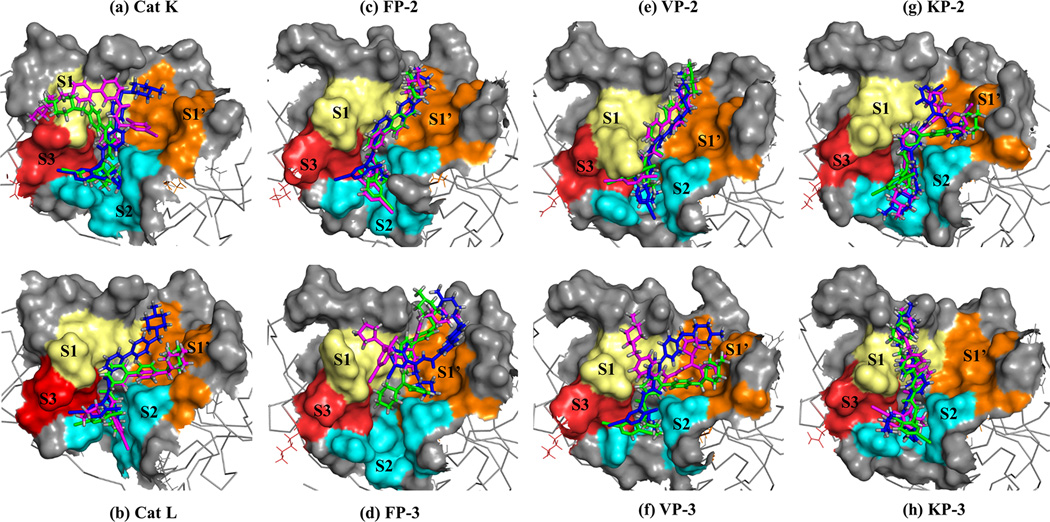
Binding modes of CPG, CPH and CPI compounds in the binding pocket of human cathepsins and plasmodial homologs. Surface view of the orientation of CPG (blue), CPH (magenta) and CPI (green) on the S1 (pale yellow), S2 (cyan), S3 (brick-red) and S1’ (orange) of (a) Cat K, (b) Cat L, (c) FP-2, (d) FP-3), (e) VP-2, (f) VP-3, (g) KP-2) and (h) KP-3.
Figure 6
Figure 6
Stability of Protein-CPs complexes as determined by GROMACS tools during the last 6 ns of MD simulations. Graphs showing the mean values of RMSD for apo structures (a), protein-ligand complexes (b), ligands only (c) and the radius of gyration for protein-ligand complexes (d). Error bars show the standard deviations.
Figure 7
Figure 7
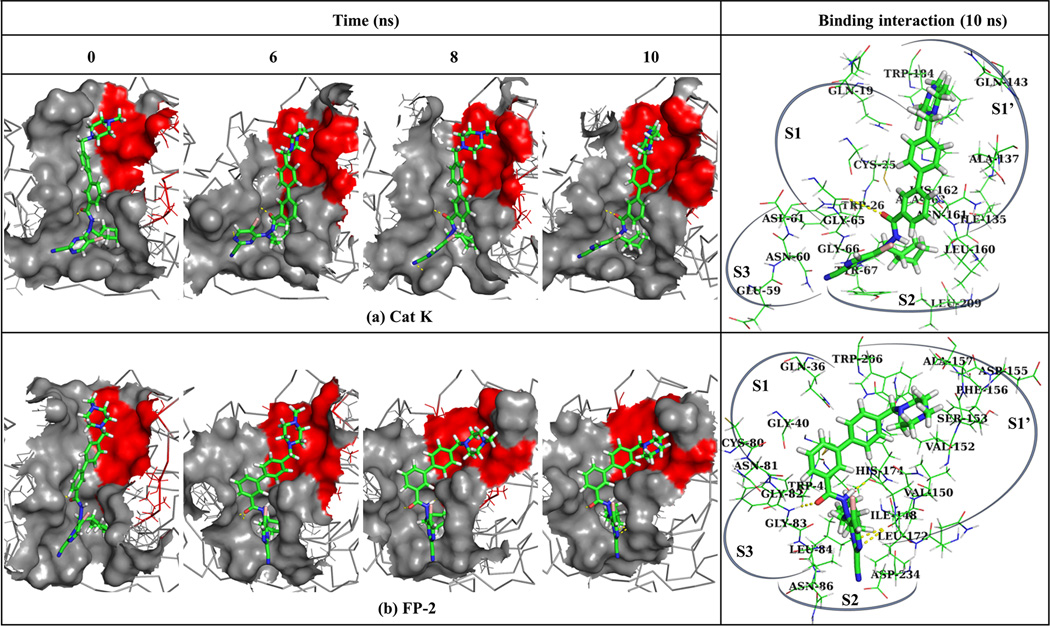
Conformational changes of CPG within active site pockets (a) Cat K and (b) FP-2 during MD simulations. The brick red surface shows the S1’ position. The corresponding panels on the right show the residues interacting with CPG in Cat K and FP-2 at 10 ns respectively. The selected regions show the different subsites that constitute the binding pocket. Yellow dashes represent hydrogen bonds between heavy atoms.
Figure 8
Figure 8
Subsite amino acid contributions to BFE for compound CPG, CPH and CPI.
Figure 9
Figure 9
Per-residue decomposition fingerprint of compound CPG, CPH and CPI in complex with (a) Cat K (b) Cat L (c) FP-2 (d) FP-3 (e) VP-2 and (f) VP-3.

References

    1. Ang KKH, Ratnam J, Gut J, Legac J, Hansell E, Mackey ZB, Renslo AR. Mining a cathepsin inhibitor library for new antiparasitic drug leads. PLoS Neglected Tropical Diseases. 2011;5(5):e1023. - PMC - PubMed
    1. Ashley E, McGready R, Proux S, Nosten F. Malaria. Travel Medicine and Infectious Disease. 2006;4(3-4):159–173. - PubMed
    1. Aurrecoechea C, Brestelli J, Brunk BP, Dommer J, Fischer S, Gajria B, Wang H. PlasmoDB: a functional genomic database for malaria parasites. Nucleic Acids Research. 2009;37(Database issue):D539–D543. - PMC - PubMed
    1. Batra S, Sabnis YA, Rosenthal PJ, Avery MA. Structure-based approach to falcipain-2 inhibitors: synthesis and biological evaluation of 1,6,7-trisubstituted dihydroisoquinolines and isoquinolines. Bioorganic & Medicinal Chemistry. 2003;11(10):2293–2299. - PubMed
    1. Benkert P, Biasini M, Schwede T. Toward the estimation of the absolute quality of individual protein structure models. Bioinformatics (Oxford, England) 2011;27(3):343–350. - PMC - PubMed

MeSH terms