


Projected growth of the adult congenital heart disease population in the United States to 2050: an integrative systems modeling approach
- PMID: 26472940
- PMCID: PMC4606959
- DOI: 10.1186/s12963-015-0063-z
Projected growth of the adult congenital heart disease population in the United States to 2050: an integrative systems modeling approach
Abstract
Background: Mortality for children with congenital heart disease (CHD) has declined with improved surgical techniques and neonatal screening; however, as these patients live longer, accurate estimates of the prevalence of adults with CHD are lacking.
Methods: To determine the prevalence and mortality trends of adults with CHD, we combined National Vital Statistics System data and National Health Interview Survey data using an integrative systems model to determine the prevalence of recalled CHD as a function of age, sex, and year (by recalled CHD, we mean positive response to the question "has a doctor told you that (name) has congenital heart disease?", which is a conservative lower-bound estimate of CHD prevalence). We used Human Mortality Database estimates and US Census Department projections of the US population to calculate the CHD-prevalent population by age, sex, and year. The primary outcome was prevalence of recalled CHD in adults from 1970 to 2050; the secondary outcomes were birth prevalence and mortality rates by sex and women of childbearing age (15-49 years).
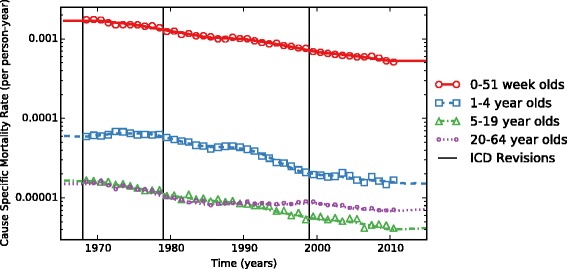
Results: The birth prevalence of recalled CHD in 2010 for males was 3.29 per 1,000 (95 % uncertainty interval (UI) 2.8-3.6), and for females was 3.23 per 1,000 (95 % UI 2.3-3.6). From 1968 to 2010, mortality among zero to 51-week-olds declined from 170 to 53 per 100,000 person years. The estimated number of adults (age 20-64 years) with recalled CHD in 1968 was 118,000 (95 % UI 72,000-150,000). By 2010, there was an increase by a factor of 2.3 (95 % UI 2.2-2.6), to 273,000 (95 % UI 190,000-330,000). There will be an estimated 510,000 (95 % UI: 400,000-580,000) in 2050. The prevalence of adults with recalled CHD will begin to plateau around the year 2050. In 2010, there were 134,000 (95 % UI 69,000-160,000) reproductive-age females (age 15-49 years) with recalled CHD in the United States.
Conclusion: Mortality rates have decreased in infants and the prevalence of adults with CHD has increased but will slow down around 2050. This population requires adult medical systems with providers experienced in the care of adult CHD patients, including those familiar with reproduction in women with CHD.
Keywords: Congenital; Heart defects; Mortality; Population; Survival; Vital statistics.
Figures



References
LinkOut - more resources
Full Text Sources
Other Literature Sources
