Review
. 2015 Oct 16;5(10):e361.
doi: 10.1038/bcj.2015.89.

Mutation of chromatin modifiers; an emerging hallmark of germinal center B-cell lymphomas

Affiliations
Review

Mutation of chromatin modifiers; an emerging hallmark of germinal center B-cell lymphomas

M A Lunning et al. Blood Cancer J. .

Abstract

Subtypes of non-Hodgkin's lymphomas align with different stages of B-cell development. Germinal center B-cell (GCB)-like diffuse large B-cell lymphoma (DLBCL), follicular lymphoma (FL) and Burkitt's lymphoma (BL) each share molecular similarities with normal GCB cells. Recent next-generation sequencing studies have gained insight into the genetic etiology of these malignancies and revealed a high frequency of mutations within genes encoding proteins that modifying chromatin. These include activating and inactivating mutations of genes that perform post-translational modification of histones and organize chromatin structure. Here, we discuss the function of histone acetyltransferases (CREBBP, EP300), histone methyltransferases (KDM2C/D, EZH2) and regulators of higher order chromatin structure (HIST1H1C/D/E, ARID1A and SMARCA4) that have been reported to be mutated in ⩾5% of DLBCL, FL or BL. Mutations of these genes are an emerging hallmark of lymphomas with GCB-cell origins, and likely represent the next generation of therapeutic targets for these malignancies.


Conflict of interest statement

MAL is a consultant for Celgene, Genentech, Spectrum, TG Therapeutics and Gilead. MRG declares no conflict of interest.

Figures
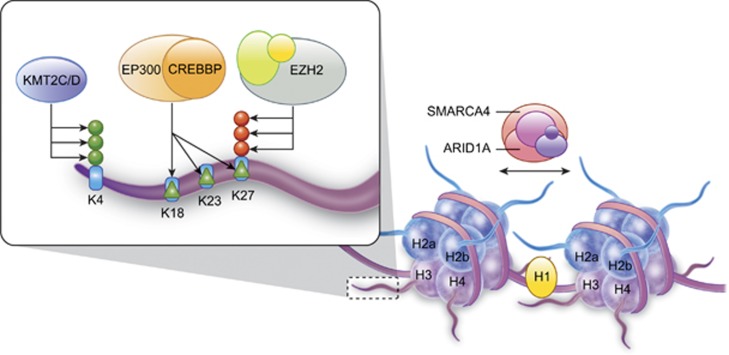
Figure 1
Figure 1
Function of chromatin modifying and organizing genes that are mutated in GCB lymphomas. A diagramatic representation shows DNA wrapped around histone octamers, consisting of histone H2a, H2b, H3 and H4, to form a nucleosome. Linker DNA between nucleosomes is bound by histone H1, and nuceolsomes are shuffled along the DNA by the SWI/SNF complex that is illustrated to include ARID1A and SMARCA4. A magnified schematic of the tail of histone H3 shows the addition of activating H3K4me3 (green circles) by KMT2C/KMT2D. This promotes the addition of activating acetylation marks (green triangles) to multiple residues on the H3 tail by recruitment of the CREBBP/EP300 complex. Activating H3K4me3 and acetylation marks oppose, and are opposed by, the repressive H3K27me3 mark (red circles) that is written by the PRC2 complex that includes EZH2. Histone H1 genes (HIST1H1B/C/D/E), ARID1A, SMARCA4, KMT2C, KMT2D, EP300, CREBBP and EZH2 are each recurrently mutated in >5% of one or more subtype of lymphoma that resemble germinal center B cells (Figure 2).
Figure 2
Figure 2
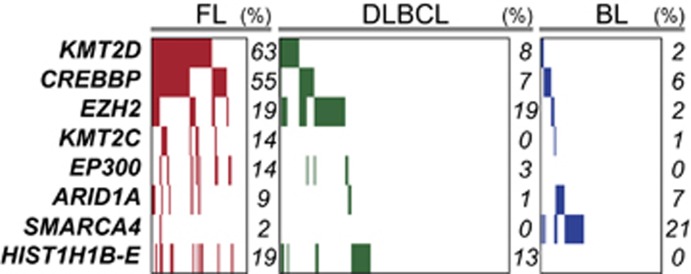
Frequency of chromatin modifying and organizing gene mutations in GCB lymphomas. Data from genome, exome and transcriptome sequencing studies of FL, BL and DLBCL with sufficient data quality, , , , , , , , , are summarized. Individual tumors are represented in columns and genes in rows. Colored bars indicate the presence of a somatic mutation and the percentage of tumors with mutations each gene are annotated to the right for each disease. Mutations of chromatin modifying and organizing genes are found in 84% (54/64) of FL tumors, 40% (62/155) of DLBCL tumors and 35% (29/82) of BL tumors. It should be noted, however, that DLBCL tumor are not divided by cell of origin subtypes within this diagram, and the majority of these mutations likely stratify within the GCB-like subtype. FLs are characterized by high frequencies of CREBBP and KMT2D mutations, DLBCLs are characterized by frequent mutations of HISTH1 family genes and EZH2, and BLs are characterized by high frequencies of SWI/SNF component (ARID1A, SMARCA4) mutations.

References

    1. 1Kuppers R. Mechanisms of B-cell lymphoma pathogenesis. Nat Rev Cancer 2005; 5: 251–262. - PubMed
    1. 2Shaffer AL, Rosenwald A, Staudt LM. Lymphoid malignancies: the dark side of B-cell differentiation. Nat Rev Immunol 2002; 2: 920–932. - PubMed
    1. 3Alizadeh AA, Eisen MB, Davis RE, Ma C, Lossos IS, Rosenwald A et al. Distinct types of diffuse large B-cell lymphoma identified by gene expression profiling. Nature 2000; 403: 503–511. - PubMed
    1. 4Pasqualucci L. The genetic basis of diffuse large B-cell lymphoma. Curr Opin Hematol 2013; 20: 336–344. - PMC - PubMed
    1. 5Molyneux EM, Rochford R, Griffin B, Newton R, Jackson G, Menon G et al. Burkitt's lymphoma. Lancet 2012; 379: 1234–1244. - PubMed

Publication types