


doi: 10.3390/md13106274.
Macrolactone Nuiapolide, Isolated from a Hawaiian Marine Cyanobacterium, Exhibits Anti-Chemotactic Activity
Affiliations
- PMID: 26473885
- PMCID: PMC4626689
- DOI: 10.3390/md13106274
Item in Clipboard
Macrolactone Nuiapolide, Isolated from a Hawaiian Marine Cyanobacterium, Exhibits Anti-Chemotactic Activity
Mar Drugs.
.
Abstract
A new bioactive macrolactone, nuiapolide (1) was identified from a marine cyanobacterium collected off the coast of Niihau, near Lehua Rock. The natural product exhibits anti-chemotactic activity at concentrations as low as 1.3 μM against Jurkat cells, cancerous T lymphocytes, and induces a G2/M phase cell cycle shift. Structural characterization of the natural product revealed the compound to be a 40-membered macrolactone with nine hydroxyl functional groups and a rare tert-butyl carbinol residue.
Keywords: cell cycle; chemotaxis; cyanobacteria; macrolactone; polyketide.
Figures
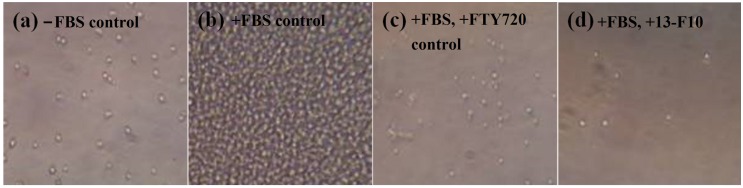
Evaluation of Jurkat cultures in the Boyden chamber assay. Images of microscope fields of the bottom well after 24 h of incubation. (a) Bottom well received no FBS and no test substance; (b) Bottom well received 10% FBS and no test substance; (c) Bottom well received 10% FBS and FTY720 (5 µg/mL); (d) Bottom well received 10% FBS and 13-F10 extract (25 µg/mL). Shrinkage of cells in (c) is indicative of cell death.
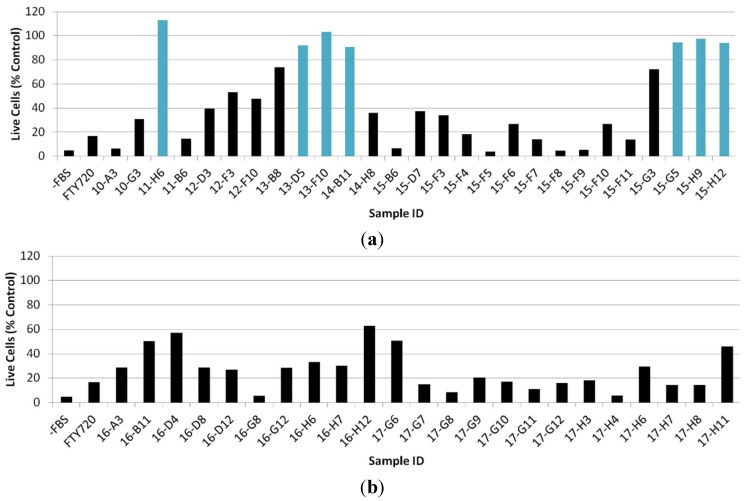
Cytotoxicity profile analysis of extracts: The turquoise bar represents samples where the percentage of live cells is ≥90% of the control. The black bar represents samples where the percentage of live cells is <90%. Controls included wells grown without FBS (−FBS) and with FTY720 (1 or 5 µg/mL). Sample codes are library plate number and coordinate on the plate. (a) Sample set 10- to 15- and (b) sample set 16- and 17-.
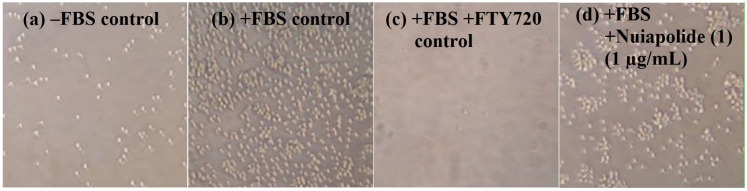
Evaluation of nuiapolide (1) activity at 1 µg/mL. Images of microscope fields of the bottom well after 24 h of incubation. (a) Bottom well received no FBS and no test substance; (b) Bottom well received 10% FBS and no test substance; (c) Bottom well received 10% FBS and FTY720 (5 µg/mL); (d) Bottom well received 10% FBS and nuiapolide (1) (1 µg/mL).
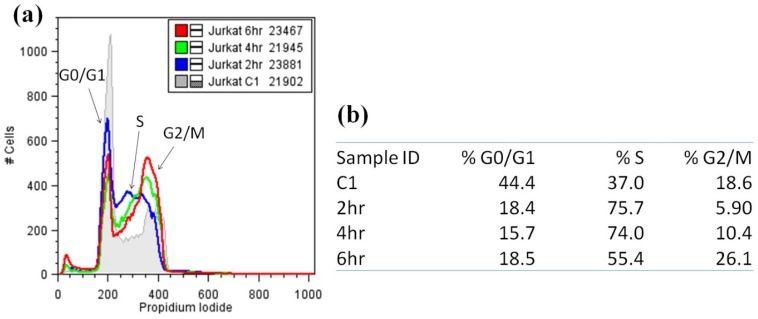
Cell cycle analysis of Jurkat cells treated with nuiapolide (1), 5 μg/mL. (a) Histograms of Jurkat cells stained with propidium iodide (numbers in the legend indicate the number of cells plotted for each treatment); (b) Table providing the % of cells distributed in each stage of the cell cycle.
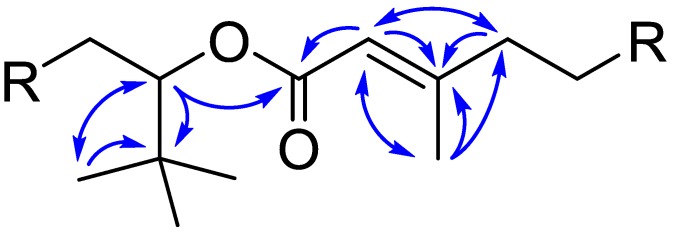
Partial structure of nuiapolide (1) with key HMBC correlations.
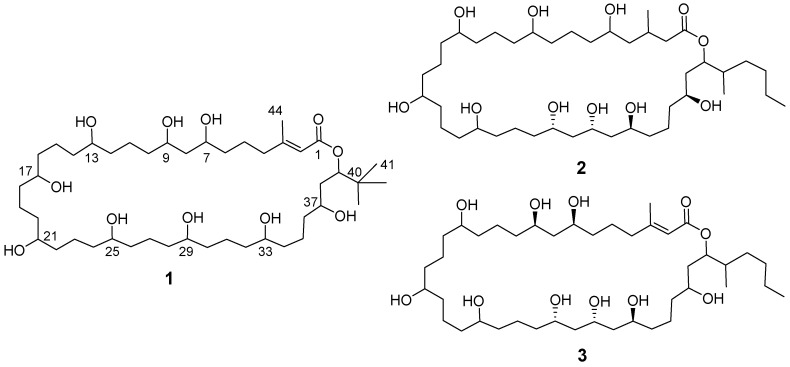
Structure of nuiapolide (1) and caylobolides A (2) and B (3).
References
-
- Attinger P. La médicine mésopotamienne. J. Med. Cuneif. 2008;11–12:1–96. - PubMed
-
- Nunn J. Ancient Egyptian Medicine. University of Oklahoma Press; Norman, OK, USA: 2002.
-
- Aggarwal B.B., Sundaram C., Malani N., Ichikawa H. Curcumin: The Indian solid gold. Adv. Exp. Med. Biol. 2007;595:1–75. - PubMed
-
- Hong F. History of medicine in China. McGill J. Med. 2004;8:7984.
-
- Fleming A. On the antibacterial action of cultures of a penicillium, with special reference to their use in the isolation of B. influenza. Br. J. Exp. Pathol. 1929;10:226–236.
Publication types
MeSH terms
Substances
Grants and funding
LinkOut - more resources
Full Text Sources
Other Literature Sources
Molecular Biology Databases
