. 2016 Sep;84 Suppl 1(Suppl Suppl 1):34-50.
doi: 10.1002/prot.24942. Epub 2015 Nov 16.

Some of the most interesting CASP11 targets through the eyes of their authors

Affiliations

Some of the most interesting CASP11 targets through the eyes of their authors

Andriy Kryshtafovych et al. Proteins. 2016 Sep.

Abstract

The Critical Assessment of protein Structure Prediction (CASP) experiment would not have been possible without the prediction targets provided by the experimental structural biology community. In this article, selected crystallographers providing targets for the CASP11 experiment discuss the functional and biological significance of the target proteins, highlight their most interesting structural features, and assess whether these features were correctly reproduced in the predictions submitted to CASP11. Proteins 2016; 84(Suppl 1):34-50. © 2015 The Authors. Proteins: Structure, Function, and Bioinformatics Published by Wiley Periodicals, Inc.

Keywords: CASP; NMR; X-ray crystallography; protein structure prediction.


Figures

Figure 1
Figure 1
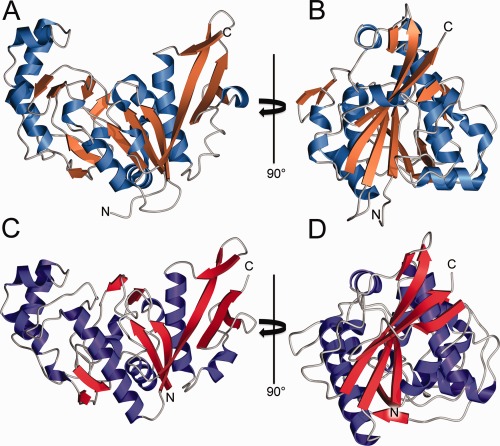
Experimental and predicted structures of E. coli YaaA. (A and B) The experimentally determined crystal structure shown as a ribbon diagram, with β‐strands colored orange and α‐helices blue. YaaA possesses a new fold and has an apical depression that is rich in basic residues. (C, D) CASP model T0806TS064_1‐D1 is shown in the same orientation as the experimental structure in panels A and B. The excellent overall agreement between experiment and prediction is apparent. In some areas, relatively minor differences in backbone torsion angles result in differing secondary structure assignments.
Figure 2
Figure 2
The laminin L4 domain. (A) Context of L4 domains within intact laminin. The position of the LF domain, another predicted CBM, is also shown. (B) (Top) Ribbon diagram (amino terminus red, carboxy terminus blue) of the high‐resolution structure of an L4 domain (PDB codes 4YEP and 4YEQ), viewed in two orientations. (Bottom) Structure of a carbohydrate‐binding protein in complex with oligosaccharide (PDB code 1GNY). The bound oligosaccharide is shown in gray space‐filling format. (C) Amino acid residue K167 (space‐filling format with the side‐chain nitrogen atom in blue) is in surface‐exposed positions interacting with acidic and aromatic amino acids (purple sticks) in CASP models (top and middle), whereas the K167 side‐chain is in fact buried in the laminin L4 structure (bottom) and found interacting with backbone carbonyl groups (yellow C=O labels).
Figure 3
Figure 3
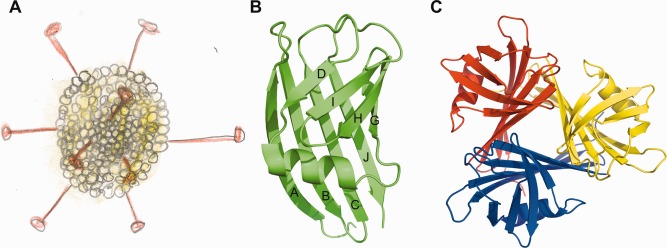
Snake Adenovirus 1 and its fiber head protein. (A) Schematic drawing of an icosahedral adenovirus with trimeric fiber proteins protruding from each of the twelve vertices. The head domains are located at the distal ends of the fibers. (B and C) Cartoon representation of a fiber head monomer (A) and a fiber head trimer (C). In part B the β‐strands are labeled. Parts B and C were prepared using the PyMOL Molecular Graphics System, Version 1.4.1, Schrödinger LLC and were first published in Singh 2014.17
Figure 4
Figure 4
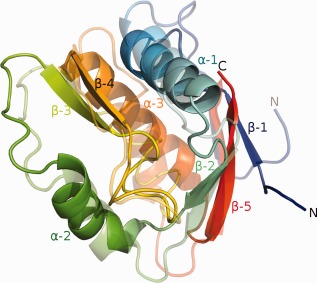
The NucB protein. A ribbon diagram of the crystal structure of NucB (solid colors) superimposed on the best prediction, TS064_2 (semitransparent colors). In both instances, the ribbon is color‐ramped from blue to red, corresponding to the N‐ and C‐termini, respectively.
Figure 5
Figure 5
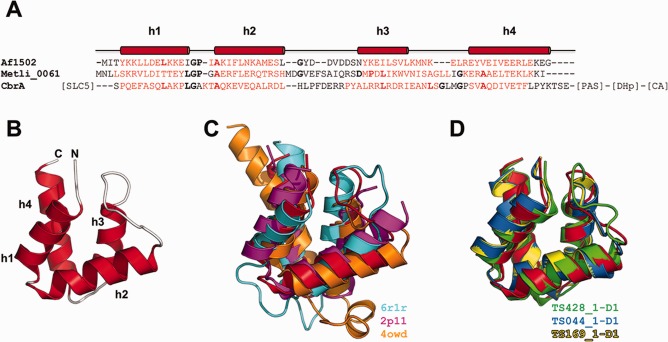
The Af1502 protein. (A) Sequence alignment of Af1502 with a stand‐alone STAC protein from Methanofollis liminatans and the STAC domain of the histidine kinase CbrA from Pseudomonas aeruginosa, colored according to the consensus secondary structure prediction (red = helix; black = loop). The observed secondary structure is shown above the alignment. Residues in bold characters are observed in a majority of STAC proteins. Further domains of CbrA are indicated in square brackets. (B) Crystal structure of Af1502 (PDB code 5A1Q). (C) Superimposition of Af1502 (red) to the best‐scoring DALI matches, as listed in the figure. All three matches are made to substructures within larger proteins. (D) Superimposition of Af1502 (red) to the best‐scoring predictions.
Figure 6
Figure 6
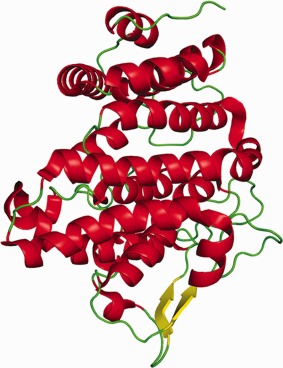
Cartoon representation of the monotreme lactation protein (MLP).
Figure 7
Figure 7
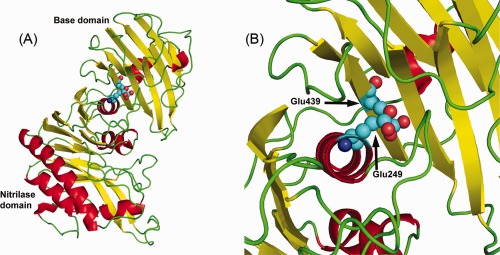
The vanin 1 protein. (A) The overall structure of human vanin 1 protein consisting of the N‐terminal nitrilase domain and the C‐terminal base domain. (B) One of the more interesting features of the structure—two glutamic residues, one from each domain, that are buried in the interface without any compensatory charges or other ions within hydrogen bond distance.
Figure 8
Figure 8
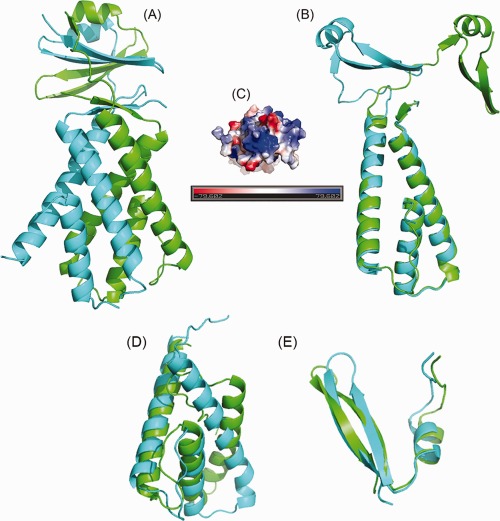
Cartoon representation of VCID6010. (A) This protein is composed of two domains: a lower helical domain and an upper β‐sheet containing domain. Each monomer in the dimer is colored differently to highlight the domain interactions and strand exchange. The lower, helical portion forms a teepee like shape composed of six helices. The upper domain of the protein contains a β‐sheet and is translated behind the axis of symmetry of the helical domain. (B) Overlay of chain A and chain B. The N‐terminal, α‐helical domains of the two chains overlay nearly perfectly whereas the C‐terminal are very dissimilar. Chain A is colored green and chain B is colored cyan. (C) Electrostatic charge distribution on VCID6010 showing a patch of positively charged residues on the bottom of the molecule. (D, E) CASP11 models (green) giving the best overlay with the VCID6010 structural domains (cyan). (D) Model T0820TS169_1‐D1 from the Lee group superimposed onto the N‐terminal domain; (E) model T0820TS328_1‐D2 from the RosEda group superimposed onto the C‐terminal domain. The figures were generated with PyMol (www.pymol.org).
Figure 9
Figure 9
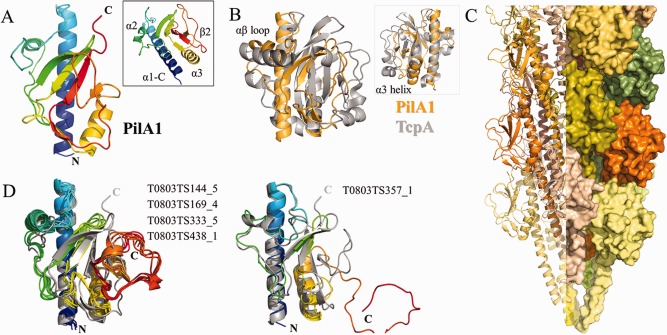
PilA1 from Clostridium difficile. (A) Ribbon diagram of PilA1 colored in a gradient from blue (N‐terminus) to red (C‐terminus). The inset panel shows the novel β2 sheet. (B) Superposition of PilA1 (gold) and TcpA (gray). The inset panel shows the reverse side, highlighting the similarity of the position of the α3 helix in the two pilins. (C) Model of a pilus fiber composed of PilA1; each subunit is colored individually. (D) CASP models, colored in gradients from blue (N‐terminus) to red (C‐terminus) superimposed onto the PilA1 crystal structure (gray). The figure was created in PyMol.

References

    1. Moult J, Fidelis K, Kryshtafovych A, Schwede T, Tramontano A. Critical assessment of methods of protein structure prediction (CASP) ‐ round x. Proteins 2014;82:1–6. - PMC - PubMed
    1. Kryshtafovych A, Moult J, Bartual SG, Bazan JF, Berman H, Casteel DE, Christodoulou E, Everett JK, Hausmann J, Heidebrecht T, Hills T, Hui R, Hunt JF, Seetharaman J, Joachimiak A, Kennedy MA, Kim C, Lingel A, Michalska K, Montelione GT, Otero JM, Perrakis A, Pizarro JC, van Raaij MJ, Ramelot TA, Rousseau F, Tong L, Wernimont AK, Young J, Schwede T. Target highlights in CASP9: experimental target structures for the critical assessment of techniques for protein structure prediction. Proteins 2011;79:6–20. - PMC - PubMed
    1. Kryshtafovych A, Moult J, Bales P, Bazan JF, Biasini M, Burgin A, Chen C, Cochran FV, Craig TK, Das R, Fass D, Garcia‐Doval C, Herzberg O, Lorimer D, Luecke H, Ma X, Nelson DC, van Raaij MJ, Rohwer F, Segall A, Seguritan V, Zeth K, Schwede T. Challenging the state of the art in protein structure prediction: highlights of experimental target structures for the 10th Critical Assessment of Techniques for Protein Structure Prediction Experiment CASP10. Proteins 2014;82:26–42. - PMC - PubMed
    1. Kryshtafovych A, Monastyrskyy B, Fidelis K. CASP prediction center infrastructure and evaluation measures in CASP10 and CASP ROLL. Proteins 2014;82(Suppl 2):7–13. - PMC - PubMed
    1. Liu Y, Bauer SC, Imlay JA. The YaaA protein of the Escherichia coli OxyR regulon lessens hydrogen peroxide toxicity by diminishing the amount of intracellular unincorporated iron. J Bacteriol 2011;193:2186–2196. - PMC - PubMed

Publication types