. 2016 Feb 1;22(3):757-64.
doi: 10.1158/1078-0432.CCR-14-3100. Epub 2015 Oct 16.

The Colony-Stimulating Factor 3 Receptor T640N Mutation Is Oncogenic, Sensitive to JAK Inhibition, and Mimics T618I

Affiliations

The Colony-Stimulating Factor 3 Receptor T640N Mutation Is Oncogenic, Sensitive to JAK Inhibition, and Mimics T618I

Julia E Maxson et al. Clin Cancer Res. .

Abstract

Purpose: Colony-stimulating factor 3 receptor (CSF3R) mutations have been identified in the majority of chronic neutrophilic leukemia (CNL) and a smaller percentage of atypical chronic myeloid leukemia (aCML) cases. Although CSF3R point mutations (e.g., T618I) are emerging as key players in CNL/aCML, the significance of rarer CSF3R mutations is unknown. In this study, we assess the importance of the CSF3R T640N mutation as a marker of CNL/aCML and potential therapeutic target.

Experimental design: Sanger sequencing of leukemia samples was performed to identify CSF3R mutations in CNL and aCML. The oncogenicity of the CSF3R T640N mutation relative to the T618I mutation was assessed by cytokine independent growth assays and by mouse bone marrow transplant. Receptor dimerization and O-glycosylation of the mutants was assessed by Western blot, and JAK inhibitor sensitivity was assessed by colony assay.

Results: Here, we identify a CSF3R T640N mutation in two patients with CNL/aCML, one of whom was originally diagnosed with MDS and acquired the T640N mutation upon evolution of disease to aCML. The T640N mutation is oncogenic in cellular transformation assays and an in vivo mouse bone marrow transplantation model. It exhibits many similar phenotypic features to T618I, including ligand independence and altered patterns of O-glycosylation--despite the transmembrane location of T640 preventing access by GalNAc transferase enzymes. Cells transformed by the T640N mutation are sensitive to JAK kinase inhibition to a similar degree as cells transformed by CSF3R T618I.

Conclusions: Because of its similarities to CSF3R T618I, the T640N mutation likely has diagnostic and therapeutic relevance in CNL/aCML.


Conflict of interest statement

Conflicts of Interest: JEM, SBL, JDM, JCP, PG, SB, SLS, MLA, CAE, MML, and EAS have no conflicts to disclose. JWT and JG receive research funding from Incyte; and JG sits on advisory boards and receives honoraria from Incyte.

Figures
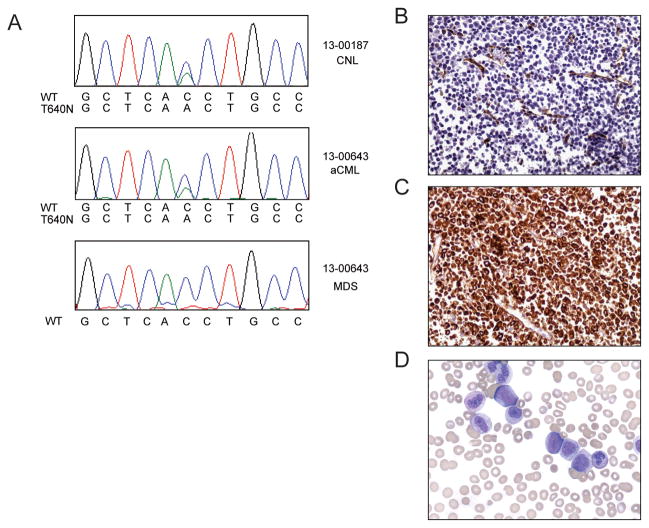
Figure 1
Figure 1. The CSF3R T640N mutation is found in patients with CML/aCML
(A) The T640N mutation was identified in Patient 13-187 who was diagnosed with de-novo CNL. Electroferograms from Sanger sequencing are shown. Patient 13-643 initially had a diagnosis of MDS and was subsequently diagnosed with aCML. Electropherograms are shown from the time of diagnosis of aCML and from a retrospective sample from the time of the original MDS diagnosis. Electropherogram peaks correspond to the following nucleotides: A (green), T (red), C (blue), G (black). Histology from a patient with aCML showing a myeloid proliferation. Cervical node showing (B) myeloid hyperplasia with CD34 immunohistochemical (IHC) staining indicating a low proportion of myeloblasts as well as the presence of endothelial structures. (C) myeloid proliferation showing myeloperoxidase positive IHC staining. (D) Peripheral blood showing spectrum of immature myeloid cells and granulocytic dysplasia.
Figure 2
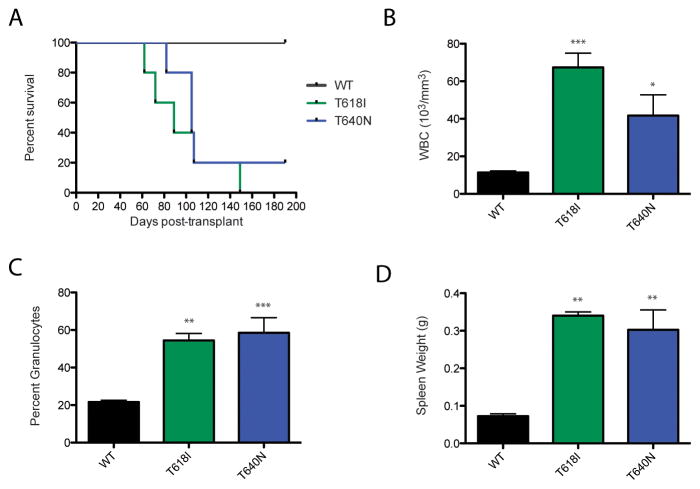
Figure 2. CSF3R T640N causes a lethal leukemia in a mouse model, similar to T618I
A mouse bone marrow transplant was performed to determine whether the T640N mutation could cause leukemia in a mouse model. (A) While WT CSF3R does not lead to death of the animals, the mice transplanted with the T640N or T618I constructs succumb to disease. (B) The CSF3R T640N and T618I transplanted mice have higher white blood cell counts than the mice transplanted with WT CSF3R. Average white blood cell counts measured with an Animal Blood Counter (Scil) are shown for the last data point prior to death of the mice, or euthanization for moribund animals or at the completion of the experiment for the WT CSF3R transplanted mice. Statistical significance was assessed using a one way ANOVA followed by a Bonferroni’s Multiple Comparison Test. * p<.05, ** p<.01, *** p<.001, and shown for each mutant relative to WT CSF3R (C) The CSF3R T640N and T618I mice had a statistically significant higher percent granulocytes than their WT counterparts prior to death (T618I, T640N) or euthanization at the conclusion of the experiment (WT CSF3R). Each individual mouse is represented in the plot along with the mean and standard error. (D) The CSF3R T618I and T640N transplanted mice have significantly larger spleens than their WT CSF3R counterparts. Spleen weight is shown in grams.
Figure 3
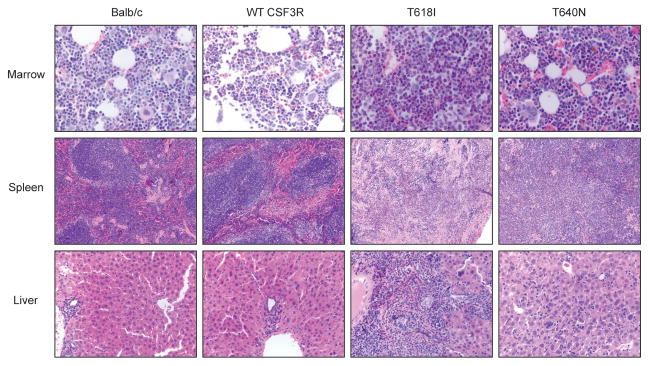
Figure 3. Histological analysis of T640N mice reveals less dramatic hypercellularity of bone marrow that in the CSF3R T618I mice
Femurs, spleen and livers were removed and fixed in 10% zinc formalin, section and stained with hematoxylin and eosin by the Histopathology Shared Resource at OHSU. Representative images are shown from the bone marrow (40X), spleen (10X) and liver (20X) of untransplanted Balb/c mice, WT CSF3R, T618I and T640N transplanted mice.
Figure 4
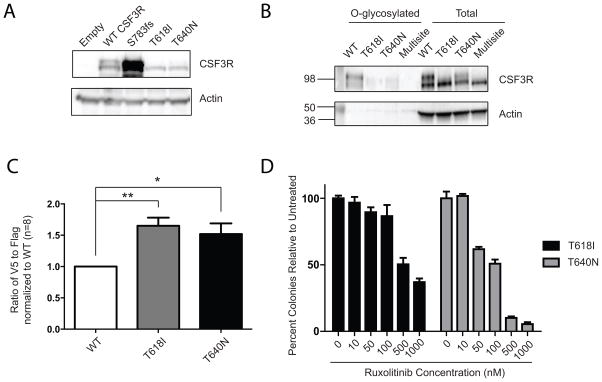
Figure 4. Altered banding pattern and O-glycosylation of the CSF3R T640N mutation, increased dimerization and JAK kinase sensitivity
(A) The CSF3R T640N has altered banding pattern relative to WT CSF3R, but is not overexpressed. The CSF3R T618I and a CSF3R truncation mutation (S783fs) are shown for comparison. (B) A direct glycosylation assay shows that the CSF3R T640N has reduced O-glycosylation when compared to WT CSF3R. 293T17 cells were transfected with WT CSF3R, T618I, T640N or a control multisite mutation that has 7 serines and threonines in the O-glycosylation cluster mutated to alanines and thus has no detectable O-glycosylation. They were labeled with GalNAz, which incorporates into O-glycosylation sites and then O-glycosylated proteins were pulled down using a biotinylated probe. The total protein is also shown. (C) Co-immunoprecipitation of a V5 and flag-tagged constructs reveals that both CSF3R T618I and T640N constructs have increased dimerization when compared to WT CSF3R. Each pair of V5 and Flag tagged constructs was transfected into 293T17 cells and then immunoprecipitated using anti-flag beads. The level of V5 and flag immunoprecipitation were quantified and then normalized to their respective inputs. The ratio of V5 (co-immunoprecipitated) to flag is expressed as a ratio relative to WT CSF3R. Statistical significance was assessed by a one way ANOVA followed by a Bonferroni’s Multiple Comparison Test. Eight replicates from three separate experiments are shown where *p<0.05 and **p<0.01. (D) The CSF3R T640N mutation is sensitive to JAK kinase inhibition. A mouse bone marrow colony assay shows that the CSF3R T618I and T640N constructs are both sensitive to the JAK kinase inhibitor ruxolitinib. Mouse bone marrow cells were infected with retrovirus expressing CSF3R T618I or CSF3R T640N constructs. Cells were plated in methylcellulose containing increasing doses of the JAK1/2 kinase inhibitor, ruxolitinib, at doses of 0, 10, 50, 100, 500, or 1000 nM.

References

    1. Gotlib J, Maxson JE, George TI, Tyner JW. The new genetics of chronic neutrophilic leukemia and atypical CML: implications for diagnosis and treatment. Blood. 2013;122:1707–11. - PMC - PubMed
    1. Maxson JE, Gotlib J, Pollyea DA, Fleischman AG, Agarwal A, Eide CA, et al. Oncogenic CSF3R mutations in chronic neutrophilic leukemia and atypical CML. The New England journal of medicine. 2013;368:1781–90. - PMC - PubMed
    1. Pardanani A, Lasho TL, Laborde RR, Elliott M, Hanson CA, Knudson RA, et al. CSF3R T618I is a highly prevalent and specific mutation in chronic neutrophilic leukemia. Leukemia : official journal of the Leukemia Society of America, Leukemia Research Fund, UK. 2013;27:1870–3. - PMC - PubMed
    1. Ward AC, van Aesch YM, Schelen AM, Touw IP. Defective internalization and sustained activation of truncated granulocyte colony-stimulating factor receptor found in severe congenital neutropenia/acute myeloid leukemia. Blood. 1999;93:447–58. - PubMed
    1. van de Geijn GJ, Gits J, Aarts LH, Heijmans-Antonissen C, Touw IP. G-CSF receptor truncations found in SCN/AML relieve SOCS3-controlled inhibition of STAT5 but leave suppression of STAT3 intact. Blood. 2004;104:667–74. - PubMed

Publication types

MeSH terms