


First identification of porcine parvovirus 6 in North America by viral metagenomic sequencing of serum from pigs infected with porcine reproductive and respiratory syndrome virus
- PMID: 26475593
- PMCID: PMC4609089
- DOI: 10.1186/s12985-015-0401-6
First identification of porcine parvovirus 6 in North America by viral metagenomic sequencing of serum from pigs infected with porcine reproductive and respiratory syndrome virus
Abstract
Background: Currently, eight species in four genera of parvovirus have been described that infect swine. These include ungulate protoparvovirus 1 (classical porcine parvovirus, PPV), ungulate tetraparvovirus 2 (PPV3), ungulate tetraparvovirus 3 (which includes PPV2, porcine hokovirus, porcine partetravirus and porcine PARV4), ungulate copiparvovirus 2 (which includes PPV4 and PPV5), ungulate bocaparvovirus 2 (which includes porcine bocavirus 1, 2 and 6), ungulate bocaparvovirus 3 (porcine bocavirus 5), ungulate bocaparvovirus 4 (porcine bocavirus 7) and ungulate bocaparvovirus 5 (porcine bocavirus 3, 4-1 and 4-2). PPV6, the most recently described porcine parvovirus, was first identified in China in late 2014 in aborted pig fetuses. Prevalence of PPV6 in China was found to be similar in finishing age pigs from farms with and without evidence of swine reproductive failure.
Methods: Porcine parvovirus 6 (PPV6) was detected by sequence-independent single primer amplification (SISPA) and confirmed by overlapping and real-time PCR in the serum of porcine reproductive and respiratory virus (PRRSv) positive samples.
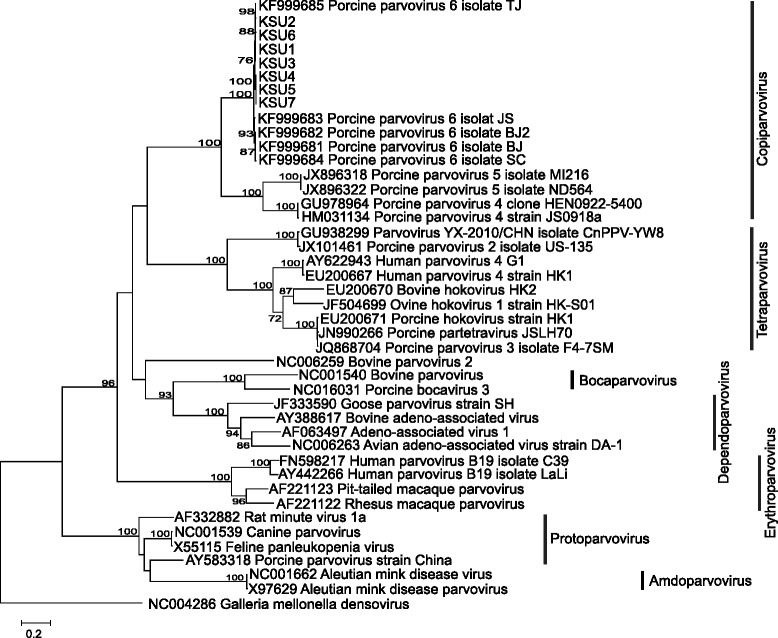
Results: Seven nearly complete genomes of PPV6 were identified in PRRSv genotype 2 positive serum samples submitted to state veterinary diagnostic laboratories in 2014. Further testing using overlapping and real-time PCR determined PPV6 to be present in 13.2 % of the serums tested. Additionally, PPV6 was present in samples from all of the geographic locations sampled encompassing nine states in the United States and one state in Mexico. The presence of PPV6 in serum indicates that the PPV6 infection is disseminated and not localized to a specific tissue type. Alignments of the near full length genomes, NS1, and capsid genes identified one of the five PPV6 isolates from China (98.6-99.5 % identity with the North American strains) to be the North American strains nearest relative.
Conclusions: These results are the first to report the presence of PPV6 in North America and demonstrate that the virus is found in multiple geographic areas in the United States and in Mexico. The overall prevalence of PPV6 in PRRSv viremic animals is relatively low. Further, all of the PPV6 genomes found in North America are most closely related to a PPV6 strain first identified in 2014 in healthy pigs from the Tianjin province of China.
Figures


References
-
- Fields BN, Knipe DM, Howley PM. Fields virology. 6. Philadelphia: Wolters Kluwer Health/Lippincott Williams & Wilkins; 2013.
Publication types
MeSH terms
Associated data
- Actions
- Actions
- Actions
- Actions
- Actions
- Actions
- Actions
LinkOut - more resources
Full Text Sources
Other Literature Sources
