. 2016 Jan 4;44(D1):D515-22.
doi: 10.1093/nar/gkv1049. Epub 2015 Oct 17.

BiGG Models: A platform for integrating, standardizing and sharing genome-scale models

Affiliations

BiGG Models: A platform for integrating, standardizing and sharing genome-scale models

Zachary A King et al. Nucleic Acids Res. .

Abstract

Genome-scale metabolic models are mathematically-structured knowledge bases that can be used to predict metabolic pathway usage and growth phenotypes. Furthermore, they can generate and test hypotheses when integrated with experimental data. To maximize the value of these models, centralized repositories of high-quality models must be established, models must adhere to established standards and model components must be linked to relevant databases. Tools for model visualization further enhance their utility. To meet these needs, we present BiGG Models (http://bigg.ucsd.edu), a completely redesigned Biochemical, Genetic and Genomic knowledge base. BiGG Models contains more than 75 high-quality, manually-curated genome-scale metabolic models. On the website, users can browse, search and visualize models. BiGG Models connects genome-scale models to genome annotations and external databases. Reaction and metabolite identifiers have been standardized across models to conform to community standards and enable rapid comparison across models. Furthermore, BiGG Models provides a comprehensive application programming interface for accessing BiGG Models with modeling and analysis tools. As a resource for highly curated, standardized and accessible models of metabolism, BiGG Models will facilitate diverse systems biology studies and support knowledge-based analysis of diverse experimental data.


Figures

Figure 1.
Figure 1.
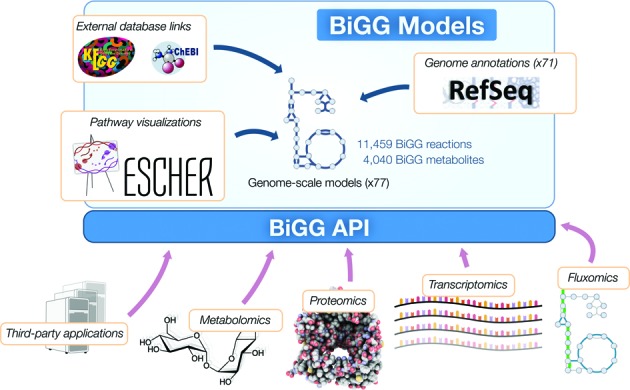
BiGG Models content. BiGG Models is built around a collection of 77 GEMs. The GEMs are integrated into a single database with shared reaction and metabolite identifiers. This core database is enriched with external database links, Escher pathway maps (24), and genome annotations. As a result, BiGG Models is a resource that can be used to analyze and contextualize many omics data types.
Figure 2.
Figure 2.
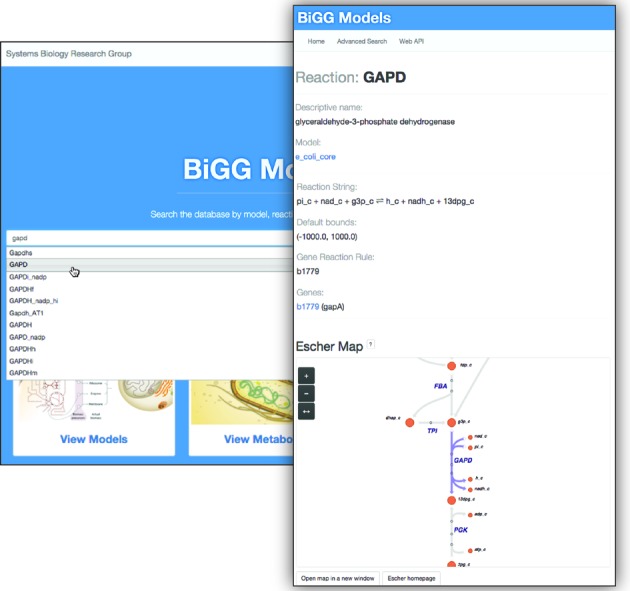
The BiGG Models homepage. The central text box allows users to search for pages in BiGG Models, including models and their reactions, metabolites and genes. Convenient links to the most popular pages about models, metabolites and reactions can be found below the search box. General information about BiGG Models can be found by clicking About at the top of the page.
Figure 3.
Figure 3.
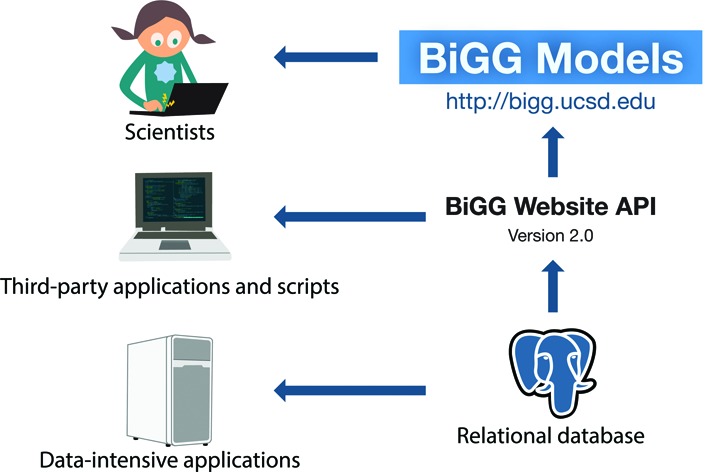
Accessing BiGG. BiGG Models has a user-friendly website for browsing and searching the knowledge base. The knowledge base can also be accessed programmatically using the web API. For more data-intensive applications, it is possible to run a local version of the BiGG database.
Figure 4.
Figure 4.
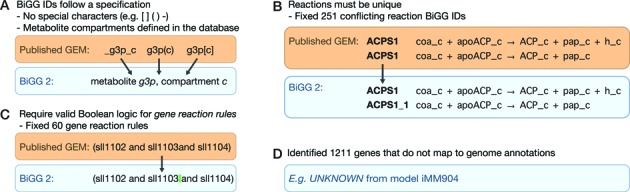
Standardizing GEMs. In order to standardize the GEMs in BiGG Models, a number of changes had to be made to the models. (A) First, metabolite and reaction IDs were standardized by removing extraneous characters and using a single format for referring to compartments. (B) In cases where the same reaction ID referred to different reactions, one of the reactions received a new identifier. (C) Invalid gene reaction rules were manually corrected. (D) All the genes that did not map to a genome annotation were recorded for future updates to both the GEMs and the genome annotations.

References

    1. Dolinski K., Troyanskaya O.G. Implications of Big Data for cell biology. Mol. Biol. Cell. 2015;26:2575–2578. - PMC - PubMed
    1. Margolis R., Derr L., Dunn M., Huerta M., Larkin J., Sheehan J., Guyer M., Green E.D. The National Institutes of Health's Big Data to Knowledge (BD2K) initiative: capitalizing on biomedical big data. J. Am. Med. Inform. Assoc. 2014;21:957–958. - PMC - PubMed
    1. Kanehisa M., Goto S., Sato Y., Kawashima M., Furumichi M., Tanabe M. Data, information, knowledge and principle: back to metabolism in KEGG. Nucleic Acids Res. 2014;42:D199–D205. - PMC - PubMed
    1. Caspi R., Altman T., Billington R., Dreher K., Foerster H., Fulcher C.A., Holland T.A., Keseler I.M., Kothari A., Kubo A., et al. The MetaCyc database of metabolic pathways and enzymes and the BioCyc collection of Pathway/Genome Databases. Nucleic Acids Res. 2014;42:D459–D471. - PMC - PubMed
    1. Costanzo M.C., Engel S.R., Wong E.D., Lloyd P., Karra K., Chan E.T., Weng S., Paskov K.M., Roe G.R., Binkley G., et al. Saccharomyces genome database provides new regulation data. Nucleic Acids Res. 2014;42:D717–D725. - PMC - PubMed

Publication types