. 2015 Oct 19:5:15082.
doi: 10.1038/srep15082.

Stepwise evolution of pandrug-resistance in Klebsiella pneumoniae

Affiliations

Stepwise evolution of pandrug-resistance in Klebsiella pneumoniae

Hosam M Zowawi et al. Sci Rep. .

Abstract

Carbapenem resistant Enterobacteriaceae (CRE) pose an urgent risk to global human health. CRE that are non-susceptible to all commercially available antibiotics threaten to return us to the pre-antibiotic era. Using Single Molecule Real Time (SMRT) sequencing we determined the complete genome of a pandrug-resistant Klebsiella pneumoniae isolate, representing the first complete genome sequence of CRE resistant to all commercially available antibiotics. The precise location of acquired antibiotic resistance elements, including mobile elements carrying genes for the OXA-181 carbapenemase, were defined. Intriguingly, we identified three chromosomal copies of an ISEcp1-bla(OXA-181) mobile element, one of which has disrupted the mgrB regulatory gene, accounting for resistance to colistin. Our findings provide the first description of pandrug-resistant CRE at the genomic level, and reveal the critical role of mobile resistance elements in accelerating the emergence of resistance to other last resort antibiotics.


Figures
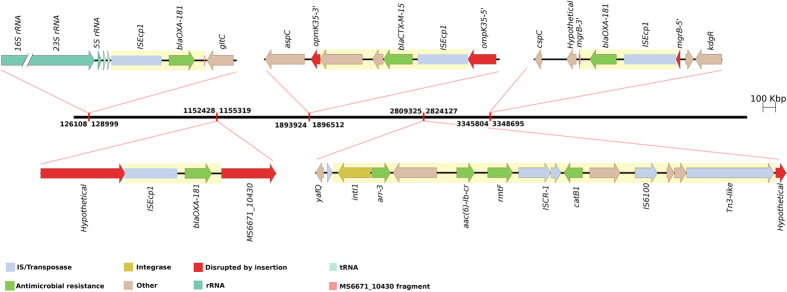
Figure 1
Figure 1. Diagram of the pandrug-resistant K. pneumoniae MS6671 chromosome highlighting the position and context of mobile genetic elements that harbor antimicrobial resistance genes.
The chromosome of MS6671 is represented to scale by the black bar with ISEcp1 and integron insertion points indicated with red rectangles. Pop-outs display schematic representations of the four ISEcp1 elements which harbor beta-lactamase genes (three copies of blaOXA-181 and one copy of blaCTX-M-15) and a class 1 integron located on the chromosome of MS6671. Insertion elements are highlighted in yellow. The coordinates of each element are indicated above and below the genome bar.
Figure 2
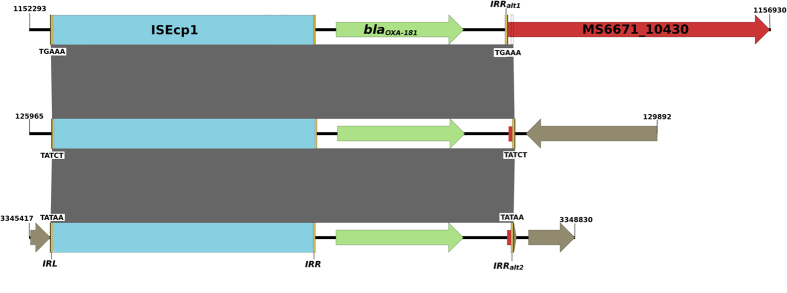
Figure 2. Comparison of ISEcp1-blaOXA-181 transposons from MS6671.
Pairwise nucleotide comparison of ISEcp1-blaOXA-181 (OXA-181) transposons and flanking genomic regions from K. pneumonaie MS6671. ISEcp1 elements are represented by blue rectangles. Protein-coding genes are represented by coloured arrows: blaOXA-181 (green); MS6671_10430 encoding a hypothetical protein (red); other (brown). Left and right flanking inverted repeats (IRL, IRR, IRRalt1, IRRalt2) are represented by yellow bars and 5 bp direct repeat sequences created by duplication of the target sequence during transposition are given (TGAAA, TATCT or TATAA). In the primary insertion site, a single 2,855 bp transposon carrying blaOXA-181 has inserted at TGAAA (position 1152428..1155282) within MS6671_10430. This transposon, similar to Tn2013 previously described in K. pneumoniae Kp3, is flanked by 14-bp inverted repeat sequences, namely IRL and IRRalt1. IRRalt2 lies 23 bp downstream of IRRalt1 within the MS6671_10430 sequence. Mobilisation of the ISEcp1-blaOXA-181 transposon using IRRalt2 instead of IRRalt1 has resulted in a 37 bp fragment of MS6671_10430 (indicated by a small red rectangle) being packaged at the 3’ end of the other two ISEcp1-blaOXA-181 transposons inserted at TATCT and TATAA (position 126108..128999 and position 3345804..3348695, respectively). Grey shading indicates regions of homology (100% nucleotide sequence identity) between sequences.

References

    1. Nathan C. & Cars O. Antibiotic Resistance - Problems, Progress, and Prospects. The New England journal of medicine, 10.1056/NEJMp1408040 (2014). - DOI - PubMed
    1. U.S. Department of Health and Human Services, Centers for Disease Control and Prevention- Antibiotic Resistance Threats in the United States, 2013 (2013). Avaialable at: http://www.cdc.gov/drugresistance/threat-report-2013. (Accessed: 7th July 2015).
    1. Laxminarayan R. et al. Antibiotic resistance-the need for global solutions. The Lancet. Infectious diseases 13, 1057–1098, 10.1016/S1473-3099(13)70318-9 (2013). - DOI - PubMed
    1. Jacoby G. A. & Munoz-Price L. S. The new beta-lactamases. The New England journal of medicine 352, 380–391, 10.1056/NEJMra041359 (2005). - DOI - PubMed
    1. Peleg A. Y. & Hooper D. C. Hospital-acquired infections due to gram-negative bacteria. The New England journal of medicine 362, 1804–1813, 10.1056/NEJMra0904124 (2010). - DOI - PMC - PubMed

Publication types