Review
. 2015 Oct 19:15:58.
doi: 10.1186/s12902-015-0037-y.

Agenesis of internal carotid artery associated with isolated growth hormone deficiency: a case report and literature review

Affiliations
Review

Agenesis of internal carotid artery associated with isolated growth hormone deficiency: a case report and literature review

Stefano Stagi et al. BMC Endocr Disord. .

Abstract

Background: Agenesis of the internal carotid artery (ICA) is a rare congenital abnormality, sporadically reported to be associated with a combined congenital hypopituitarism. Nevertheless, only a few cases have been extensively described, and none of these have been characterized by an isolated growth hormone (GH) deficiency.

Case presentation: Here, we describe a 17-year old boy referred to our hospital for fatigue, decreased muscle strength and severe headache reported after the cessation of rhGH treatment for a GH deficiency diagnosed at the age of 2 years and 3 months. Magnetic resonance imaging (MRI) showed an adenohypophyseal hypoplasia with a lack of posterior pituitary hyperintensity, whereas MRI angiography indicated the absence of a normal flow void in the left ICA. Endocrinological tests confirmed the GH deficiency (GH peak after growth-hormone-releasing hormone (GHRH) + arginine: 2.42 ng/mL) with a very low IGF-I value (31 ng/mL) and normal function of other pituitary axes.

Conclusion: To the best of our knowledge this is the first confirmed case of an isolated GH deficiency in a patient with ICA agenesis. The presence of an isolated pituitary deficit is unlike to be considered only as an effect of hemodynamic mechanism, suggesting a role for genetic factor(s) as a common cause of these two rare birth defects. Further studies could clarify this issue and the underlying mechanisms to better understand the etiopathogenetic characteristics of this disorder.


Figures

Fig. 1
Fig. 1
Length (a), weight (b), height (c) and body mass index (BMI; d) growth charts of the patient. The growth charts of the length and weight refer to the first 3 years 4 months of life. The arrows indicate the age at which growth hormone treatment was initiated (black arrow). The length and the weight were evaluated according the growth charts compiled by de Onis et al. [37]. The height and BMI were evaluated according the growth charts compiled by Cacciari et al. [17]
Fig. 2
Fig. 2
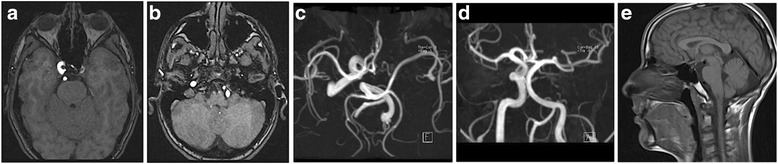
A MRI angiography time-of-flight (TOF) three-dimensional (3D) technique through the circle of Willis revealed agenesis of the intracranial portion of the left internal carotid artery (ICA). a. 3D TOF in the axial plane at the carotid siphon level shows agenesis of the left ICA. b. 3D TOF in the axial plane for the vertebrobasilar system shows the left vertebral artery and the compensatory hypertrophy. c. MRI angiography maximum intensity projection (MIP) reconstruction in the axial plane reveals agenesis of the intracranial portion of the left ICA. d. MRI angiography MIP reconstruction in the coronal plane highlights hypertrophy in the left vertebral collateral blood flow. e. Sagittal T1W TSE sequence shows adenohypophyseal hypoplasia (height 2.5 mm and width 3.5 mm) with a lack of posterior pituitary hyperintensity

References

    1. Clarós P, Bandos R, Gilea I, Clarós A, Jr, Capdevila A, García Rodríguez J, et al. Major congenital anomalies of the internal carotid artery: agenesis, aplasia and hypoplasia. Int J Pediatr Otorhinolaryngol. 1999;49:69–76. doi: 10.1016/S0165-5876(99)00012-9. - DOI - PubMed
    1. Lee JH, Oh CW, Lee SH, Han DH. Aplasia of the internal carotid artery. Acta Neurochir (Wien) 2003;145:117–125. doi: 10.1007/s00701-002-1046-y. - DOI - PubMed
    1. Savasta S, Merli P, Introzzi F, Strocchio L, Lanati G, Incorpora G, et al. Agenesis of internal carotid artery and hypopituitarism: case report and review of literature. J Clin Endocrinol Metab. 2012;97:3414–3420. doi: 10.1210/jc.2011-3389. - DOI - PubMed
    1. Kelberman D, Rizzoti K, Lovell-Badge R, Robinson IC, Dattani MT. Genetic regulation of pituitary gland development in human and mouse. Endocr Rev. 2009;30:790–829. doi: 10.1210/er.2009-0008. - DOI - PMC - PubMed
    1. Blustajn J, Netchine I, Frédy D, Bakouche P, Piekarski JD, Meder JF. Dysgenesis of the internal carotid artery associated with transsphenoidal encephalocele: a neural crest syndrome? AJNR Am J Neuroradiol. 1999;20:1154–1157. - PMC - PubMed

Substances

LinkOut - more resources