


Alterations in walking knee joint stiffness in individuals with knee osteoarthritis and self-reported knee instability
- PMID: 26481256
- PMCID: PMC5572142
- DOI: 10.1016/j.gaitpost.2015.09.025
Alterations in walking knee joint stiffness in individuals with knee osteoarthritis and self-reported knee instability
Abstract
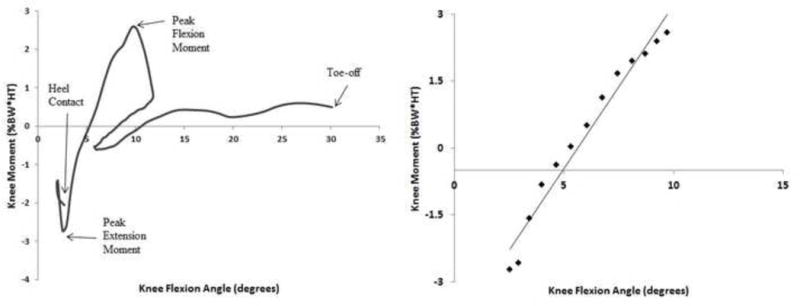
Increased walking knee joint stiffness has been reported in patients with knee osteoarthritis (OA) as a compensatory strategy to improve knee joint stability. However, presence of episodic self-reported knee instability in a large subgroup of patients with knee OA may be a sign of inadequate walking knee joint stiffness. The objective of this work was to evaluate the differences in walking knee joint stiffness in patients with knee OA with and without self-reported instability and examine the relationship between walking knee joint stiffness with quadriceps strength, knee joint laxity, and varus knee malalignment. Overground biomechanical data at a self-selected gait velocity was collected for 35 individuals with knee OA without self-reported instability (stable group) and 17 individuals with knee OA and episodic self-reported instability (unstable group). Knee joint stiffness was calculated during the weight-acceptance phase of gait as the change in the external knee joint moment divided by the change in the knee flexion angle. The unstable group walked with lower knee joint stiffness (p=0.01), mainly due to smaller heel-contact knee flexion angles (p<0.01) and greater knee flexion excursions (p<0.01) compared to their knee stable counterparts. No significant relationships were observed between walking knee joint stiffness and quadriceps strength, knee joint laxity or varus knee malalignment. Reduced walking knee joint stiffness appears to be associated with episodic knee instability and independent of quadriceps muscle weakness, knee joint laxity or varus malalignment. Further investigations of the temporal relationship between self-reported knee joint instability and walking knee joint stiffness are warranted.
Keywords: Gait; Instability; Kinematics; Knee osteoarthritis; Stiffness.
Copyright © 2015 Elsevier B.V. All rights reserved.
Conflict of interest statement
The authors confirm that there are no known conflicts of interest regarding the work described in the current manuscript.
Figures
References
-
- Fitzgerald GK, Piva SR, Irrgang JJ. Reports of joint instability in knee osteoarthritis: its prevalence and relationship to physical function. Arthritis Rheum. 2004;51:941–6. - PubMed
-
- van der Esch M, Knoop J, van der Leeden M, Voorneman R, Gerritsen M, Reiding D, et al. Self-reported knee instability and activity limitations in patients with knee osteoarthritis: results of the Amsterdam osteoarthritis cohort. Clin Rheumatol. 2012;31:1505–10. - PubMed
-
- Sharma L, Lou C, Felson DT, Dunlop DD, Kirwan-Mellis G, Hayes KW, et al. Laxity in healthy and osteoarthritic knees. Arthritis Rheum. 1999;42:861–70. - PubMed
Publication types
MeSH terms
Grants and funding
LinkOut - more resources
Full Text Sources
Other Literature Sources
