


Learning by subtraction: Hippocampal activity and effects of ethanol during the acquisition and performance of response sequences
- PMID: 26482846
- PMCID: PMC4837033
- DOI: 10.1002/hipo.22545
Learning by subtraction: Hippocampal activity and effects of ethanol during the acquisition and performance of response sequences
Abstract
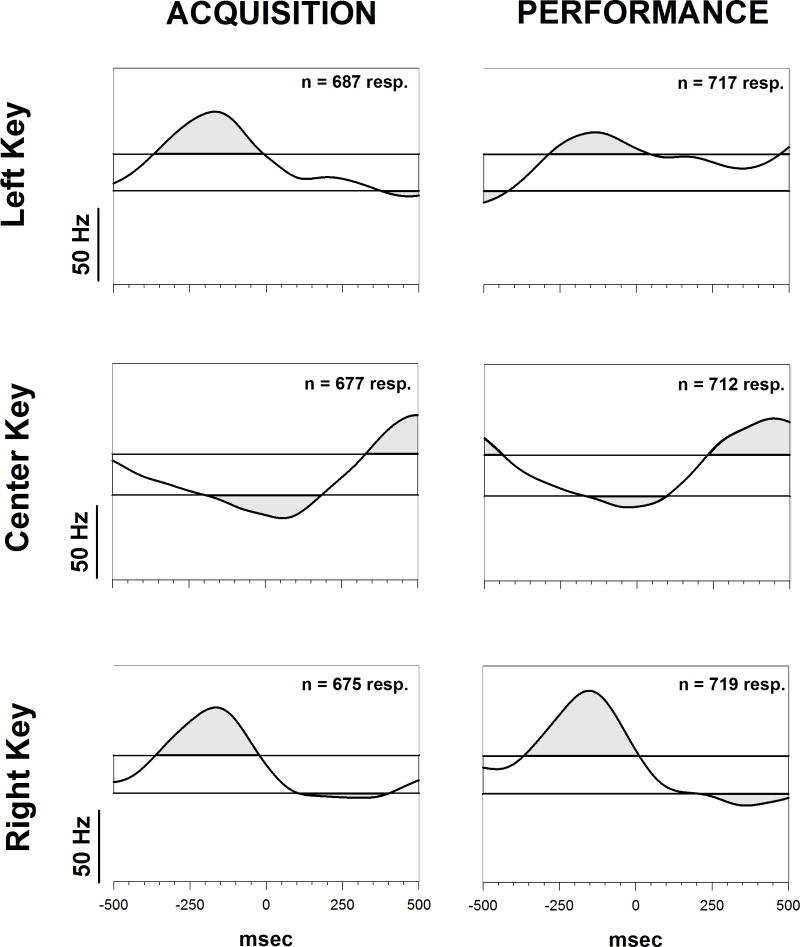
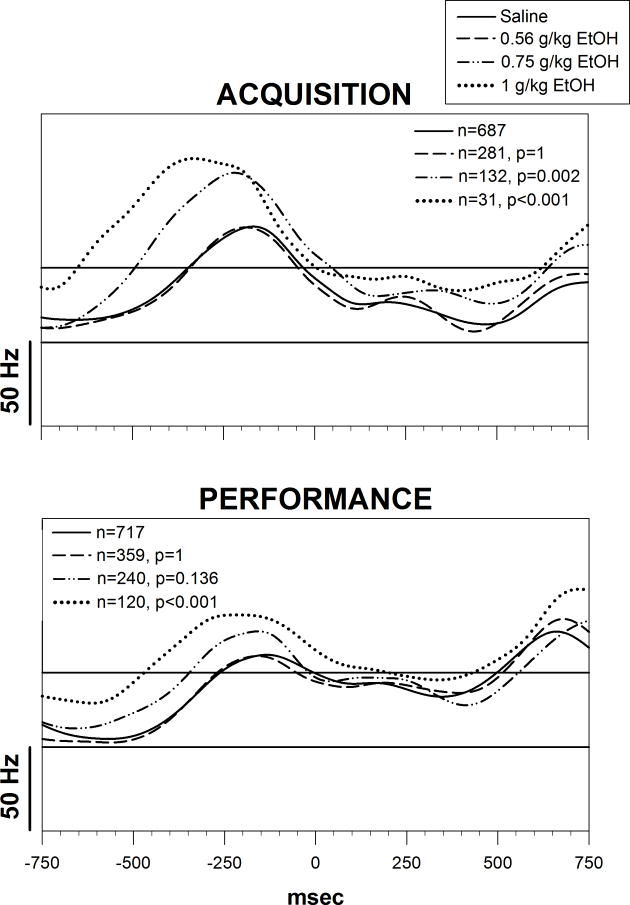
Learning is believed to be reflected in the activity of the hippocampus. However, neural correlates of learning have been difficult to characterize because hippocampal activity is integrated with ongoing behavior. To address this issue, male rats (n = 5) implanted with electrodes (n = 14) in the CA1 subfield responded during two tasks within a single test session. In one task, subjects acquired a new 3-response sequence (acquisition), whereas in the other task, subjects completed a well-rehearsed 3-response sequence (performance). Both tasks though could be completed using an identical response topography and used the same sensory stimuli and schedule of reinforcement. More important, comparing neural patterns during sequence acquisition to those during sequence performance allows for a subtractive approach whereby activity associated with learning could potentially be dissociated from the activity associated with ongoing behavior. At sites where CA1 activity was closely associated with behavior, the patterns of activity were differentially modulated by key position and the serial position of a response within the schedule of reinforcement. Temporal shifts between peak activity and responding on particular keys also occurred during sequence acquisition, but not during sequence performance. Ethanol disrupted CA1 activity while producing rate-decreasing effects in both tasks and error-increasing effects that were more selective for sequence acquisition than sequence performance. Ethanol also produced alterations in the magnitude of modulations and temporal pattern of CA1 activity, although these effects were not selective for sequence acquisition. Similar to ethanol, hippocampal micro-stimulation decreased response rate in both tasks and selectively increased the percentage of errors during sequence acquisition, and provided a more direct demonstration of hippocampal involvement during sequence acquisition. Together, these results strongly support the notion that ethanol disrupts sequence acquisition by disrupting hippocampal activity and that the hippocampus is necessary for the conditioned associations required for sequence acquisition.
Keywords: CA1; micro-stimulation; multi-unit activity; rat; repeated acquisition.
© 2015 Wiley Periodicals, Inc.
Conflict of interest statement
The authors declare no conflicts of interest.
Figures






References
-
- Arai A, Lynch G. Factors regulating the magnitude of long-term potentiation induced by theta pattern stimulation. Brain Research. 1992;598:173–184. - PubMed
-
- Berger TW, Berry SD, Thompson RF. Role of the hippocampus in classical conditioning of aversive and appetitive behaviors. In: Isaacson RL, Pribram KI-I, editors. The Hippocampus. New York: Plenum Press; 1986. pp. 203–239.
-
- Boren JJ. Repeated acquisition of new behavioral chains. American Psychologist. 1963;17:421. (Abstract)
-
- Bostock E, Muller RU, Kubie JL. Experience dependent modifications of hippocampal place cell firing. Hippocampus. 1991;2:193–205. - PubMed
Publication types
MeSH terms
Substances
Grants and funding
LinkOut - more resources
Full Text Sources
Other Literature Sources
Miscellaneous
