


Type 2 diabetes and its correlates among adults in Bangladesh: a population based study
- PMID: 26483053
- PMCID: PMC4610042
- DOI: 10.1186/s12889-015-2413-y
Type 2 diabetes and its correlates among adults in Bangladesh: a population based study
Abstract
Background: Type 2 diabetes is one of the most prevalent non-communicable diseases in Bangladesh. However, the correlates of type 2 diabetes among adults in Bangladesh remain unknown. We aimed to investigate the correlates of type 2 diabetes among the adults in Bangladesh.
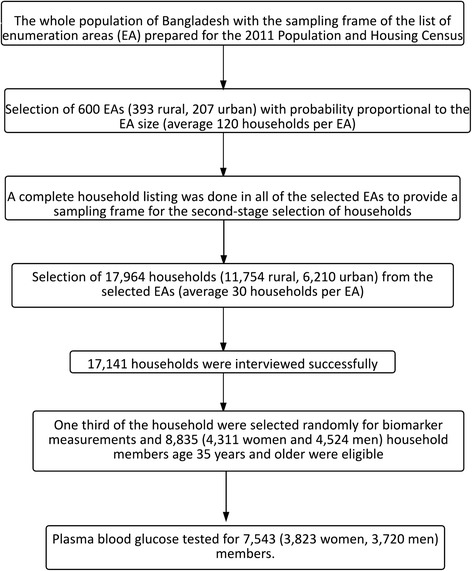
Methods: We conducted a cross-sectional study using data from the nationally representative 2011 Bangladesh Demographic and Health Survey. A random sample of 7,543 (3,823 women and 3,720 men) adults of age 35 years and older from both urban and rural areas, who participated in the survey was included. Diabetes was defined as having a fasting plasma blood glucose level of ≥ 7 mm/L or taking diabetes medication during the survey. Hypothesized factors, e.g., age, sex, education, place of residence, social status, body mass index, and hypertension were considered in the analyses. Multivariable logistic regression models were used to identify the important correlates of type 2 diabetes.
Results: Among the respondents, the overall prevalence of diabetes was 11 %, and the prevalence was slightly higher in women (11.2 %) than men (10.6 %). Respondents with the age group of 55-59 years had higher odds of having diabetes (odds ratios (OR) = 2.37, 95 % confidence interval (CI): 1.76-3.21) than the age group of 35-39 years. Moreover, respondents who had higher educational attainment (OR = 1.67, 95 % CI: 1.18-2.36) and higher social status (OR = 2.01, 95 % CI: 1.50-2.70) had higher odds of having diabetes than the respondents with no education and lower social status, respectively. We also found socioeconomic status, place of residence (rural or urban), regions of residence (different divisions), overweight and obesity, and hypertension as significant correlates of type 2 diabetes in Bangladesh.
Conclusions: Our study shows that older age, higher socioeconomic status, higher educational attainment, hypertension, and obesity were found to be significant correlates of type 2 diabetes. Need-based policy program strategies including early diagnosis, awareness via mass media, and health education programs for changing lifestyles should be initiated for older age, wealthy, and/or higher educated individuals in Bangladesh. Moreover, area-specific longitudinal research is necessary to find out the underlying causes of regional variations.
Figures
References
-
- Lozano R, Naghavi M, Foreman K, Lim S, Shibuya K, Aboyans V, Abraham J, Adair T, Aggarwal R, Ahn SY. Global and regional mortality from 235 causes of death for 20 age groups in 1990 and 2010: a systematic analysis for the Global Burden of Disease Study 2010. Lancet. 2012;380(9859):2095–128. doi: 10.1016/S0140-6736(12)61728-0. - DOI - PMC - PubMed
-
- Murray CJL, Vos T, Lozano R, Naghavi M, Flaxman AD, Michaud C, Ezzati M, Shibuya K, Salomon JA, Abdalla S. Disability-adjusted life years (DALYs) for 291 diseases and injuries in 21 regions, 1990–2010: a systematic analysis for the Global Burden of Disease Study 2010. Lancet. 2012;380(9859):2197–223. doi: 10.1016/S0140-6736(12)61689-4. - DOI - PubMed
-
- International Diabetes Federation (IDF) Diabetes Atlas. 6. Brussels: International Diabetes Federation; 2013.
-
- Kumar SS, Houlden RL. Ethnocultural diversity and the diabetes epidemic in Canada: a call to action. Can J Diab. 2005;29(2):84–5.
MeSH terms
LinkOut - more resources
Full Text Sources
Other Literature Sources
Medical
