


El Niño-Southern Oscillation frequency cascade
- PMID: 26483455
- PMCID: PMC4640731
- DOI: 10.1073/pnas.1508622112
El Niño-Southern Oscillation frequency cascade
Abstract
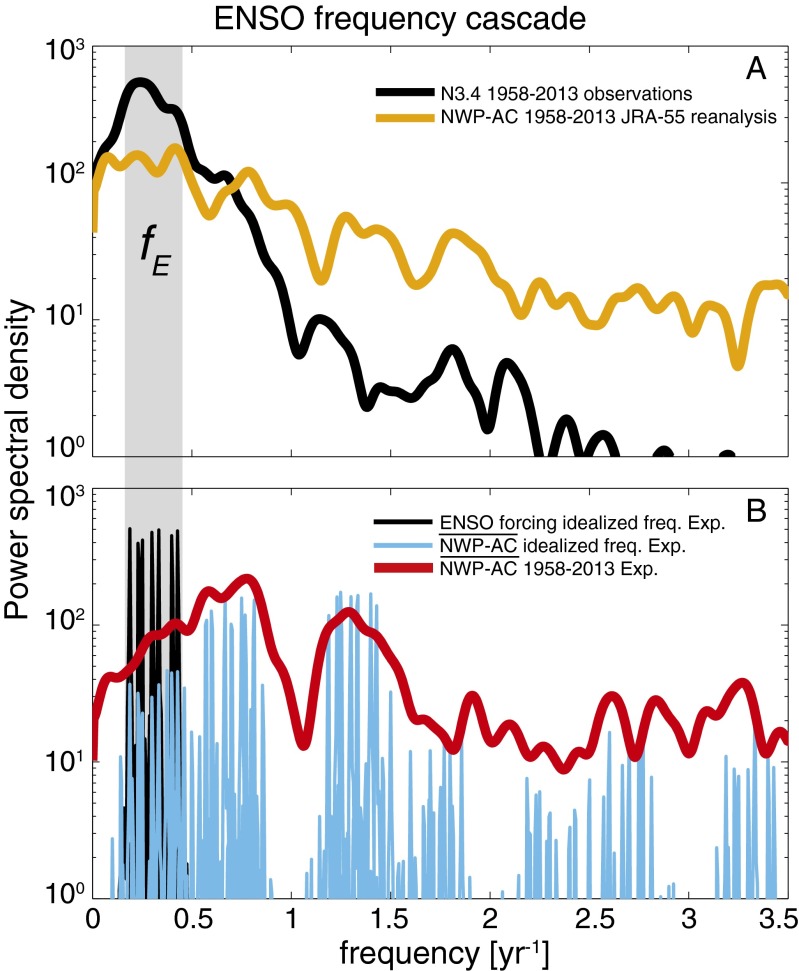
The El Niño-Southern Oscillation (ENSO) phenomenon, the most pronounced feature of internally generated climate variability, occurs on interannual timescales and impacts the global climate system through an interaction with the annual cycle. The tight coupling between ENSO and the annual cycle is particularly pronounced over the tropical Western Pacific. Here we show that this nonlinear interaction results in a frequency cascade in the atmospheric circulation, which is characterized by deterministic high-frequency variability on near-annual and subannual timescales. Through climate model experiments and observational analysis, it is documented that a substantial fraction of the anomalous Northwest Pacific anticyclone variability, which is the main atmospheric link between ENSO and the East Asian Monsoon system, can be explained by these interactions and is thus deterministic and potentially predictable.
Keywords: ENSO; annual cycle; combination mode; frequency cascade; monsoon.
Conflict of interest statement
The authors declare no conflict of interest.
Figures
References
-
- Zebiak SE, Cane MA. A model El Niño−Southern Oscillation. Mon Weather Rev. 1987;115(10):2262–2278.
-
- Suarez MJ, Schopf PS. A delayed action oscillator for ENSO. J Atmos Sci. 1988;45(21):3283–3287.
-
- Philander SG. El Niño, La Niña and the Southern Oscillation. Academic; New York: 1990.
-
- Neelin JD, et al. ENSO theory. J Geophys Res. 1998;103(C7):14261–14290.
-
- McPhaden MJ, Zebiak SE, Glantz MH. ENSO as an integrating concept in Earth science. Science. 2006;314(5806):1740–1745. - PubMed
Publication types
LinkOut - more resources
Full Text Sources
Other Literature Sources
